Yashica is a Software Engineer turned Content Writer, who loves to write on social causes and expertise in writing technical stuff. She loves to watch movies and explore new places. She believes that you need to live once before you die. So experimenting with her life and career choices, she is trying to live her life to the fullest.
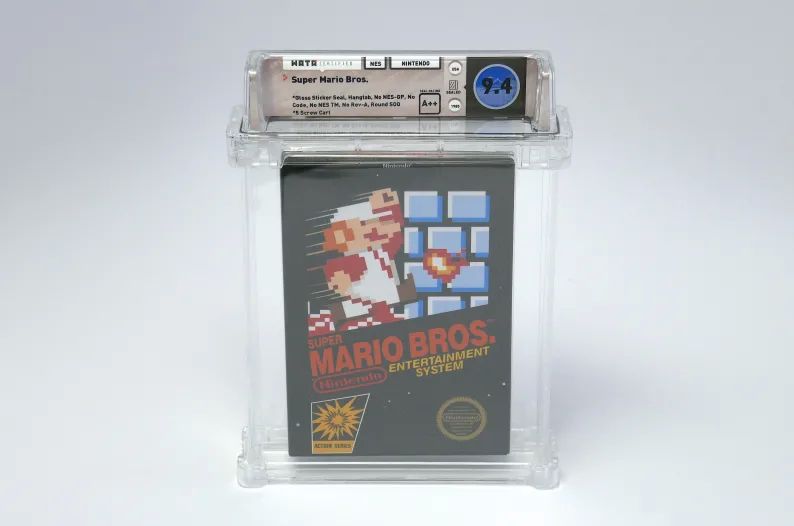
Super Mario, is one of the most acclaimed video games of all times and one of the most popular games among the children of 80s and 90s. The love of people for this amazing game can be measured through the huge amount for which an old pristine sealed copy of Super Mario was auctioned.
Image Source: kotaku.com
An
original mint copy of the Super Mario Bros., for NES, was sold for
$100,150 at an auction, making a world record for being the first
ever graded video game to be sold for a six-digit amount. The game is
professionally graded and certified one and was auctioned by the
Heritage Auctions. Wata Games has certified the game, and for its
condition, it gave it 9.5 out of 10 and a “Seal Rating” of A++.
“Beyond
the artistic and historical significance of this game is its supreme
state of preservation,” says Kenneth Thrower, co-founder and chief
grader of Wata Games.
The
game was bought by a group of collectors including Jim Halperin,
founder and co-chairman of Heritage Auction, Zac Gieg, owner of Just
Press Play Video Games, Rich Lecce, who is a video game collector,
and the owner of Robert B. Lecce Numismatist Inc.
This copy of the video game was one of those rare copies that were sealed with a Nintendo sticker on the top of the box, whether other regular video games are shrink-wrapped.
As
there are so many versions of Super Mario Bros., and all of the video
consoles had at least one of their own Super Mario version released
in the past thirty years, this mint copy of Mario is a bit different
from all of those versions of Super Mario and is one of the rare of
the versions of it.
This
preserved copy of Super Mario Bros. was one of the early released
copies of the same, published in Los Angeles and New York, during the
testing of the video game, in 1985. This copy of video game was kept
in a flawless condition and the seal of quality won it the huge
value. This game cartridge is one of the eleven versions that were
shipped between 1985 to 1994, in a black box, having slightly
different features from one another.
Yashica is a Software Engineer turned Content Writer, who loves to write on social causes and expertise in writing technical stuff. She loves to watch movies and explore new places. She believes that you need to live once before you die. So experimenting with her life and career choices, she is trying to live her life to the fullest.
Video games have seen a great
transformation since its commencement. It all started with old 3D
tic-tac-toe and Moon Landing games, and now, we see visually rich
mission games and numerous small scale Smartphone games, which are
really good at their functionalities.
The rise of video games not only provided people with new means of entertainment but has also given the opportunity to many businesses and developers to head into new horizons. The founders of the company Ubisoft also founded their passion in the same field, and now they are the owner of the third biggest video game development company.
Origin
Five brothers, Christian, Claude, Gérard, Michel and Yves, from the Guillemot family of northwest France founded Ubisoft in 1986. In the beginning, the Guillemot brothers had joined their family business. They started working even before they started going to University and had gained enough experience to start their own business.
Image Source: sharkone
Before Ubisoft, the Guillemot brothers had tried their hands in many other businesses. As their family business was based on farming, there was a real less margin in the business. Soon, they realised that the farming industry was not paying much and was going through a decline. So, the first business they did out of farming was selling audio CDs, as these were the latest trend in the market. The business was good, and soon, they were able to deal in personal computers and established a small shop.
The trade was going well, and
along with selling computers, they also sold things that were needed
in farming. The Guillemot then stocked up video games in the shop and
installed 20 machines to play video games at the shop. In 1980, they
shifted from buying the video games from France market to the US’s,
as it was much cheaper to buy those video games from the US. This led
to a huge difference in the profits, and as a result, the five
brothers started another new business. In 1984, they founded
Guillemot Informatique and began the mail-order business around
computers and software.
By the year 1985, they were
earning good profits through video games and realised that they can
have much more of that if they start developing video games by
themselves.
Founding
Ubisoft
Guillemot brothers founded
Ubisoft in Carentoir, in Brittany, on 12 March 1986. Ubisoft is the
acronym for Ubiquitous Software, and formally, it was named as
Ubisoft Entertainment S.A. For the development purpose, they gathered
a team of developers from their neighbouring places and set up their
first office in a chateau in Carentoir.
For two years of the startup,
the brothers continued operating their company from the chateau only,
but it was way expensive to maintain the office. So many of their
developers relocated to Paris. One of their first recruited staff,
Michel Ancel, who also returned to his hometown in the same year,
came back with another developer Frederic Houde with a prototype of a
game with highly-animated features in 1994.
The prototype caught the
immediate attention of Guillemot brothers, and in 1994, they started
working on the same, making it the prime project of the company. They
also set up an office in Montreuil and hired 100 developers to work
on the project. Finally, in 1995, Ubisoft launched its first hit
video game Rayman, which targeted the new line of fifth-generation
consoles, like the Atari Jaguar and PlayStation. The instant success
of the game made the company popular worldwide.
The game was a huge hit, and
only in one year, Ubisoft went for its IPO, in 1996, and raised over
US$80 million in funds. The company also expanded to other worldwide
cities, including Annecy, Shanghai, Montreal, and Milan, in a span of
four years from its inception.
With the expansion of the
internet in 1999, the Guillemot brothers found another opportunity to
widen the growth of Ubisoft in the US market, too. They, then founded
Gameloft, an online game publisher, in 1999. In the year 2000,
Ubisoft acquired an American video game development company Red Storm
Entertainment, that too, helped Ubisoft to expand in the American
market, bringing titles like Tom Clancy’s Ghost Recon and Tom
Clancy’s Rainbow Six series.
The success in the US market led Ubisoft to work with companies like Microsoft, at the time, when no one was ready to develop games for Xbox. With Microsoft, Ubisoft brought games like Halo and Ghost Recon, etc.
As of 2017, the estimated
valuation of the company was registered at $6.4 billion. Currently,
the company owns several video game studios across the world. The
company gets the credits of many popular games to its name, including
Assassin’s Creed, Far Cry, Just Dance, Prince of Persia, Rayman,
Raving Rabbids, and Tom Clancy’s.
As of March 2018, it is the
fourth largest publicly-traded game company in America and Europe
after Activision Blizzard, Electronic Arts, and Take-Two Interactive
in terms of revenue and market capitalisation.
Yashica is a Software Engineer turned Content Writer, who loves to write on social causes and expertise in writing technical stuff. She loves to watch movies and explore new places. She believes that you need to live once before you die. So experimenting with her life and career choices, she is trying to live her life to the fullest.
The Google CEO, Sundar Pichai, announced on Wednesday that Google is planning to expand in various new locations in the U.S. The CEO broke the news through a blog post where he described that Google plans to invest in multiple data centres and offices.
Image Source: sky.com
The news can be a good one for
the citizens of the US, as this expansion of Google’s data centres
and offices will generate more job opportunities for them. Currently,
the company has only revealed the names of the cities, including
Nebraska, Nevada, and Oklahoma, and the expansion will take place in
24 different states and 13 communities. In this expansion, even the
construction work will generate over 10,000 construction jobs.
In the blog-post, Pichai
wrote, “With this new investment, Google will now have a home in 24
total states, including data centres in 13 communities. 2019 marks
the second year in a row we’ll be growing faster outside of the Bay
Area than in it.”
The announcement is considered
as the result of the criticism, that Google faced, in the past few
years. Google was criticised about the fact that it is not
contributing to the US economy, as much as the company of the
previous era used to.
In this regard, last year, the
company invested over $9 billion on the facilities and this year
Google has planned to invest over $13 billion on the new offices and
the data centres.
“Our expansion across the
U.S. has been crucial to finding great new talent, improving the
services that people use every day, and investing in our business,”
Pichai wrote in the post. He said this will be the second year in a
row that Google will grow “faster outside of the Bay Area than
in it.”
Google is not the only Silicon Valley tech giant, which is expanding to the other parts of the US, but companies like Apple and Amazon are also crossing the boundaries. Apple is also investing $1 billion in new offices in Austin to spread its growing workforce across the U.S., such that the expansion may lead to over 15,000 new jobs. On the other hand, Amazon, too, is planning to open its new offices in New York City and Virginia, as well as is looking for a good location for its second headquarter in the US.
Yashica is a Software Engineer turned Content Writer, who loves to write on social causes and expertise in writing technical stuff. She loves to watch movies and explore new places. She believes that you need to live once before you die. So experimenting with her life and career choices, she is trying to live her life to the fullest.
Last week, Facebook was talking about unifying its all messaging apps into one, such that the businesses can easily access the Instagram direct messages. And now, reportedly, Instagram is testing its direct message feature for the web version of the app.
First spotted by the reverse engineering expert Jane Manchun Wong, she twitted a screenshot of the feature on her official Twitter account.
Currently, only the Instagram mobile app is supporting the DM (Direct Message) feature. The desktop version of the website is a minimal, pared-down version of the same, which only shows the feed and a few other basic features in it. Instagram on desktop only offers its users to scroll down the feed, search for other Instagrammers and follow them and still needs a feature to upload pictures and stories. After all the app is a photograph based social media platform. Noticeably, even the Browser Notification support was added to the web version of the app last September.
There may be a few reasons behind, why Instagram has suddenly started the testing for the DM features for the web.
One being that Instagram started the testing for its standalone messaging app, i.e. DM, in 2017 and after the launch of the DM app, Instagram may have recorded an increase in the messaging app users. So, it may have encouraged Instagram to provide its users with the facility to use the Instagram DM easily, independent of the devices they are using.
Also, Instagram does not have an app for the iPad, and the iPad users have to rely on using the browser to use Instagram. So having the DM feature for the web will also enable the iPad users to access their DMs on the iPad.
But, as Instagram started the testing of the DM feature for the desktop only after Facebook made an announcement about unifying all three messaging apps, i.e. Facebook Messenger, What’s App and Instagram, this can be the prime reason behind the same.
Yashica is a Software Engineer turned Content Writer, who loves to write on social causes and expertise in writing technical stuff. She loves to watch movies and explore new places. She believes that you need to live once before you die. So experimenting with her life and career choices, she is trying to live her life to the fullest.
Trying, trying, and trying, this is the basic rule to achieve your goals. If you fail once, you have to try harder next time, as giving up will lead you to nowhere, but failure. Except, if you keep trying, there will be a day when you will thank yourself for your own hard work and sustainability. The American businessman Nick Woodman also believes in the power of trying, and after failing in his first two startups, his third startup, ‘Go Pro‘, helped him achieve his dreams, and he finally, built a billion-dollar empire for himself.
Early Life
Woodman was born on 24 June
1975 to Concepcion Woodman and Dean Woodman. He spent his childhood
in Menlo Park and Atherton, California. His father founded the
Robertson Stephens, an investment bank based in San Francisco. He did
his high school from Menlo School. He then attended the University of
California, San Diego, where he graduated in visual arts, with a
minor in creative writing in 1997.
Experimenting
with Startups
Woodman was always curious
about starting up his own business, for that he began with an
eCommerce website named EmpowerAll.com, which was outlined to sell
electronic goods for no more than a $2 profit. But the website could
do well for him. Later, he launched a gaming and marketing platform,
Funbug, again which could not live up to the mark.
Founding
GoPro
It was then when he was travelling to Australia and Indonesia for a trip. He loves surfing, and while surfing in Australia during the tour, he tried to capture his adventure on the camera. He asked his friends to click his pictures while surfing, but they all failed. Later, he tried to take the pictures himself by attaching the camera to his hands with a rubber band, but again it was all in vain.
Image Source: engadget.com
This incident led him to
brainstorm about developing ways to help people with such needs. The
idea of developing cameras that can be attached with a belt came into
his mind, and Woodman went forward to do the needful to transform the
idea into a big business plan.
Woodman borrowed a sewing
machine from his mother and started experimenting with different
designs to formulate belts for cameras. He also took a loan of
$2,00,000 from his father and $35000 from his mother in order to
start the business. He also invested his savings, around $10000,
obtained from selling the sea-shells, that he had brought from Bali
and sold in the California coast, in his startup.
In 2002, he founded GoPro. The name was inspired by the Pro surfers who got their pictures clicked by professional photographers. Initially, the company focussed on developing camera models with ‘point and shoot’ property, in order to get high-quality pictures instantly.
The first model from the
company was manufactured by a Chinese company named Hotax. The model
was a 35mm film camera, attached with the belt designed by Woodman
himself, after a few modifications in the design. The retail cost for
the camera was set at $30. In the beginning, he went to sell his
camera on his 1971 model Volkswagen bus. With the success of the
camera, it went through a few improvements like support for Wifi,
waterproof housing and addition of SD card.
After two years from the
inception of the company, it got its first big order in 2004, from a
Japanese company. In the same year, the total earned revenue of the
company was $150,000 and the following year, it raised to $350,000.
In late 2012, Foxconn spent
$200 million to purchase 8.88% of the company, making the company
value at $2.25 billion and Woodman a billionaire. In the year 2014,
the company went public.
Personal
Life
Woodman is married to Jill R.
Scully and has three children with her. The family lives in Woodside,
California. In 2013, he won the national Ernst & Young
Entrepreneur of the Year award. He has also been invited to many
events as a speaker, to share his experience and some tips as a
successful entrepreneur.
Woodman is also in
philanthropy and has founded Jill + Nicholas Woodman Foundation, a
charitable trust in the Silicon Valley.
Yashica is a Software Engineer turned Content Writer, who loves to write on social causes and expertise in writing technical stuff. She loves to watch movies and explore new places. She believes that you need to live once before you die. So experimenting with her life and career choices, she is trying to live her life to the fullest.
LinkedIn has revealed that it is going to launch the beta version of its new live video streaming feature. Tech Crunch on Monday spotted the news, according to which the company will be providing its invite-only live feature to be broadcasted for select groups in the U.S.
Image Source: inc.com
The
live feature will broadcast conferences, advice from the experts,
news, interviews as well as events from big companies and famous
influencers. The feature will also help people have discussions
online.
Although the feature is an invite-only and is still in its beta, LinkedIn is also offering a contact form, through which, the people who want to try out the live streaming, can apply for it. The company has not given any clues on if the feature will be available for everyone or not.
For
now, the feature is in its pilot mode and will be rolling out this
week for testing. The company has collaborated with several
third-party developers that have sufficient experience in live
broadcasting streaming services development. The company aims at
having posted more polished live videos on the platform, that matches
the theme of LinkedIn. The third party developers may include
Wirecast, Switcher Studio, Wowza Media Systems, Socialive and
Brandlive, etc. and according to LinkedIn, more names will be added
to the list. Also, Microsoft’s Azure Media Services will also work
as a part of this effort.
Noticeably, Microsoft had acquired LinkedIn in 2016, but it has never interfered or been a part of the company’s working.
In August 2017, LinkedIn had also introduced a native video feature for users, which started functioning as in-feed video ads, last year in the spring. According to LinkedIn, the users are more likely to watch videos rather reading long static sponsored content. The company also revealed that it is already earning 30 per cent more comments over the videos ads.
Companies like Facebook and Twitter are already providing the same feature to their users, and it has been the biggest form for them to grab more user engagement. So it would be interesting to see how the live video streaming feature will change things for LinkedIn.
Yashica is a Software Engineer turned Content Writer, who loves to write on social causes and expertise in writing technical stuff. She loves to watch movies and explore new places. She believes that you need to live once before you die. So experimenting with her life and career choices, she is trying to live her life to the fullest.