Yashica is a Software Engineer turned Content Writer, who loves to write on social causes and expertise in writing technical stuff. She loves to watch movies and explore new places. She believes that you need to live once before you die. So experimenting with her life and career choices, she is trying to live her life to the fullest.
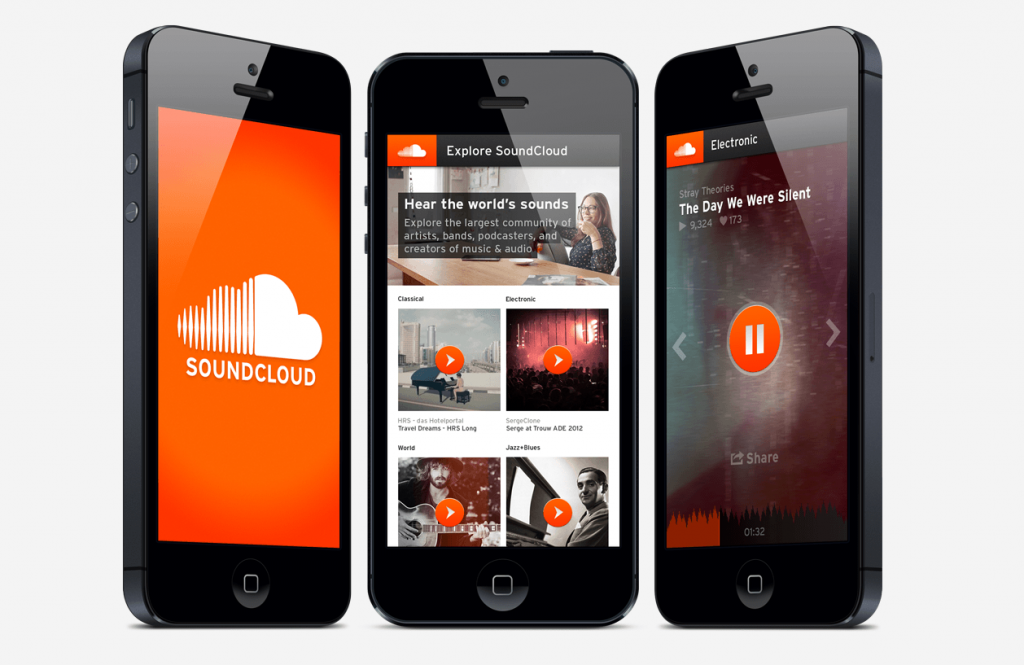
SoundCloud, the online audio distribution platform and music sharing website, has announced that it is going to add a distribution tool to its self-monetization Premier program. That means, now the eligible users will be able to upload, monetize and publish their songs over all the major streaming services and web stores, including Spotify, Apple Music, YouTube Music, Beatport, Instagram and more, through SoundCloud.
Image Source: openconnection.com
Although
other distribution platforms keep a slice from the profits earned
through the uploaded content by the artists, SoundCloud has promised
that the artists will be able to keep 100 per cent of the royalties,
and also, all the rights over their content will be reserved by them
only. Also, all the payouts earned through the various platforms will
be sent to the artists directly through the app.
“Creators
using the SoundCloud Premier distribution feature keep 100% of their
rights, keep 100% of their distribution royalties from third-party
services, and pay no distribution fees,” said SoundCloud in the
announcement.
According
to the announcement, all the ‘eligible’ SoundCloud Premier users
will be able to access the new feature to upload their original
content on the platform. According to the eligibility criteria, the
creators must be 18 or above. Also, they must have at least 1,000
monetizable track plays, and all the tracks from the creator must be
original, having no copyright strike on any of the content in the
past.
The
feature is still in beta, and soon, will be available to the
SoundCloud Pro and SoundCloud Pro Unlimited users. Currently, the
subscription fee for Pro users is $6, and for Pro Unlimited it is
$12. With the addition of the distribution feature, the fee may be
increased to an extent, as with no claim over the royalty and the
copyrights, SoundCloud still have to make some money. According to
the announcement, the ones with the eligible account will be informed
through an email in the coming few weeks.
According to the CEO of SoundCloud, Kerry Trainor, the addition of the new feature will help the SoundCloud become more user-friendly and will be a great step in the evolution of the music industry. SoundCloud has already supported many of the artists in their success, and those artists, including Juice WRLD, are often heard giving the credits of their success to the app.
Yashica is a Software Engineer turned Content Writer, who loves to write on social causes and expertise in writing technical stuff. She loves to watch movies and explore new places. She believes that you need to live once before you die. So experimenting with her life and career choices, she is trying to live her life to the fullest.
Founding Red Hat at the time when the market was changing rapidly, was quite a big step, as the co-founders of Red Hat, Marc Ewing and Bob Young followed their gut feeling and kept their ears opened to every good advice from the experts. While building a business model, obviously one should focus on the product that he/she will be building under the name of their business, but at the same time for long term sustainability, one has to be future ready and take the steps carefully.
Founders
Marc Ewing was born on 9 May 1969 and completed his graduate degree from Carnegie Mellon University, in 1992. Ewing was a bright student and was also involved in the 86open project in the mid-1990s in college. His grandfather had gifted him a red colour hat that he used to wear during his college days, and this way, he had become popular as the ‘red hat guy’ in the college.
Image Source: irishtimes.com
The co-founder of Red Hat, Bob
Young, was a native of Hamilton, Ontario, Canada. He completed his
high school from Trinity College School in Port Hope and graduated as
Bachelor of Arts from Victoria College at the University of Toronto.
Young, after completing his
education, started a computer rental and leasing business and founded
Vernon Computer Rentals, in 1984. But in 1990, he sold the company to
Greyvest Capital and the money that came from the deal, made him an
overnight millionaire. But the good time was not permanent, and he
lost his millionaire status just in a few months as a result of some
bad business moves from Greyvest Capital.
Young, still, was with
Greyvest and to enhance his business he started attending the
meetings, where programmers talked about the latest trends in the
software program UNIX, running on the servers. He was an outsider but
knew that those meetings were the key to his biggest business idea.
At the time Young was
attending those meetings, he started a newsletter named New York Unix
that had all information about the next meetings. In 1993, after
losing his job at Greyvest, he incorporated the newsletter as his
another business and founded ACC Corp Inc., which at the beginning
was earning from the advertisements. At the same time, Linux was
becoming a hot topic as it was free software and many of the
companies were choosing Linux over Unix. Eventually, Young started
selling Linux software, books and accessories.
Founding
Red Hat
At the same time, Young was
getting requests from the groups that were subscribed to his
newsletter to write more about open source software and Linux. Young,
too, was interested in writing about the same but had no idea about
what an open-source software was.
He was struggling through the
financial crisis, but the Linux based products that he was selling
was the main source of his income. So he became more curious about
finding more resellers for the Linux products. This led him to reach
Marc Ewing, who had set up a little Linux shop in Durham, North
Carolina, named as Red Hat.
The company, unmistakably, got
its name from the same red hat that he used to wear in college. Marc
was working on a Unix project and accidentally, built the first
software under Red Hat, in 1994. The project he was working on was to
run on a Unix system, but since it was too expensive, he developed
the software for Linux.
The evolution of Linux also
made Marc interested in the same, and as Linux was an open source
software, he started working on fixing Linux.
Finally, on 29 July 1994, he
released his first Linux distribution software that was easier to use
version over the GPL version. The software became a hit overnight.
Young started officially
distributing Red Hat’s software, and after discussing with many
Linux experts, Young joined his hands with Ewing to incorporate Acc
with Red Hat, and the two turned the co-founders of Red Hat Inc. with
a partnership of fifty-fifty.
The two was working
passionately for the company, without knowing the real worth of it.
In 1999, the company went public, and for their surprise, the company
achieved the eighth-biggest first-day gain in the history of Wall
Street.
In the same year, Red Hat
acquired Cygnus Solutions, followed by the acquisition of the other
companies including WireSpeed, C2Net and Hell’s Kitchen Systems,
Planning Technologies, Inc., in the later years. In the year 2000,
the company won the “Operating System Product of the Year”
award for Red Hat Linux 6.1. In 2002, Red Hat introduced Red Hat
Linux Advanced Server.
In 2005, Red Hat stock became
part of the NASDAQ-100 and, in 2006, Red Hat stock moved from to
trading on the New York Stock Exchange (RHT).
In 2012, Red Hat became the
first open source software company that entered into the
one-billion-dollar group, and in 2015, it surpassed the
two-billion-dollar milestone. Just in another three years, in 2018,
the company recorded the annual revenue of three-billion-dollar.
On 28 October 2018, IBM announced that it is planning to acquire Red Hat for US$34 billion.
The company headquarter was
moved to Raleigh, North Carolina, U.S. from Durham in 2002. As per
the 2018 records, the company has raised to 12,600 employees.
Bob Young served as Red Hat’s CEO until 1999, and left the company in 2002, to found his print-on-demand, self-publishing company, Lulu.com. Red Hat is one of the fastest growing companies and one of the pioneers in the open-source software industry.
Yashica is a Software Engineer turned Content Writer, who loves to write on social causes and expertise in writing technical stuff. She loves to watch movies and explore new places. She believes that you need to live once before you die. So experimenting with her life and career choices, she is trying to live her life to the fullest.
Razer has announced that it is going to shut down its a year old digital game store by the end of this month.
The gaming peripheral manufacturing company, Razer, is one of the dominant brands in the gaming industry. Last year, it had launched its digital game store, to try its hands on digital distribution platform for PC games, to earn a share in the profits of the game sales business. But even before completing one year of its Game Store, the company announced to close it down by defining it “as part of realignment plans.”
“We regret to
announce that Razer Game Store will cease operations on February 28,
2019, at 0100hrs Pacific Time as part of the company’s realignment
plans,” Razer wrote in a statement. “It has been a
privilege for us to recommend and deliver great digital game deals to
you. We have been extremely fortunate to have you as part of our
awesome community. Thank you for the support and making all this
possible.”
Razer launched its
Game Store in April 2018, as an effort to get into the digital gaming
business. The Game Store was designed to provide its users with
access to thousands of online games at one place. The store was
launched as an opponent to its contemporaries like Steam and Amazon,
and it included games from Razer’s partners including Ubisoft,
Bethesda, Bandai Namco, Deep Silver and Rockstar. The platform also
provided games from other stores through Steam or Uplay product keys.
The company also
provided many offers and perks to its users through the platform like
credits to earn for Razer’s silver loyalty program, attractive
discounts over Razer’s games and hardware, etc.
We can only estimate from this unexpected announcement from Razer, that even after putting all its efforts, the launching of the Game Store did not go well according to its plan. Also, the company has not given any other statement over why it is closing its short-lived Game Store so abruptly. Although it is not the end for the cheap games from Razer and also all the pre-orders that have been made to the Razer’s Game store will be fulfilled before the Game Store shuts down. The company will also continue operating its Razer Gold and Razer Silver programs, through which the users can avail offers and discount on the Razer hardware.
Yashica is a Software Engineer turned Content Writer, who loves to write on social causes and expertise in writing technical stuff. She loves to watch movies and explore new places. She believes that you need to live once before you die. So experimenting with her life and career choices, she is trying to live her life to the fullest.
There are rare cases when your
honesty and realization of your fundamental duty would have paid you
well. Yes, you might have received appreciation from people, but did
it become the biggest business idea for you ever?
This is what happened to the Param Jaggi, who is the co-founder of Hatch App. Param Jaggi is of Indian descent, who dropped out of Vanderbilt University at the age of 19, to work for his own self. He was a brilliant student and even invented EcoTube when he was in school at the age of 16. The EcoTube was built under a science project, that used the algae photosynthesis to reduce carbon emissions from cars. The device worked well and Jaggi patented the device in his name. Jaggi’s father is an engineer and wanted him to become a doctor. But as Jaggi was already working for a better cause, i.e., saving the environment, his family never interfered. Jaggi also sold his innovative bio-fuel preparation method to a Fortune 500 company.
Image Source: thewholetruthbooth.com
During the same time, he also
developed an interest in web development, and later, when he turned
19, he decided to work as a freelancer, as he was already developing
web and mobile apps and was earning enough. At that time he was
charging $10K to $30 to build simple apps and that too only in a time
equal to a weekend. For Jaggi, it had become quite easy to copy paste
the similar code in the background of each web app and finish the
project within a week. This fact made him think that he was charging
way too much for delivering the ‘almost same’ code to every other
client. “What’s fundamentally wrong with the software development
industry, especially custom development systems, is that they price
out products based on your price elasticity”, said Jaggi in an
interview.
On the other hand, the other
co-founder of Hatch Apps, Amelia Friedman, was also an entrepreneur
who started her own business when she was still in college. She was a
student of Brown University and was running college-level programs in
different languages. At the time she completed her graduate degree,
her program had reached to 7 cities, with over 32 different programs.
Founding
Hatch Apps
Jaggi was a 19-years old
eco-innovator, and Friedman was a self-made entrepreneur. The two
got a chance to attend the Halcyon Incubator in Washington, DC, where
the two met each other, the very first time. The meeting included the
discussion over many things including how Jaggi wanted to bring price
stability to the app building industry. And the idea of Hatch Apps
was formed.
Jaggi’s plan was clear. He
wanted to create a platform, upon which people could build their own
apps without paying extra money. In 2015, the two launched Hatch Apps
and started working on the basic plan. At the same time, the need for
extra funds arisen. So they developed the 2016 Election game in just
three days and were able to raise $100,000 for Hatch Apps within a
few weeks.
The Hatch Apps is one of its
kind, where a user can build apps by just dragging and dropping the
elements, without actually knowing the coding behind those elements.
During the testing of the app, Jaggi built the first app on Hatch
Apps, just in three days even having the deadline of five days.
In March 2017, this software
company raised $1.3M in angel funding to launch their product. The
company has a team of more than twenty people and charges only $1K a
month for app development. For $2K to $5K, customers can implement
specific customizations and add-ons.
Jaggi is working as the CEO of Hatch Apps, and Friedman holds the position of the COO of the company. Jaggi has also got his name listed twice in the Forbes “30 Under 30”.
The company is still managing
its ways in the market and slowly is getting ahead to earn more
consumers. For now, the idea is really innovative and one of its
kind, so the future of the company looks quite bright.
Yashica is a Software Engineer turned Content Writer, who loves to write on social causes and expertise in writing technical stuff. She loves to watch movies and explore new places. She believes that you need to live once before you die. So experimenting with her life and career choices, she is trying to live her life to the fullest.
Rapidly growing technology has made us quite aware of the changes that may take place in the coming future. Uber has already announced about its air taxis, and soon we may see people above the sleek roads, in the air driving their flying cars.
But for now, we just have to adjust with the SeaBubbles’ “flying” boats. Yes! You read it right. The France-based company SeaBubbles has just introduced five prototypes of its electric flying boats in Miami this week. The company has been experimenting with its various models for the past three years, and now, it has introduced its first-to-market boat, which is a 4.5-meter flying boat. The boat can carry four passengers besides the driver and uses the waterproof lithium-ion batteries.
Image Source: thepeninsulaqatar.com
The flying boat taxis are the result of the combination of technologies from the nautical industries, aviation, and intelligent software, and the team SeaBubbles includes the qualified aeronautical engineers and watermen, who are working on building fast water taxis to help in reducing the traffic on the roads.
The boat is raised out of the water using the foils that give an illusion of flying boat. In this way, the water drag is reduced, and the boat’s covering is separated from the water, making it run faster even in the rougher waters, maintaining the comfort of the passengers.
For building those flying boats, the company has joined its hands with many other companies, who have helped in building the parts of the boat, using the best of the technologies.
The startup is the idea of its CEO and the French yachtsman Alain Thébault, who broke a world record for sailing speed twice, at 50.17 knots, in 2009, and his co-founder Anders Bringdal, who also set a windsurfing world record, at 51.45 knots. The two co-founders want to bring a clean and fast taxi service for the waterways for the major cities, in order to help reduce the daily traffic in the cities. Earlier the company had also launched one of its windowless white flying boat, named as “Soapdish.”
These flying taxis will also be more cost-effective as those are running on electricity and not on gas. The taxis can be charged at a power station, and those stations will preferably be solar charged.
“The cities today have one thing in common: pollution and congestion. You could do this with a normal boat. But with a normal boat with a normal combustion engine, the fuel price you’re paying is between $70 and $130 per hour. With us, it’s $2 dollars” said Bringdal.
SeaBubbles also has its own mobile application, similar to those of Uber and Ola. The company is currently looking for buyers in Miami, and it alerady has its customers in Russia, Rotterdam and Amsterdam, etc. Although it is also operating in Paris there is a speed limit on boats in Paris, which is not favourable for those Bubble taxis as those are built to run faster.
Yashica is a Software Engineer turned Content Writer, who loves to write on social causes and expertise in writing technical stuff. She loves to watch movies and explore new places. She believes that you need to live once before you die. So experimenting with her life and career choices, she is trying to live her life to the fullest.
Zipcar
has a history even before the car-renting businesses were not even
that common. Built by two moms, the idea at the time was unique, and
it was their passion that made it successful in just a few months.
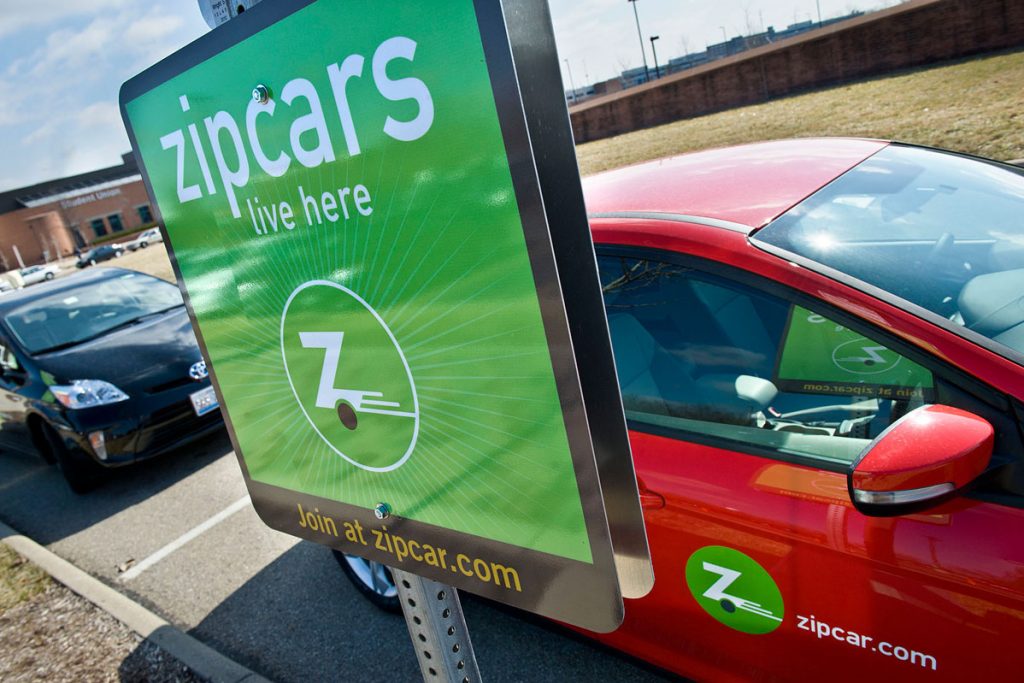
Zipcar is an almost 2 decades old company, founded in the year 2000, by Antje Danielson, a Harvard geochemist and Robin Chase, a stay-at-home mom and an MIT business school graduate. The two ladies met each other at their children’s kindergarten, in Cambridge, Massachusetts. Both were struggling financially, as Chase had left her job due to the birth of her first child and Danielson was the only working member in her family.
Image Source: wright.edu
But as the time was passing both of them wanted to make use of their studies, and as a business graduate, Chase has expressed her desire to start a business with Danielson. Danielson was on the same track and had studied about Switzerland’s Mobility Cooperative, and shared the idea of starting a similar technology based car-rental company, in the US, with Chase. Chase also liked the idea, but it was a big project that included a huge risk. So both talked to their husbands and got the approval for the business.
Finally, in January 2000, both started their car-rental business, Zipcar. Zipcar provided the automobile reservations to its members through charging them a monthly or annual fee. Before incorporating the company, the two had already raised investments for its launch of around $75,000 in startup financing. After they launched the startup, Chase held the position of the president of Zipcar and Danielson became the vice president of the company.
The
first rental car from Zipcar went onto the roads in May 2000, and in
just three-four months it registered over 600 customers for the
service. The company was doing well, but the two co-founders were not
going along too well. In 2001, Robin Chase fired Danielson, after
Chase petitioned Zipcar’s board for the ability to make hiring and
firing decisions without consulting them.
The
fire of the co-founder did not impact the company much, and it kept
on expanding in New York City and Washington DC. Even the company was
expanding, it was unable to secure more funding, and as a result, the
board of the company replaced Chase as the CEO of the company with
Scott Griffith. Within two years the company was able to raise $10
million in funding led by Benchmark Capital. In the same year, a new
office was opened in San Francisco, following by another office in
Toronto in the next year. The establishment of Toronto led to the
fastest growing market in Toronto for Zipcar.
In
late 2006, the company reached London, and in 2007, Zipcar opened an
office in Vancouver. In the same year, in the month of October, the
company had a merger with Flexcar. After the merger, the company
earned over 225,000 members, double the number of the member it had
in the previous year.
In
June 2009, the company launched its iPhone app, with the features
like honking the horn and unlocking some Zipcars. In April 2010,
Zipcar acquired the London-based car-sharing club Streetcar.
In
2013, Avis Budget Group acquired Zipcar. In 2014, the company opened
its offices in Houston, Dallas TX regions, Greater Toronto and
Hamilton, Ontario. In the same year, the company also extended to
Paris, France and Madrid, Spain. Zipcar also launched its floating
car-sharing service in Brussels, Belgium, in 2016.
Zipcar
offers the car rental service for over fifty different car models,
even including the luxury car models like Audi and BMW. The company
headquarters still remains in Boston, Massachusetts and it has raised
to over 500 employees.
The reason behind the success has been that it started through word-of-mouth promotion and had invested well in the technology. The business idea was simple and was based on customer feedback. So in the past two decades, it has grown in a phenomenal way. Even it has been more than a decade for the two co-founders left the company, Zipcar had its own success story. And, the success story of Zipcar shows us that keeping things simple and targeting customer satisfaction is the key to success.
Yashica is a Software Engineer turned Content Writer, who loves to write on social causes and expertise in writing technical stuff. She loves to watch movies and explore new places. She believes that you need to live once before you die. So experimenting with her life and career choices, she is trying to live her life to the fullest.