
Your Tech Story

Annasha

Annasha Dey is an NIT student, who apart from studying engineering is also a content writer. She has a great interest in photography, writing, reading novels, and travelling as well. She is a foodie who loves socializing and hanging out with her friends. She is also a trained Kathak dancer and a big fashion enthusiast. Dey also loves watching TV series, which includes F.R.I.E.N.D.S. and Big Bang Theory. To be a better writer she prefers to read more

xerox

Joseph C. Wilson : The Founder of Xerox Who Brought an Innovation in the Printing Industry

The great inventions in the sector of printing and photocopy have made our lives much easier. Think about a world where we needed to pay a few dollars just for one colour print, absolutely not affordable right? Given that photocopy is essential in every sector starting from an educational institution to a corporate company and even a hospital, it had to be made pocket-friendly. And, with the inventions made by Xerox Corporation, especially Joseph C. Wilson the industry of photocopying will not be dealt with casualties at least for the next century.

Xerox Corporation, a multinational conglomerate pioneering in the world of the printing industry was founded more than a century ago in 1906. The company then was established as The Haloid Photographic Company, and the three masterminds behind this mammoth transforming setup were Joseph C. Wilson, Chester Carlson, and Jeff Leonard. Let’s have a detailed look into the life of Wilson, and his inventions, and how it led to founding Xerox.

Life of Wilson

Born in 1909 to J.R. Wilson and Kate Wilson, Wilson spent his childhood in Rochester. During his early childhood, Wilson grew a love for literature in his heart. He completed his high school from West High School, Rochester and pursued economics in the University of Rochester. Later, he went to Harvard to complete his MBA. After getting his business degree, he joined Haloid and became the head of the company.

History of Xerox Corporation
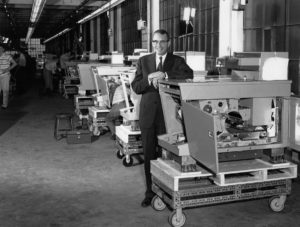
Xerox founder
Image Source: Xerox Twitter

Xerox was founded on 18 April 1906 as Haloid. During this time, Carlson worked independently on his innovation that revolved around printing images. He was a very promising physicist, and Wilson after taking over the company from his father showed keen interest to work with Carlson’s product. And all of these happened during the time of the Second World War, which added up mostly to the sale of photographic papers for government work. Though the photographic papers were in demand, Wilson had strong competitors, too. So, he needed to come up with an excellent idea at the earliest hour to save Haloid from dissolving.

Wilson wanted to launch a new product called Xerox 914, which had Carlson’s technology incorporated in it. It took Carlson almost two decades to perfect the technology, and finally, it was released in 1959. The product brought a revolution in the industry, resulting in $60 million revenue of Xerox at the end of 1961, which escalated to $500 million by 1965. The technology that was used in the product was Electro-photography, and Wilson gave it a new term called “xerography’.

That is how Haloid came into the spotlight, and its most important goal was to make photocopying easier and cheaper for the world.

Wilson’s Idea Flooded the Company with Profits

A year after the launch of 914, Wilson Center for Research and Technology was established in Webster, New York, and the following years, the company was enlisted on the New York Stock Exchange as Xerox (XRX). In this year, the company’s earnings grew to 151%.

In 1969, another invention followed. It was a laser printer, Xerox 9700 and brought billions of dollars of business to the company. Once the company settled on firm grounds, it made multiple acquisitions, including University Microfilms International, Scientific Data Systems, Electro-Optical Systems, etc. Even after Wilson’s death in the early 1970s, the company is still embarking with new technologies, acquiring gigantic businesses and making great innovations. In 1970, Xerox Palo Alto Research Center was developed, and it started developing modern technologies like graphical user interface and laser printing.

With the advent of a new decade, a new century and a millennium, Xerox started the year 2000 with a big acquisition of Tektronix colour printing for $925 million. This was followed by further acquisitions of companies like XMPie (software provider) and Newfield IT.

Currently, Xerox Corporation is a major part of the IT industry with its headquarters based in Norwalk, Connecticut, New York. The products of Xerox include printers, scanners, projectors and other office equipment. With John Visentin as the Vice Chairman and the 10th CEO of the company, around 35,000 people are working together to find more efficient equipment for the near future. Today, Xerox has become a significant brand name both in research and development and marketing.

meesho

Meesho : India’s First Facebook-Backed Startup Emerged out of a Failed Business

The world has already created a rough background framework in the mind of every young entrepreneur out there. If you are a good programmer and a tech guy, you are surely a potential entrepreneur, or that is what everyone thinks. But, there is always this one person who burst our bubbles and brings us back to the real world. Sanjeev Barnwal, the co-founder of Meesho, an online e-commerce platform created for the resellers in 2015, believes that it is always not coding that opens the scope of doing good business. One of the most important criteria for fueling a business is to know your clients. So, meeting the clients in real life, interacting with them contributes to one’s successful business as well. Let us know more about this platform, and its founders, Sanjeev Barnwal and Vidit Aatrey.

Sanjeev Barnwal

Belonging to a middle-class family from Ranchi, Barnwal was always influenced to do well in his academic life. In his 10+2, he opted for computer science only to get rid of biology. Since, he chose to study pure science, like most of the students these days, he also wanted to pursue engineering, and not to mention from the best institution of India, i.e., IIT. After passing his twelfth standard, he went straight to Kota to prepare for the entrance exam, and next year, he made it to IIT Delhi, Department of Electrical Engineering. After getting into college, Barnwal realized the power technology and coding is acquiring in our lives.

During his days in the IIT, he met Vidit Aatrey, his classmate. But these four years were absolutely not the time when they sat together and planned their own start-up. After completing his BTech, Barnwal moved to Tokyo, Japan and started working for Sony Corporation. After working there for a couple of years, Barnwal was really inspired by the start-up community growth in India and wanted to join in. So, he called up Aatrey, his IIT Delhi batch mate, to ask if there is any start-up which he could possibly join. But, Aatrey was very much interested to create a start-up of his own, rather joining one. And this is how it all began.

Meesho founders
Image Source: angel.co

Vidit Aatrey

With an AIR of 182, Aatrey was admitted to the Electrical Engineering department of IIT Delhi in 2008. After graduating, while Barnwal moved to Tokyo, Aatrey joined ITC as Supply Chain Manager and worked there for a couple of years. He switched to InMobi in 2014 and moved to Bangalore. He was doing really well in this company, until one fine day he received a phone call from his old batchmate, Sanjeev from IIT Delhi. Over a single conversation, both of them decided to quit their jobs for something which was as uncertain as an exit poll in India.

Anyway, both of them resigned, and Barnwal returned to India in June 2015 to start his new venture with Aatrey.

And, the End Result was Meesho!

At first, both of them decided to open a fashion-based online marketplace that would remap all the shops for customers, and through the app, the user could actually try the product before buying it. They named their start-up FashNear and launched it in mid-2015, but unfortunately the idea back-fired.

So, they came up with another idea of a start-up and created a platform where offline retailers could take their business online, and sell through different social platforms like Instagram, Whatsapp, Facebook etc. After they came up with the idea of this new business, they worked day and night to create this online premise. Their office was their 2-BHK apartment in Bangalore and weekends meant nothing to them except coding more and more. After a long month, they finally set up the company and launched Meesho in December 2015. This is how Meesho was born, from a failed business to the first Indian start-up Facebook invested in. The co-founders performed diligently and made their comeback in the same year.

Where Meesho Stands Today?

Meesho has received a robust response from the customers of India as it has turned the table for many young businessmen/businesswomen of India who basically gave their business a face due to this entire online social media marketing.

Meesho raised good funding in these few years as well as many prestigious awards. After a year of its launch, Meesho was selected by the Y-Combinator and earned $120,000 from there. The latest investment by Facebook was in June 2019, and the last month Meesho raised $125 million from series D funding.

Today, Meesho has over 500 members inspiring every commoner of India with a passion to create something of his or her own.

vianai

Vishal Sikka : Ex-CEO of Infosys and the Founder of AI-based Startup Vianai System

Speaking of artificial intelligence, it is quite important to mention machine learning too, because both of these go hand in hand. Today, most of the huge software companies use the concept of ML and AI to build their software and products. In a nutshell, artificial intelligence is becoming the building block for the new tomorrow, with its past rooted to the core of science. It is kind of mandatory to learn about ML and AI for most of the programmers today. Because it opens a window of vast opportunities for one’s career as well as a scientific development.

A lot of companies have started adopting the concept of AI and ML to enhance their products and the approach of development. And, one of the most recent start-ups based on AI has been launched in this very year by Dr Vishal Sikka, Ex CEO of Infosys. After leaving Infosys in 2017, Dr Sikka decided to start his own business, and hence, launched it on 12th September 2019. With a sky-limit scope in the area of AI, Dr Sikka’s main motive is to harness its power and make every industry adopt this concept and implement it in every product.

Early life and education

Born into a Punjabi family in Madhya Pradesh, India, Vishal Sikka’s father was an officer in the Indian Railway and his mother was a teacher. At the age of six, the family moved to Vadodara, Gujarat from Shajapur, Madhya Pradesh. Since his father was an engineer and his mother a teacher, academics turned out to be his strength and engineering his love.

Vishal Sikka founder Vianai
Image Source: thehindu.com

He went to Kendriya Vidyalaya, Rajkot and completed his schooling from Rosary High School. Following his father’s foot trails, Sikka pursued his Bachelor’s degree in Computer Engineering from the Maharaja Sayajirao University of Baroda. Though he was admitted to one of the renowned colleges in India, Vishal Sikka wasn’t satisfied with it. He left the college immediately after he got admission to Syracuse University, New York. He pursued a B.S degree in Computer Science and later, went to Stanford University to complete his PhD.

Early Career

After completing his PhD, he started working with Xerox’s research lab, and after working there for some time, he realized his dream, i.e., launching a start-up. He founded iBrain, his first start-up which was acquired by PatternRX, and his second start-up was Bodha.com, which was acquired by Peregrine Systems. At this time, Sikka joined Peregrine as the Vice-President for Platform Technologies. His main area of work was application development and technical designing.

One of the advantages in Vishal Sikka’s career was the time when he just started accelerating in his professional world. He came very close to Hasso Plattner, founder of SAP. This helped him a lot in landing a job in SAP. He joined SAP in 2002 as the head of strategic innovative projects. Eventually, he was promoted to Senior Vice President and ultimately, to the position of first-ever CTO in April 2007. After working for more than a decade in SAP, Sikka finally resigned from the company on 4th May 2014.

Once you reach a certain point in a career, you don’t have to turn back twice to question your decisions. And, this happened to Sikka the moment he joined SAP. Sikka decided to leave SAP for some personal reasons, and undoubtedly, a person of his calibre was on-demand in the tech market.

Soon after he left SAP, Vishal Sikka joined Infosys on 12th June 2014. The ex-CEO of SAP was named the new CEO and Managing Director of the second-largest IT industry of India. He was declared as the whole-time director of the board of Infosys on 14th June 2014. After serving in this company for three long years, Sikka stepped down from his position and set off his course towards establishing his own start-up.

Vianai Systems

In 12th September 2019, Sikka finally launched his own AI-based start-up Vianai systems with the dream that AI and ML have the full potential to change every industry. Sikka’s start-up received a seed funding of $50 million which is going to increase with rocket-speed shortly.

eyeview

Oren Harnevo : The Founder of Eyeview, a Digital Marketing Company

Advertisement plays a key role in proper marketing for any product, brand or service. And once the demand is created in the marketplace, the company gets anchored, if not for a lifetime, at least for a good period of time. Digital marketing is the face of every product today, starting from a small online service to a mammoth multinational company. If not for advertisement, proper marketing of brands would have seemed like a far-fetched goal today. And, pioneering in the pool of marketing, Oren Harnevo created his own video marketing company, Eyeview in January 2007. Once the internet started getting popular throughout the world, Harnevo was successfully able to channel its true power and expose it in the world of marketing. Today, his company serves some of the top premier brands of U.S like P&G, Honda and BMW.

Early life and early career of Harnevo

Harnevo, like most of the programmers, was into computer and coding from a very young age. He started coding from the age of 10 and never really stopped it.

Harnevo, after graduating from his high school, didn’t pursue any undergraduate program immediately. He served as a Sergeant of Special Forces in Israel Defense Forces for three years (1996-1999). After serving for the army of Israel, Harnevo went to Tel Aviv University, Israel in 1999. He pursued his Bachelor’s degree in Computer Science and graduated in 2003. Instead of pursuing his Master’s degree, Harnevo pursued another Bachelor’s degree from the same university in film, cinema and television.

Oren Harnevo Eyeview
Image Source: eyeview.com

Harnevo, not to mention, was very good with computers, or else, it wouldn’t have been possible for a guy with no knowledge in computer programming to create such a tech empire for himself. Right after he received his degree in computer science, he joined Teamworks Technology as a Web Developer in January 2000. By this time, he already mastered HTML, Java, Javascript, SQL and Cold Fusion. He worked there as a junior developer and left the company after a year.

While Harnevo was pursuing his degree in arts (film and cinema), he joined Redzebra ltd, as a product manager. He was in charge of product management and development of an online medical portal, LifeOnKey.

Now that Harnevo had received two degrees on diametrically opposite subjects, he was ready to storm his mind and bring out some excellent ideas, ideas to blend the power of computer programming with the right amount of entertainment through media and cook a perfect potion for video marketing. The ideal amalgamation of science and arts is what Harnevo specialized in all these years.

In May 2004, Harnevo joined 888.com as a Project & Product Manager and continued for almost three years.

Founding Eyeview

Working as a product manager and having experience on the platform of digital marketing for so many years, Harnevo definitely spotted a good potential in video marketing. Moreover, he studied about media which made him superior to only developers. His choice for academics might have seemed strange, but it did pay off well. Harnevo sets a perfect example of an entrepreneur who actually proved that at times, jack of all deeds and master of none plays the ace in your life.

In January 2007, Harnevo established Eyeview, a video marketing based startup in the city of New York. Eyeview mainly created personalized video ads for companies, brands and products. The company mainly emphasizes on delivering 1-to-1 outcome-based video marketing and seems like it has gathered quite a good audience in terms of both quality and quantity in the last twelve years. Eyeview was also as the ninth fastest-growing company in North America on Deloitte’s 2015 Technology Fast 500. The company has also successfully raised $80 million from top venture capitalists.

Harnevo has been the CEO of the company for more than twelve years. He stepped down from his position on June 2019 and became a member of the board.

Awards and Achievements

In 2008, Harnevo was awarded the Harvard Business School 2008 Best Start-up, followed by the award for best video advertisement technology in 2011 by Digiday.

Apart from being the recipient of some prestigious awards, Harnevo has also been featured on the Wall Street Journal, Forbes and Ad Age.

cloudian

Success Story of Cloudian, a Data Storage Company, Co-founded by Hiroshi Ohta

The advancement of technology is providing us with stairway to a new world. Every day, every second, our world is changing. New gadgets and new phenomenons are discovered daily. The path, that we have chosen for modernizing our world, depends vividly on data. Today, everything that we do, from launching a website to posting a picture on our Instagram account, data is needed. And, after a few decades, our world will reach a certain position where the development of every nation will be decided by the amount of data one can store or have access to.

And, speaking of data, as such an integral part of the modern sphere, it is definitely necessary to mention Hiroshi Ohta. Hiroshi Ohta, along with Michael Tso founded Cloudian, a company that brought innovation in the data storage system. Founded in 2011, the company has its headquarters based in San Mateo, California, United States.

The main product of Cloudian is object storage software that was built for big enterprises as with new software and applications from a huge number of companies made data storage really tough and complex. So, an easy to use data storage system was the cry of the hour.

The Idea Behind Cloudian

cloudian founder hiroshi ohta
Image Source: advertisingweek.com

Before Hiroshi Ohta came up with the idea of building his own company, he used to work at J-Phone. It is a telecom operator company, based in Japan, where Ohta was in charge of service development. During his time in this mobile company, he pioneered many skills and also provided the base for “Sha-Mail”, first mail in the world with pictorial advantage. Since he worked in the sector of communication, Ohta spotted a significant increase of users in the telecommunication world, and this resulted in the gathering of data in networks.

With an increase in the number of smartphones, laptops, and tablet in today’s world, the audience might likely run out of data and need to pay for storage. And, if such a situation arrives, where data becomes an integral part of our basic requirements, then it definitely has to be affordable. Thinking about this, Ohta decided to quit the company and built data storage product for the traffic insanely driving to the cloud world. He started working on Cloudian Hyperstore software (a software having Amazon S3 support).

Why Object Storage Technology?

The biggest advantage of this kind of storage software technology is that you can store and have access to data irrespective of your geographical location. Previously, the software that had been created by many companies only limited the scope of accessing data from nowhere, but the data centres. But, Ohta undoubtedly solved this problem through Cloudian software.

Another big problem that started arising was the cost of maintenance because some software programs were targeted to increase the data volume. This increased the cost of storage and got off track from one of the data storage’s biggest goal, that is being economical.

Cloudian’s products solve both the major problems, along with keeping the quality of products high. From media to medical school, every institution, company, organization, including a single user, need data storage facilities for various reasons. And, there is no scene of “market drop” in this area, at least, for half a century now.

Success of Cloudian

One year, after founding the company, Cloudian signed a deal with a Japanese telecommunication company to fuel its cloud object storage service. This was the big start after which Cloudian has entertained many lucrative clients, including Motorola, Element Fleet, Tyco and many more.

The company also has a very fancy list when it comes to investors. In 2014, the company raised $24 million from Intel Capital, Goldman Sachs, INCJ and Fidelity Growth Partners Japan. In 2016, four new investors were added to list including Lenovo, City National Bank, Epsilon Venture Partners and DVP Investment. Cloudian raised $41 million in the funding round of October 2016. After the new Series E funding round, the total worth of Cloudian hit an impressive figure of $173 million. The company has also established a partnership with Cisco, which triggered the list of investors, and basically, means more funding.

Future Aspects

One of the most important targets that Ohta talks about is the users should be very familiar and comfortable to use these products. Also, the applications that are being created with Cloudian’s storage technology as the backbone should be at best interest of the audience.

Bell Curve

Julian Shapiro: The Founder of Bell Curve, Marketing Agency and the Mascot of Animation

Have you ever discovered your interest in doing something because you were just bored? Well, that happens to many of us, but only a few make it their passion. And, a handful among the few can establish themselves successfully through it. For example, we love playing video games, but that doesn’t mean every one of us turns out to be a game developer, but a guy named Nitish Mittersain did, didn’t he? You should be highly passion driven if you want to live through what you love. And, Julian Shapiro proved to be one of them.

Julian Shapiro, the founder of the Bell Curve and many other online services, started to show interest in coding from an age of twelve. And, the reason he started tinkering with his computer was he got nothing to do after he moved to a new city. Eventually, he started exploring different aspects of computer, and the wonders, one can make if he/she has good coding skills and was undoubtedly carried away by its charm.

Shapiro started his coding journey with Visual Basic 6, and by the time he was fourteen, he was pretty good at what he was doing. He realized that his skills were in high demand, and he could easily make money out of it. So, he started developing websites for small companies, swooping into the entrepreneurial world.

A Great Start

Since Julian Shapiro started as a teenage entrepreneur, he gradually became one of those tech-savvies interested in learning something new every day. Shapiro was very much involved in domain names for startups and companies. But he noticed that most of the businesses have below-average quality names for their companies and decided to work on it. With the existing knowledge of web development, Shapiro started building tools that would analyze around 50,000 domains daily and among those domains which were likely to be worthwhile.

Julian Shapiro
Image: Julian Shapiro

He put a lot of efforts into like building an algorithm for making combinations of alphabets and sorting out the potential names and acquiring them for a few dollars. After working diligently for six months, Shapiro finally made an inventory of domain names, thus selling it to companies for a few thousand dollars each. He named this service NameLayer and released it in August 2011.

Accelerating as a Tech Entrepreneur

After selling NameLayer to Techstars in 2014, Julian Shapiro again went back to his most comfortable place of web development. While creating several projects, he noticed that web animation doesn’t receive much importance, and no such significant modification or improvement was done in that area. Thinking that this hinders the designs of professional web developers, he started working on it.

In September 2013, Shapiro created his own animation engine, Velocity, to improve the tooling of web development through motion animation. The launch of velocity was very effective as people, especially the front-end designers, started using it extensively because they really understood the impact of web animation on marketing. Famous companies like Microsoft and Uber also started using Velocity.

What About Bell Curve?

With Neal O’Grady and Asher King-Abramson as partners, Shapiro founded Bell Curve in April 2017. It is a San Francisco based startup that operates as a marketing agency and conducts growth training programs. Bell Curve, basically, runs advertisements for startups and businesses across the world. Leading companies like Envoy, Streak and Tovala hired Bell Curve to run their advertisement sector.

Today, Bell Curve comprises a team of 9 members, including Julian Shapiro. This new startup is making great progress, but most importantly, Shapiro at the end of the day strictly adhered to what he loves the most, that is, web development. He devoted his career to make unbound contributions in this area of development.

Moreover, the digital content of the Bell Curve is so powerful that the company gives growth talks at Google and Y Combinator.

Other Aspects of Shapiro’s Career

In November 2014, Shapiro joined Webflow, Inc as a Vice President of Marketing. The company was about web development for professionals, something that Shapiro can never turn down. He worked there for ten months.

Julian Shapiro also started his own blog, Julian.com from September 2015. And, he is the only owner of the website. Shapiro also writes in TechCrunch about growth marketing since March 2019.

Another project that Shapiro worked and is worth mentioning is Libscore. Shapiro created Libscore in partnership with Stripe and Digital Ocean to help people understand that at what rate their libraries are actually used by people after putting it on open source. It helps to gather the statistics, thus providing the developer with proper feedback.