Your Tech Story

Technology

OpenAI Seeks $90 Billion Valuation in Possible Share Sale, WSJ Says

OpenAI Claims Tool to Detect AI-Generated Images Is 99% Accurate

A technology being developed by OpenAI will accurately and efficiently identify photographs produced by its Dall-E 3 artificial intelligence platform.

OpenAI Seeks $90 Billion Valuation in Possible Share Sale, WSJ Says
Image Source: finance.yahoo.com

The creator of the well-known chatbot ChatGPT and the picture generator DALL-E, Mira Murati, stated on Tuesday the newly released OpenAI tool is 99% accurate. She stated that it is undergoing internal testing before a scheduled public release but did not provide a time frame.

While both CEOs were at Laguna Beach, the Wall Street Journal, California, for the Tech Live event, Murati appeared together with OpenAI CEO Sam Altman.

There are currently a few tools available, however, they may not accurately identify photographs or other information created by Artificial Intelligence (AI).

OpenAI created an identical tool in January that was meant to identify language that was generated by AI, but it was cancelled in July due to its reliability issues. The business claimed it was devoted to finding techniques to determine whether audio or visual media had been produced using AI as well as to upgrading that software.

Given that artificial intelligence (AI) technologies may be used to modify or manufacture news coverage on major world events, the necessity for such detection systems is only increasing in relevance. Another part of the problem is addressed by Adobe Inc.’s Firefly image creator, which guarantees not to produce anything that violates the artists’ intellectual property rights.

The OpenAI leaders also provided some information on Tuesday on the artificial intelligence model that would come after GPT-4. OpenAI applied for a “GPT-5” trademark with the United States Patent and Trademark Office in July, even though the firm hasn’t officially announced what the successor model to GPT-4 may be named.

Chatbots like ChatGPT, which employs GPT-4 and a previous model, GPT-3.5, have a tendency to fabricate information, a condition known as hallucination. When asked if a GPT-5 model would be less likely to do this, Murati replied with a Maybe.

she also stated that they would see that. for now, they’ve made significant improvements with GPT-4 in the hallucinatory area, but they’re still not exactly where they need to be, she added.

Altman also discussed the potential that OpenAI would create its computer chips instead of relying on those made by firms like Nvidia Corp., the industry-leading firm at the moment, to train and run its artificial intelligence models.

YouTube Working on Tool That Lets Creators Sing Like Drake

YouTube Working on Tool That Lets Creators Sing Like Drake

In a bold move at the intersection of technology, artificial intelligence, and the music industry, YouTube is reportedly working on a revolutionary tool that would enable content creators to record audio using the voices of famous musicians. This groundbreaking initiative could transform the way users engage with content on the video-sharing platform.

YouTube Working on Tool That Lets Creators Sing Like Drake
Image Source: bloomberg.com

According to individuals familiar with the matter who requested anonymity due to the confidential nature of the discussions, YouTube has initiated talks with major music companies to obtain the necessary rights to train this AI-powered tool. While negotiations are ongoing, no formal agreements have been reached with record labels. These discussions are expected to shape the future of content creation on the platform.

YouTube recently unveiled a suite of AI-based tools, marking its continued commitment to harnessing artificial intelligence for content creation. These tools, introduced just last month, encompass features like background creation for videos and automatic dubbing into different languages. However, the much-anticipated music tool was not released as planned due to the rights-related complexities.

The legal landscape concerning the use of artificial intelligence in conjunction with the names, images, and likenesses of public figures, including musicians, is still evolving and has already sparked legal disputes. YouTube faces the challenge of navigating this intricate path to ensure the technology’s legal and ethical use. Although YouTube has had a tumultuous relationship with the music industry in the past, the company has made significant strides in recent years by increasing royalty payments to artists and labels.

When contacted for comment, a company spokesperson declined to provide any additional information, maintaining a shroud of secrecy around this ambitious project.

YouTube, owned by tech giant Alphabet Inc., is no stranger to the world of artificial intelligence and machine learning. Alphabet has been at the forefront of developing cutting-edge AI products for several years, and YouTube’s latest venture is part of the race among tech companies, including Microsoft, to lead the charge into what many consider the next frontier in technology.

Also Read: Chip Stocks Shed $73 Billion After US Curbs Nvidia Sales to China

With Alphabet’s substantial investment in AI, YouTube has been pushed to explore innovative solutions and tools that could transform the way content is created and shared on its platform. This development aligns with Alphabet’s broader vision to harness AI’s potential and offers creators a chance to explore new horizons in content creation by singing like their favorite artists.

As discussions between YouTube and major music companies progress, the future of content creation on the platform remains a tantalizing prospect. This tool, if successfully developed and implemented, could usher in a new era of content creation, where creators can truly embrace the voices of their musical idols to captivate audiences in ways previously unimaginable.

Chip Stocks Shed $73 Billion After US Curbs Nvidia Sales to China

Chip Stocks Shed $73 Billion After US Curbs Nvidia Sales to China

In a significant blow to the semiconductor industry, chip stocks experienced a sharp decline on Tuesday following the United States’ announcement of sweeping updates to export curbs aimed at restricting China’s access to advanced computer chips. The PHLX Semiconductor Sector index, a key indicator comprising 30 chip stocks, was poised to wipe out approximately $73 billion in combined market value.

Chip Stocks Shed $73 Billion After US Curbs Nvidia Sales to China
Image Source: bloomberg.com

The newly imposed restrictions specifically target Nvidia Corp., a major player in the semiconductor market. The affected chips include Nvidia’s A800 and H800 models, which were designed for the Chinese market. The updated rules mandate that companies notify the US government before selling chips that fall below the controlled threshold, a move intended to tighten control over the export of advanced semiconductor technology.

A senior US official highlighted the significance of these curbs, emphasizing the potential risks associated with even slightly inferior chips that could be employed in artificial intelligence (AI) and supercomputing applications. The latest measures reflect a broader effort by the US to maintain control over the export of technologies with dual-use capabilities.

Nvidia responded to the development, with a company spokesperson stating that they are committed to complying with all applicable regulations while serving their customers. Despite the challenges posed by the new restrictions, Nvidia remains confident due to the robust global demand for its products and anticipates minimal impact on its overall results.

Also Read: Baidu Says Its AI as Good as ChatGPT in Big Claim for China

However, industry analysts suggest a more cautious outlook. Kunjan Sobhani, an analyst for Bloomberg Intelligence, noted that while the immediate impact on Nvidia’s estimates might not be substantial, the long-term prospects of the company could be at risk. Sobhani highlighted the possibility of a decline in Nvidia’s future sales, indicating that a recent surge in orders from large Chinese customers might have been driven by stockpiling of 800-series chips in anticipation of such restrictions.

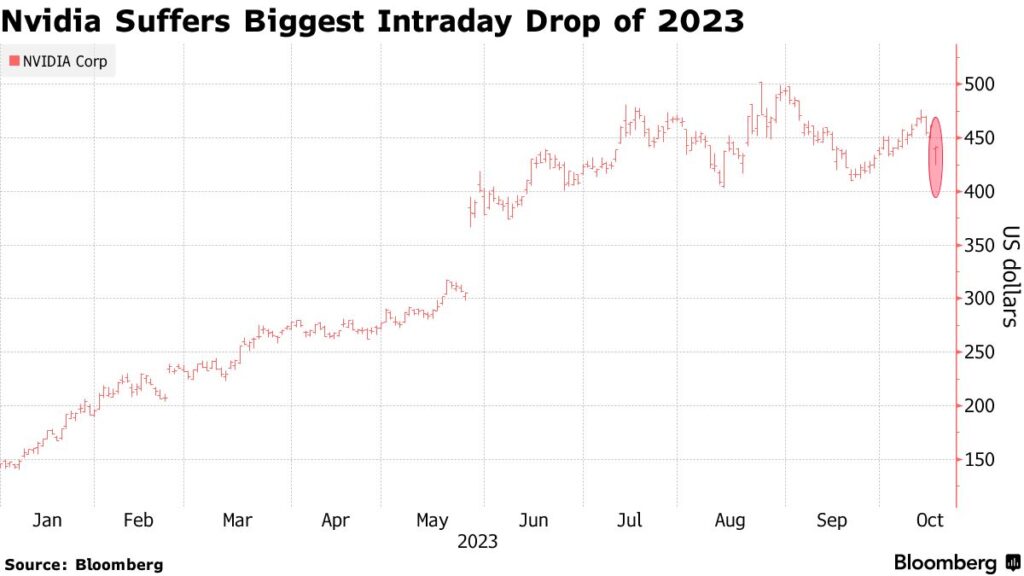
Investors responded swiftly to the news, causing Nvidia shares to plummet by as much as 7.8% on Tuesday. This marked the most significant intraday fall for the company since December, reflecting the market’s concern over the potential ramifications of the tightened export controls on Nvidia’s business operations.

Baidu Says Its AI as Good as ChatGPT in Big Claim for China

Baidu Says Its AI as Good as ChatGPT in Big Claim for China

Robin Li, the founder of Baidu Inc., announced that his business’s large language model (LLM) has now become as better as OpenAI’s sophisticated GPT-4, taking the forefront in his nation’s quest to create artificial intelligence that can compete with the United States.

Baidu Says Its AI as Good as ChatGPT in Big Claim for China
Image Source: biztechafrica.com

on Tuesday in Beijing, the multibillionaire put Ernie 4.0 through a round of questions and answers to demonstrate its ability to respond to questions and resolve challenges instantly. In terms of complexity and all-around capabilities, Ernie has equaled OpenAI’s pioneering offering, Li told a crowded auditorium that was formerly a steel mill.

Despite the US bot launching months before, the flagship Ernie chatbot has already exceeded 45 million users, an accomplishment that still needs to catch up to ChatGPT’s anticipated 180 million users. The company that dominates Chinese search, frequently described as a domestic Google, is counting on artificial intelligence to help it outcompete competitors that dominate other parts of the internet, such as Tencent Holdings Ltd. and Alibaba Group Holding Ltd. On Tuesday, stocks of Baidu fell by approximately 1.5 percent.

Following ChatGPT’s demonstration of the potentially disruptive capabilities of generative AI, which can create video and content from straightforward inputs, Baidu is at the forefront of a wave of massive investments throughout China. It is recognized as a frontrunner in the competition to develop a cutting-edge platform for the largest internet marketplace around the world, which also involves several startups and significant local IT companies.

They are trying to catch up with American companies such as Microsoft Corp. and Google to provide support such as ChatGPT as well as Dall-E, but Beijing’s severe restrictions and US sanctions restricting Chinese utilization of the most cutting-edge processors for training and running artificial intelligence models might cast a shadow over their chances. This concern is being fueled by Washington’s strengthening of restrictions on the importation of AI technology.

Also Read: LinkedIn Cuts 668 Jobs in Second Round of Layoffs This Year

Li informed the crowd that Ernie is not inferior to GPT-4 in any way.

Given their extreme complexity, AI models are difficult to evaluate. Li tested the most recent iteration of Ernie Bot in real-time. He instructed it to create a book on the realm of old martial arts while posing math problems and asking questions about things like buying real estate.

This is a sharp contrast to the prepared film the tech tycoon released in March to introduce China’s initial response to OpenAI’s popular bot.

LinkedIn Cuts 668 Jobs in Second Round of Layoffs This Year

LinkedIn Cuts 668 Jobs in Second Round of Layoffs This Year

In a move reflective of broader trends in the tech industry, Microsoft’s professional networking platform, LinkedIn, has announced the second round of layoffs in 2023. 

LinkedIn Cuts 668 Jobs in Second Round of Layoffs This Year
Image Source: tech.hindustantimes.com

The company disclosed on Monday that 668 employees from its engineering, talent, and finance teams would be affected by the restructuring, constituting over 3% of its 20,000-strong workforce. This decision comes in the wake of slowing revenue growth for the social media network for professionals.

The tech sector, which has been grappling with an uncertain economic outlook, has witnessed a significant spike in job losses this year. According to employment firm Challenger, Gray & Christmas, 141,516 employees have been laid off in the first half of the year, a stark contrast to the approximately 6,000 job losses recorded during the same period the previous year.

In response to the layoffs, LinkedIn emphasized its commitment to adapting organizational structures and streamlining decision-making processes. The company also stressed its ongoing investment in strategic priorities to ensure the delivery of value for its members and customers. The layoffs are seen as part of a broader trend in the industry to align workforce size with changing market dynamics.

LinkedIn’s revenue model relies on advertising sales and subscription fees charged to recruiting and sales professionals utilizing the platform for talent acquisition. Despite boasting a community of 950 million members, the company’s revenue growth has been sluggish. In the fourth quarter of its fiscal year 2023, LinkedIn reported a 5% increase in revenue year-on-year, a drop from the 10% growth observed in the previous quarter.

Also Read: South Korea’s Nand Flash Memory Chip Exports Return to Growth

Microsoft attributes the challenges faced by LinkedIn to a slowdown in hiring and a decline in advertising spending. The company, however, remains optimistic about the future and continues to welcome new members into its professional community. Earlier this year, in May, LinkedIn took a proactive step to streamline operations, announcing the layoff of 716 employees across sales, operations, and support teams to foster quicker decision-making processes.

As the tech industry navigates evolving economic conditions, these layoffs at LinkedIn underscore the ongoing challenges faced by companies in aligning their operations with market demands. The ripple effects of these decisions are not only felt within the organization but also contribute to the broader narrative of a transforming employment landscape in the technology sector.

South Korea’s Nand Flash Memory Chip Exports Return to Growth

South Korea’s Nand Flash Memory Chip Exports Return to Growth

Nand flash memory shipments from South Korea increased for the very first time in the past twelve months, adding to the indications that the decline in semiconductor demand had peaked.

South Korea’s Nand Flash Memory Chip Exports Return to Growth
Image Source: finance.yahoo.com

In contrast to an 8.9 percent decline in August, shipments rose 5.6 percent from a year prior in September, the commerce ministry reported in a statement on Monday. Dynamic random access memory exports (DRAM), another segment of the memory-chip industry, fell by 24.6 percent in the same time frame, a less dramatic decrease than the 35.2 percent drop seen a month prior.

Memory chips are a key component of Korean exports, which are highly dependent on the demand for technological products on a worldwide scale. Nand is less profitable than DRAM, but it is a preferred material among manufacturers of memory cards, digital cameras, as well as other gadgets that are portable due to its capacity to store data even in the absence of electricity.

In an effort to support economic development in an era when worldwide interest rates are anticipated to rise for longer and impact total spending, Korean officials are banking on a rebound in chip demand.

The majority of the worldwide memory market is controlled by Samsung Electronics Co. along with SK Hynix Inc., while Japanese wafer and equipment producers hope to benefit from a rebound in semiconductor sales. The electronics sector of Samsung is primarily recognized for its well-liked smartphones and televisions. Due to shortages, the corporation has increased its reliance on providing semiconductors to manufacturers worldwide in the past few years.

According to data from the Commerce Ministry, total semiconductor shipments to China continued to struggle in September, down 22.7 percent from a year before. While shipments to the US fell by 30 percent, those to the European Union (EU) increased by 56.5 percent.

With an estimated 230-billion-dollar investment by memory chip juggernaut Samsung Electronics, South Korea claims it will construct a sizable facility to manufacture memory chips in the bigger Seoul area.

President Yoon Suk Yeol revealed the intentions on Wednesday, and the electronics behemoth later confirmed them.

Also Read: TCS Seeks to Use Microsoft AI Partnership to Improve Margins

“We will build the world’s largest new ‘high-tech system semiconductor cluster’ in the Seoul Metropolitan area based on large-scale private investment of almost 300 trillion Korean won,” he said.

“In addition, we will grow the ‘semiconductor mega cluster’ to the world’s largest in connection with the existing memory semiconductor manufacturing complexes.”

edition.cnn.com