Your Tech Story

tech news

$42 billion

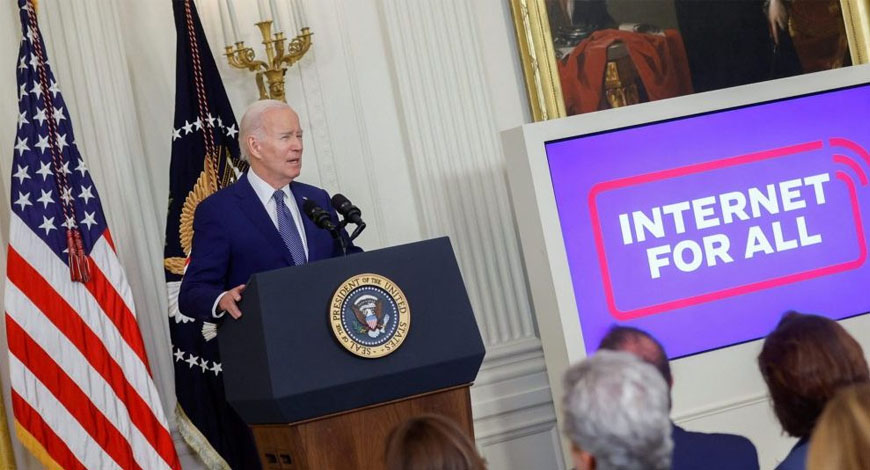
US to spend $42 billion to make internet access universal by 2030

To ensure that everyone has the opportunity to use high-speed broadband by 2030, the White House allocated a total of $42 billion to the fifty states including U.S. territories as part of the latest advertising initiative for economic strategies of President Joe Biden.

The $1 trillion 2021 infrastructure package that Biden supported authorized the funds for BEAD (the Broadband Equity Access and Deployment) Programme. The expenditure will be determined by the recently revealed coverage map of the Federal Communications Commission, which shows where there are connectivity problems.

$42 billion
Image Source: communicationstoday.co.in

The two most populated states in the United States, Texas, and California, are at the top of the financing list with the amount of 3.1 billion USD and 1.9 billion USD out of the $42 billion, respectively.

However, since there’s a shortage of broadband connection, other, fewer-populated states including Alabama, Louisiana, and Virginia made the top ten list for financing. Vast rural regions in those states have less access to internet access compared to the big cities.

“It’s the biggest investment in high-speed internet ever. Because for today’s economy to work for everyone, internet access is just as important as electricity, or water, or other basic services,” Biden said in a White House address on Monday.

Source: usnews.com

Every single state receives at least 107 million USD, with rewards ranging from 27 million USD up to 3.3 billion USD for Texas and territories of the United States such as the U.S. Virgin Islands.

Also Read: Nasdaq to sell debt worth $5 bln to fund Adenza deal

As his 2024 reelection campaign gets underway, Biden’s statement marks the beginning of the following part of his trip showing how laws established while his Democratic Party dominated Congress would affect Americans every day.

Biden is also scheduled to deliver what officials in the White House regarded as a significant economic address on Wednesday in Chicago, outlining the so-called “Bidenomics,” stated in a document sent on Monday to Democrats in Congress and other friends by senior advisors Anita Dunn as well as Mike Donilon.

Part of the 2024 election will be viewed as a vote on how Biden handled the country’s financial situation. Good Things include the creation of jobs and fewer unemployed people, but negatives include rising prices and the ripple effects of increasing interest rates, which have increased concerns about an economic downturn.

As per a Reuters survey done a few weeks ago, 35 percent of the people polled agreed with how Biden is managing the economy, whereas 54 percent of Americans disagree with the way he is doing his job. In the midterm elections of 2022, Dems lost their majority in the House of Representatives.

According to the management, there are currently 8.5 million places in the United States without access to internet connections.

Apptio

IBM nears US$5 billion deal for Apptio

In its newest move to boost its cloud and machine learning abilities, IBM announced on Monday that it will offer Vista Equity Partners a total of 4.6 billion USD in cash to purchase the technology Apptio which is a spend-management platform.

The price of IBM stocks fell somewhat in early trading. IBM stated that it will use cash on hand to fund the purchase and anticipates that it will conclude in the second half of 2023.

Apptio
Image Source: businesstimes.com.sg

The agreement is made at a time when businesses are reducing their technology spending due to adverse macroeconomic circumstances. IBM recorded an earnings rise of just under one percent year over year in the March quarter while cutting around 3,900 positions in the early part of the year.

Also Read: Japan’s Suzuki to Make ‘flying cars’ with SkyDrive

The tech behemoth said that the purchase of Apptio, a software-as-a-service (SaaS) company with more than 1,500 clients and alliances with cloud providers including Salesforce as well as Amazon.com’s AWS (Amazon Web Services), will boost IBM’s Red Hat work, Artificial Intelligence portfolio, along with consulting division.

Since its establishment in 2007, Apptio has offered online management services for IT budgeting, forecasting, including analysis. According to the business’s website, over 90 percent of Fortune 100 organizations utilize its products.

“Going forward, we are opportunistic (on M&A) and looking for opportunities in the software and consulting space,” Senior Vice President Rob Thomas told Reuters in an interview.

Source: reuters.com

Century-old IBM is changing its direction to concentrate on more recent artificial intelligence and services offered via the cloud.

It made its largest purchase to date in 2019 when it paid roughly thirty-four billion dollars for the software supplier Red Hat, and two years later it rotated out its IT facilities and information center firm Kyndryl Holdings. The business completed the sale of a few of its pharmaceutical analysis and information assets last year.

Also Read: Nasdaq to sell debt worth $5 bln to fund Adenza deal

Arvind Krishna, the CEO of IBM since 2020, has kept the 112-year-old business in flux. Even though they would probably be less than the thirty-four billion-dollar Red Hat purchase, he stated a few weeks ago that IBM is still intent on mergers.

According to financial analysts at UBS, Apptio’s sales totaled approximately 233 million USD in 2018 and are projected to increase by 11–13 percent compounding yearly until the fiscal year 2022.

Almost 3 years following the software business’s IPO, the private equity company, Vista Equity Partners acquired Apptio in a two-billion-dollar deal.

Waze

Google lays off staff at its mapping app Waze

Alphabet child company, Google, disclosed that it is reducing staff at mapping software Waze since it integrates the program’s ad network with its Google Ads infrastructure but it did not provide the exact number of layoffs that will be done.

A Google division called Waze, originally known as FreeMap Israel provides GPS-enabled satellite apps for navigation for mobile devices and other computing platforms.

Waze
Image Source: financialexpress.com

It integrates user-submitted journey times along with route details as well as turn-by-turn guidance while collecting location-dependent data via a cell phone network. Waze advertises the application as an entirely free download and usage driven by communities project.

 “In order to create a better, more seamless long-term experience for Waze advertisers, we’ve begun transitioning Waze’s existing advertising system to Google Ads technology. As part of this update, we’ve reduced those roles focused on Waze Ads monetization,” Google, which acquired Waze for about $1.3 billion in 2013, said.

Source: indianexpress.com

In order to streamline operations, Google confirmed in December that it was going to combine the Waze & Google Maps departments. As a result, Waze would become an entity of the Google Geographic section, which manages Google Maps as well as Google Earth, including Street View among other real-world mapping tools.

Also Read: TikTok COO Pappas quits after five years in the role

The Verge highlighted that Waze had been purchased by Google for the sum of 1.3 billion USD in 2013 along with the fact it had stayed separate from Google Maps until 2021. The situation shifted, though, in September of the previous year after Sundar Pichai, the chief executive of Google, revealed that he was striving to increase corporate productivity in response to investor demand.

As reported by Bloomberg, Google’s owner firm Alphabet stated at the beginning of this year that it will be cutting off approximately 12,000 workers, or about 6 percent of its staff. Google has been attempting to cut expenses as income from online advertisements has been dropping.

“Google remains deeply committed to growing Waze’s unique brand, its beloved app, and its thriving community of volunteers and users,” Caroline Bourdeau, Waze’s head of PR, said in the statement.

Source: theverge.com

Job cuts are not a new thing nowadays. Many tech Giants such as Twitter, Amazon, etc are also laying off employees in the economic downturn caused by post covid situations. 

Nasdaq

Nasdaq to sell debt worth $5 bln to fund Adenza deal

To pay for its acquisition of the software business Adenza, which is controlled by Thoma Bravo, Nasdaq stated on Thursday that it wants to dispose of its debt for $5.07 billion.

The exchange provider will become a financial tech business as part of the $10.5 billion acquisition, which was disclosed a few weeks ago. It includes $5.75 billion in currency and 85.6 million units of Nasdaq stock in common.

Nasdaq
Image Source: freemalaysiatoday.com

Based on a release, Nasdaq plans to offer senior bonds for $4.25 billion as well as 750 million euros which is about 821.33 million USD.

The business, which is based in New York, announced that it has entirely pledged to provide bridge funding for the cash portion of the purchase agreement and aims to put out around 5.9 billion USD of loans between the agreement’s signature and closure.

Also Read: TikTok COO Pappas quits after five years in the role

Nasdaq and several of its competitors have been transitioning into fintech (financial technology) companies, mostly through acquisitions, as regulatory as well as nationalist opposition successfully prevented significant international trade acquisitions and as the amount of trading decreased during the financial crisis between 2008 and 2009, limiting revenue based on the transaction.

The U.S. exchange operator acquired OMX, a holding company of the Nordic markets, for 3.7 billion USD in the year 2007, ISE (International Securities Exchange) for a price tag of 1.1 billion USD in 2016, alongside Verafin, an exporter of applications designed to combat illicit financial activity, for a total of $2.75 billion in 2020.

The first digital trading platform in the world, Nasdaq is an online worldwide platform for purchasing and selling securities.

In the US as well as Europe, it runs 29 markets, one clearinghouse, along with five primary securities storage facilities.

The Nasdaq is home to most of the largest technology companies worldwide.

Also Read: Japan’s Suzuki to Make ‘flying cars’ with SkyDrive

Nasdaq began as a division of NASD which stands for the National Association of Securities Dealers, which is now referred to as FINRA (the Financial Industry Regulatory Authority), and its name started as an abbreviation for National Association of Securities Dealers Automated Quotations.

The Securities and Exchange Commission, also known as the SEC, pushed NASD to centralize the marketplace for stocks that aren’t listed on an exchange, which led to the creation of Nasdaq. The first computerized trading platform was the outcome along with starting its operations in 1971 on February 8.

Pappas

TikTok COO Pappas quits after five years in the role

TikTok’s Chief Operating Officer (COO), V Pappas, is leaving the popular social media platform after almost five years with the company. In a note to employees and on Twitter, Pappas, who uses she/her and they/them pronouns, mentioned that now that TikTok has achieved significant success, she feels it’s the right time to pursue her entrepreneurial passions. TikTok CEO Chew Shou Zi announced that Pappas will continue to serve as a strategic adviser.

Pappas
Image Source: scmp.com

Chew expressed gratitude for Pappas’ contributions, acknowledging her instrumental role in growing the business, promoting the company, enhancing product offerings and marketing campaigns, and fostering a positive community of creators and users.

Chew wrote, “I want to take this opportunity to thank V for their many contributions over the years. Throughout their time at TikTok, they have been instrumental in growing the business, advocating for the company, elevating our product offerings and marketing campaigns, and fostering a positive community of creators and users.

They have had a significant and lasting impact and we are truly grateful for their tireless efforts.” US lawmakers grill TikTok CEO on App’s alleged ties to Chinese Communist Party.

Also Read: Intel spends $33 billion in Germany in landmark expansion

Pappas initially joined TikTok in 2018 as the general manager and later became the interim head in 2020 when the previous CEO departed. She assumed the COO position the following year and has been a vocal advocate for the company, testifying before the US Senate committee on social media’s impact on homeland security.

TikTok has faced scrutiny over its Chinese origins, with concerns raised about user data sharing with the Chinese government and the dissemination of propaganda and misinformation.

The company is currently in negotiations with the Biden administration regarding its data privacy plans. TikTok maintains that it has never been asked by the Chinese government to share US user data and that it would refuse such a request if made.

In 2020, the Trump administration in the United States issued executive orders that sought to ban TikTok, citing national security concerns related to data privacy.

However, these bans were later blocked by court rulings, and negotiations between TikTok and various US companies, including Oracle and Walmart, resulted in the formation of a new entity called TikTok Global. This partnership was intended to address the concerns raised by the US government.

Since then, TikTok has taken steps to address data privacy and security concerns. They have established transparency centers, expanded their content moderation policies, and emphasized their commitment to safeguarding user data. TikTok’s data is stored in the United States, with backup copies in Singapore.

In addition to Pappas’ departure, TikTok CEO Chew announced an organizational shake-up. Zenia Mucha, a former communications executive at Disney, will join TikTok as the Chief Brand and Communications Officer, overseeing marketing and public relations. Adam Presser, currently the chief of staff, will take on the role of head of operations.

intel

Intel spends $33 billion in Germany in landmark expansion

As a portion of its ambition for development in Europe, Intel (INTC.O) will invest over thirty billion euros (approximately 33 billion USD) in developing two chip-making facilities in Magdeburg. German Chancellor Olaf Scholz welcomed the agreement on Monday as the most significant overseas investment that Germany has ever received.

Intel
Image Source: freetimelearning.com

According to an individual who is acquainted with the situation, Berlin has decided to assist the worth of up to 10 billion euros to the American chipmaker, above the 6.8 billion euros it had previously given Intel to construct two advanced manufacturing plants in the eastern metropolis.

The government along with the territory of Saxony-Anhalt, where Magdeburg is situated, were thanked by the CEO of Intel Pat Gelsinger for achieving the goal of a lively, environmentally friendly, leading-edge semiconductor sector in Germany as well as the EU.

Also Read: Japan’s Suzuki to Make ‘flying cars’ with SkyDrive

To regain its position as the industry leader in chip manufacturing and more effectively rival AMD Nvidia (NVDA.O), (AMD.O), alongside Samsung, Intel has invested billions in constructing plants on three different continents.

“Today’s agreement is an important step for Germany as a high-tech production location – and for our resilience,” Scholz said after Monday’s signing.

“With this investment, we are catching up technologically with the world’s best and expanding our own capacities for the ecosystem development and production of microchips.”

Source: reuters.com

It’s the third significant deal of Intel in just a few days with the German transaction. Whilst Israel announced that Intel will invest a total of $25 billion in manufacturing there on Sunday, Poland, an additional member of the European Union (EU), received proposals for a 4.6 billion USD chip facility on Friday.

As Per McKinsey, the global semiconductor manufacturing market is predicted to grow from 600 billion dollars in 2021 to an estimated trillion-dollar sector by 2030.

having Germany anxious about dropping its appeal as an investment destination, both the United States along with Europe are working to entice major manufacturing companies with a combination of government support and advantageous laws.

Berlin’s authorities are spending millions of euros on incentives to entice technology companies, despite rising concern over the supply chain’s frailty and its reliance on South Korea as well as Taiwan for semiconductors.

“The size of Intel’s reaffirmed and increased commitment to its expansion in Magdeburg speaks louder than words about Germany’s appeal as a high-tech business location,” said Robert Hermann, CEO of government agency Germany Trade & Invest.

Source: reuters.com