Your Tech Story

tech news

Chips

How Chips worth $1 created a Global Economic Crisis?

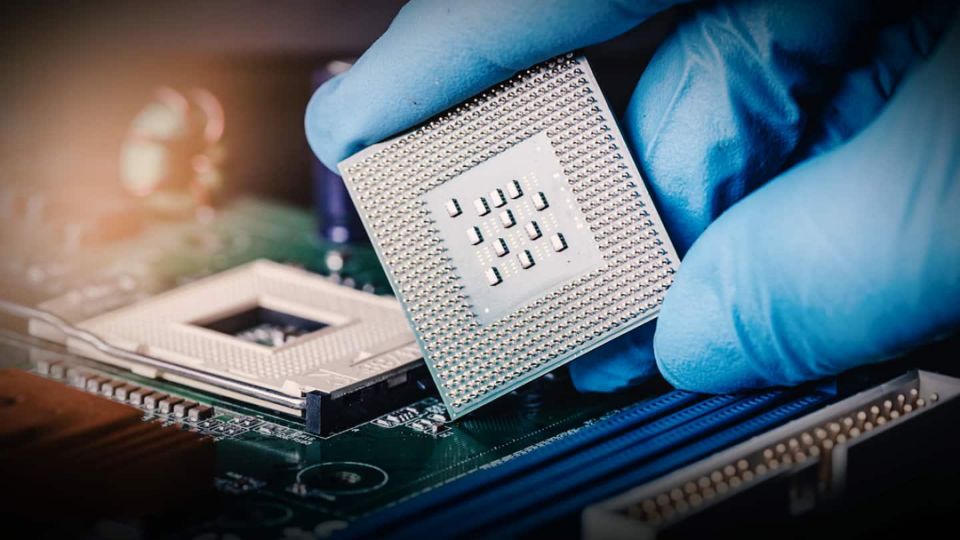
We have heard how the $450 billion semiconductor industry has hit a huge global crisis in this lockdown. Due to lack of production and strain in transportation and availability, the semiconductor industry is going through a big turmoil. But, the question is what exactly sparked this crisis affecting semiconductor companies across the world? The answer to this question is a $1 dollar chip called a display driver.

Due to the shortage of chips, the business didn’t go down for semiconductor companies alone but also for big computer and smartphone companies. These small chips designed by the semiconductor industry powers the super fast and efficient computers or smartphones that make our life better. Though the range of chips designed by any company varies greatly with price, this display driver is the one that is putting the entire silicon industry in jeopardy.

Shortage of Display Drivers

A display driver is one of the many chips used in electronic gadgets. The sole purpose of this driver is to send necessary information or a set of instructions required for illuminating your mobile screen or laptop or any navigation device. Now, the main problem that has arisen in the semiconductor industry and beyond is that there aren’t enough display drivers to suffice the demand. The production units are overwhelming as the firms cannot meet the demand which on the other hand is causing the hike of price.

Chips
Image Source: in.finance.yahoo.com

The shortage of display drivers in the market has also increased the cost for liquid crystal display panels as those drivers are essential to building the same. And, spiking prices of these display panels are affecting the manufacturer of laptops, cars, televisions, airplanes, and high-end refrigerators. Even if a company has all the other necessary parts for building a product it will remain incomplete without the display driver. So, the company’s relying on a source of display drivers has its hands tight.

Situation getting Worse

Along with the global shortage of display drivers, power management chips are also lagging in production. Many automobile industries like Ford, Nissan, and Volkswagen have started scaling back their production but it is very tough to make up for the lost revenue during the pandemic. And, keeping aside the consequences of the pandemic that has caused the shortage of supply in the first place, many other unfortunate incidents are also taking place. For example, a rare winter storm in Texas has caused damage to US productions and a fire in Japan led to the shutting down of a facility for a month.

The imbalance that has been caused by one thing has led to a series of harsh events and it is a tough job to establish balance. Taiwan Semiconductor Manufacturing Co has said that though they are running the plants at full capacity still they cannot meet the demand. Jordan Wu, co-founder, and CEO of Himax Technologies said that “every application is short of chips” and he hasn’t witnessed anything like this in the past 20 years.

The Origin of the Crisis

The main origin of the crisis and how the situation eventually evolved is explained by Jordan Wu in a very elaborate manner. First of all, when the pandemic started with people stuck inside the house an understandable miscalculation took place. Major industries tried to predict consumer behavior on the basis of the financial crisis model. But what we witnessed was the demand for good laptops, mobiles, game consoles, and other gadgets started increasing as the lockdown started extending.

The main reason was people started working remotely and education was also shifted to an online platform. At this time the display drivers didn’t face any shortage as the automobile industries got into a long pause as people didn’t step out of their house. So, the suppliers stopped shipping chips to the automobile industry. A few months back when people again started stepping out and resuming normal life they preferred traveling in personal cars rather than public transport. This led to the sudden demand for display drivers as the demand for other electronic gadgets didn’t go down.

So, now even if the company’s push all their employees and production units to their fullest, demands cannot be met. Since the demand has hiked and there is a shortage in supply prices of many electronics are increasing. For example, the price of 50-inch LCD television doubled between January and March. With this ongoing situation, Jordan said, “We have not reached a position where we can see the light at the end of the tunnel.”

Spotify

Spotify buys Locker Room app’s company Betty Labs in live Audio Push.

On 30th March 2021, Spotify revealed the news of acquiring Betty Labs, the company that made the sports-focused social audio app called Locker Room. By purchasing this company whose app became a bit hit since the launch last year, Spotify is marching its way into live audio. The live audio-based social apps are gaining much popularity in a small-time, especially with the ongoing pandemic situation.

Last year in April 2020, an invite-only audio chat social networking platform, Clubhouse was released and within a month its valuation became $100 million. Betty Lab’s social app, Locker Room was launched in October 2020 and it has become very popular among sports fans for chatting and holding watch parties.

Spotify acquiring Betty Labs speaks a ton about the company’s plans to evolve and expand in the field of music and beyond. In response to the latest acquisition, the company has said that it plans to “evolve and expand” Locker Room to offer sports, music, and cultural programming as well as live discussions with professional athletes, musicians, and other personalities (Gadgets 360).

Offering more options to the Audience

A big music streaming platform like Spotify has millions of users which comprise both the content creators and the listeners. To stay in business and keep growing, evolving is very essential as well as granting the wishes of your audience. Live format is attracting many new and existing users in music streaming platforms. Introducing a live format will broaden the community and enhance the services already offered by both apps.

Gustav Söderström, Chief Research & Development Officer at Spotify, said, “Creators and fans have been asking for live formats on Spotify, and we’re excited that soon, we’ll make them available to hundreds of millions of listeners and millions of creators on our platform.”

Source: newsroom.spotify.com

Howard Akumiah, Founder and CEO of Betty Labs, said that “We are excited to join forces with Spotify and continue building the future of audio – we’ll invest more in our product, open the experience to Spotify’s audience, diversify our content offerings, and continue expanding the community we’ve built.”

Source: newsroom.spotify.com

About Spotify

Spotify was founded in 2006 by Daniel Ek and Martin Lorentzon. It is a Swedish music streaming company that has more than 300 million active users. The company has a freemium subscription model and it is available both on iOS and Android smartphones. Currently, the company’s Spotify app is available in most parts of Europe, the Americas, Oceania, Africa, Mauritius, and Asia. The company is still expanding and it’s expected that by the end of this year, Spotify will be available to users of 178 different nations.

Spotify
Image Source: digital.hbs.edu

Spotify had a fall in the number of users during the advent of COVID-19 but it is recovering and very fast. The premium users of Spotify are increasing rapidly and last year it reached 133 million premium users. Over the years, the company has made several acquisitions and some of them are Tunigo, a music discovery app, The Echo Nest, a music intelligence company, Seed Scientific, a data science consulting firm, etc. The company is also planning to acquire Megaphone from The Slate Group for $235 million.

About Betty Labs

Betty Labs is mainly focused on providing live experiences through a social audio application. The company’s application Locker Room is used for live discussions with sports insiders and athletes. This gives the sports fan an opportunity and a platform to talk with major personalities and get more facts and ideas about important topics. It is a new company and has a total of thirteen investors till now. But, with Spotify acquiring Locker Room, Betty Labs will get more exposure in the coming days which will attract new users.

Qualcomm Snapdragon Sound

Qualcomm launched Snapdragon Sound promising better quality and connectivity

Qualcomm launches Snapdragon Sound as a new suite that can be connected to smartphones and well as wireless headphones and earphones. The first announcement regarding this suite for audio products was announced last year during the Qualcomm Summit in December. The Snapdragon Sounds claim to have improved interoperability between Qualcomm Snapdragon fueled smartphones and also with audio products such as headphones and earphones (Gadgets 360).

The new product suite by Qualcomm has promised better audio quality and efficient connectivity for its users. Apart from these two major improvements, it has also embedded additional features like active noise cancellation (ANC) and voice communication software. To enable and use the Snapdragon Sound, both source device and outfit should be supporting the particular technology.

Qualcomm Snapdragon Sound

This new suite is expected to roll out in the market within the next few weeks. The Qualcomm Snapdragon Sound can be enabled on smartphones powered by Snapdragon 888 which is going to roll out this year. This new product is targeting the electronics manufacturer who originally built smartphone and audio products. The Snapdragon Sound will be provided as a one-step solution for product makers working in ANC, Bluetooth, chipset, and other connectivity technologies.

Qualcomm Snapdragon Sound
Image Source: anandtech.com

If a user is using a compatible audio product along with supporting a smartphone such as one with Snapdragon 888, this will allow the activation of the entire audio suite experiencing every feature included in Snapdragon Sound. Some of the features of this new audio suite are ANC, Qualcomm FastConnect, aptX Bluetooth codec, etc.

Other companies working for Snapdragon Sound

Qualcomm worked with two other companies for developing the Snapdragon Sound, namely, Xiaomi and Audio Technica (Japanese headphone maker). The new audio suite will be embedded on some of the company’s new products which will broaden the scope for compatibility and attract more audiences. The users will understand that Snapdragon Sound has been enabled and it is operational when they will receive a new pop-up logo on the connected device. The Snapdragon Sound can be connected even in speakers but both the source and output device should support the technology.

The main technologies that are expected to make the Snapdragon Sound exceptional with enhanced audio quality and connectivity are Qualcomm FastConnect 6900 and the Snapdragon 8-series chipset range. The former technology will enable faster and stable Bluetooth connectivity. There is also Qualcomm active noise cancellation technology which will make the experience more real and authentic. The aptX adaptive codec will be used for high-quality audio transmission over Bluetooth and there will be an amplifier package and Qualcomm Aqstic DAC(Gadgets 360). 

Since Qualcomm has announced the rollout officially, the product makers can now license the entire audio suite for their new products. The company is also working with Amazon Music HD in order to certify the listening experience and reach out to more people. They want to convey all the purposes that will be provided by the new Snapdragon Sound.

Features of Snapdragon Sound

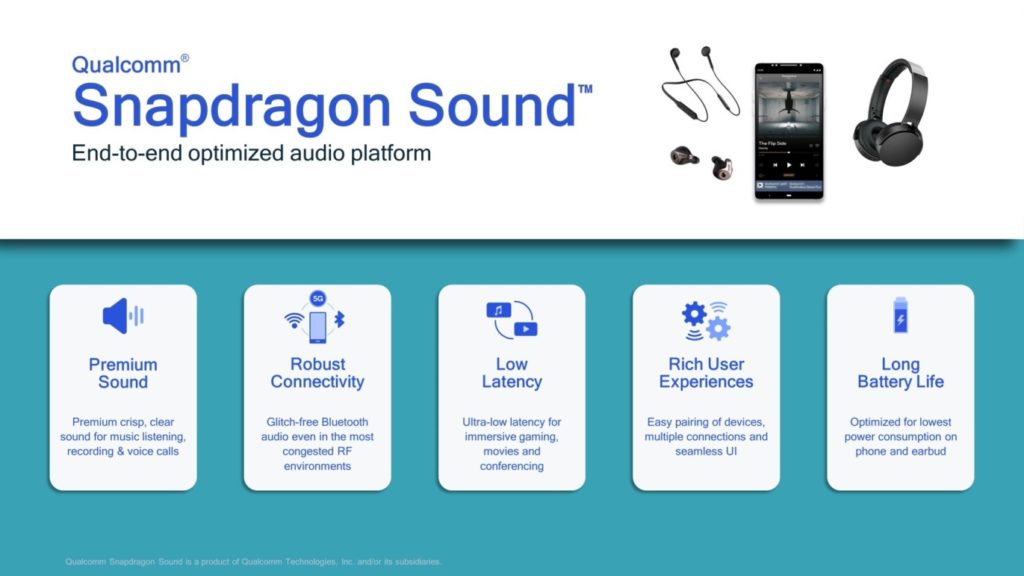
Snapdragon Sound is ensuring the best audio experience bringing the Qualcomm technologies altogether. The new Snapdragon Sound will provide the best audio paired with excellent connectivity and delivering high-resolution music. Using Snapdragon Sound, the voice calls will be clearer and it will ensure a lag-free gaming experience. The audio suite also ensures extended battery life. You can check out the official website of Snapdragon Sound to get a demo of what your music will sound like.

The Snapdragon Sound is compatible with both smartphones as well as wireless earbuds to headphones. This is the kind of technology aspired by every gamer and those attending business calls 24/7 across the globe. If you don’t choose to connect to earphones or headphones, Snapdragon Sound will play the music extra loud from your phone’s speaker using Aqstic technology. This will not damage the phone speakers.

The audio quality will be uncompressed 24-bit 96 kHz. For Bluetooth connectivity, the audio will be compressed and delivered in quality up to 16-bit 44kHz. Snapdragon Sound uses the aptX voice technology to make calls clearer by improving the sound quality. The background noises will be minimized which has a huge advantage of receiving calls no matter where you are.

Timnit Gebru

Two Google engineers resigned after the company fired AI researcher, Timnit Gebru

A lot of disputes have been taking place in Alphabet Inc’s Google regarding ethics and work culture among the company’s employees. The intensity of the situation has been rattled as two engineers of Google resigned after the company dismissed the AI researcher Timnit Gebru. From the engineering department, one engineering director and a software developer quit Google and it’s a sign of not approving of the departure of Timnit Gebru.

Diversity and ethics have become a point of conflict on Google for some time now as David Baker, an employee of Google resigned last month. He worked at Google for sixteen years and during his departure, he said that Gebru’s dismissal “extinguished my desire to continue as a Googler”(witnessed by Reuters). David Baker worked as a director in the user safety division in Google. He also mentioned that the environment of Google was acting against the belief of diversity though it claimed otherwise. His exact words were “We cannot say we believe in diversity, and then ignore the conspicuous absence of many voices from within our walls.”

Resignation of Kannan

Vinesh Kannan, a software engineer who worked at Google resigned on Tuesday. On Wednesday, he tweeted about his resignation and that Google mistreated Timnit Gebru. He also mentioned April Christina Curley, an ex-employee of Google who claimed that she was wrongly fired by the company. The dismissal of April took place last year which means that the tension regarding diversity in work culture is going on in Google for a long time. Kannan also mentioned that both of them were wrong but Google declined to comment on this. The company has assured that it is trying its best to restore trust between the company and its employees, also it disputes April’s accusations.

Why the sudden disputes?

The tension regarding the departure of Timnit has been growing for the last few months. The workers in Google have demanded academic freedom and management commitments in the company’s research organization. In December, around 2,600 employees of Google signed a letter supporting Timnit, and last month more than 800 people joined a union to bring advancement in workplace protection.

The story of Timnit Gebru

Timnit Gebru is one of the most leading Black women who have a very impactful contribution in the field of ethical AI. Last year, Timnit was promoted by Google as the co-leader of a group focussed on ethical AI due to her remarkable performance in annual employee appraisal. After she was promoted, Jeff Dean, head of Google AI, only made a single comment regarding what she and her team are supposed to focus on. He mentioned that Timnit and her team should look forward to building software for processing human language that should abide by the AI principles of the company.

Timnit Gebru
Image Source: miro.medium.com

There was an exchange of email conversations between Timnit and Jeff during October 2020. Timnit informed Jeff that her team was working on a paper which was regarding the same area of understanding the complexity of language while Jeff told her that he would be interested in reading it. And, after six weeks of that conversation, Timnit was surprisingly fired by Google. She was on her vacation when she received the news.

Explaining Timnit’s departure

After Timnit was fired by Google, Jeff tried to explain the situation to his other employees. Jeff mentioned that the paper she and her team was working on didn’t meet the publication bar of the company. He also mentioned that the paper was missing relevant information regarding the recent improvements done in this field. While Timnit’s superiors tried to convince her to retract the paper Google’s Research team mentioned that the previous works of authors who claimed benefits of large language models were not scrutinized properly before approval. This created a lot of fuss questioning Google’s scrutiny process.

Microsoft

Microsoft president says it has fallen victim to the SolarWinds hack

Microsoft alerts the world as it claims to be the victim of the recent SolarWinds hack presumably by the Russian-backed hacker group. Brad Smith, president of Microsoft, said that this attack provides a moment of reckoning. With the year coming to an end, the final weeks have become more challenging due to the nation-wide cyber-attack shaking the strong security foundation of the United States. Brad further said that the recent threat shows how the cybersecurity landscape is changing and becoming more dangerous for the world. The latest cyber assault has effective both the government of the United States and many companies in the tech sector.

Possessing a threat to Microsoft 

Since the software of SolarWinds is used by many customers around the globe, the victim list is increasing every day. Microsoft has also announced that its system was exposed to the hack though the degree of casualties is not mentioned. Smith further mentioned that the act has created a serious technical vulnerability for the U.S. and it was done deliberately to advance a nation’s intelligence agency. Though Smith didn’t accuse the Russians explicitly but put clear hints and remarks.

In the blog post by Brad Smith, he has shown a map illustrating the geographical density of the customers affected by the SolarWinds software. The map has used telemetry from Microsoft’s Defender Anti-virus software to elaborate the effects of the hack. It shows the audience that the victims are scattered around the globe but the U.S. is the most affected nation. According to Microsoft, 80% of the affected customers are located in the U.S. and other victims are spotted in Canada, UK, Belgium, Spain, Mexico, Israel, and UAE.

Microsoft
Image Source: developer.microsoft.com

The SolarWinds hack

The past week newspapers have been crawling with the news of a nationwide cyber attack first spotted by the security firm FireEye. The hackers inserted the malware into the network management software used by customers around the globe. SolarWinds is the company that sells this product to the other giant tech companies and the malware was spotted when FireEye updated the software.

When investigating the attack, traces were found that several U.S. government agencies have also been compromised. When SolarWinds reported the attack, around 17,000 customers already downloaded the compromised update. After announcing the cyber attack, Kevin Mandia, CEO of FireEye said that “we are witnessing an attack by a nation with top-tier offensive capabilities.” Currently, the FBI and Homeland Security are investigating the matter.

Ongoing investigation 

The hackers have attacked several sectors of government from the Navy to the U.S. military along with the major companies of fortune 500. So, the investigators have to track digital footprints for all the sectors separately. On Wednesday, there was a joint statement regarding the whole-of-government-response issued by the FBI (The Federal Bureau of Investigation), CISA (Cybersecurity and Infrastructure Security Agency), and ODNI (Office of the Director of National Intelligence).

Microsoft has introduced blocking versions of SolarWinds Orion that contained the malware. Microsoft along with other tech companies has seized the control of a domain responsible for the SolarWinds breach. SolarWinds has decided not to reveal the names of the Fortune 500 companies that are affected by the breach. It will help both SolarWinds and the companies from avoiding negative publicity. And, Microsoft has urged to take stronger steps against cyber-attacks for both government and private level.

A challenging year

This year started with the global pandemic, shaking the entire social and economical wellbeing of every citizen around the world. On top of this, cyber-attacks have proven to use more novel techniques for stealing sensitive information and destroying the moral foundations of any nation. This year has also witnessed the attacks on several research institutes and companies researching COVID-19 vaccines. In March, cyberattacks increased rapidly on both private and public health networks targeting from local government to the World Health Organization.

According to Microsoft, the company has spotted three nation-state actors targeting seven prominent companies involved in the treatment of COVID-19. Amidst a global crisis, such cyber assaults are very daunting for any nation and its people. A government is supposed to protect the nation’s people, and if the government itself is under attack, soon there will big chaos.

NCR

NCR – Output of John Patterson’s vision to start Modern American Company aka America’s Model Factory

USA based software firm NCR (National Cash Register) is known for its wide range of services. Apart from providing complete software solutions, it also develops several other products. The firm is also known as America’s Model Factory, and the founder John Patterson is recognized as the father of industrial welfare. Why so? Because the firm has been performing extensive welfare work for a long time. In fact, it is a pioneer firm in America that start the welfare department for doing this work actively. 

Started in 1884, the firm has seen reconstructions of its business several times. In 1991, AT&T acquired NCR, which again re-established in 1997. Because the reconstruction of AT&T had made in the previous year. Since then it became a separate firm as one of the modern American firms.

NCR Backstory of Foundation

The invention of the mechanical cash register in 1879 led to the formation of the National Manufacturing Company, Dayton. It was purely to manufacture and handle the marketing of that register. While in 1884, the Patterson brothers purchased the patents of the mechanical cash register along with the company. In the same year, they re-established it as National Cash Register. Patterson brothers transformed these firms into a modern corporation, considered as one of the foremost modern American companies. T. J. Watson, Sr., Charles Kettering, and E. Deeds also played important role in the early days of NCR. 

NCR
Image Source: wikimedia.org

As mention earlier, the firm has witnessed lots of variations in its structure. One of such re-construction made in 1974, also the firm renamed as NCR corporation at that time. Recently, in 2018, the firm has shifted the headquarter at Midtown Atlanta from Duluth, Georgia. 

John Patterson and Early Busines of NCR

At the time when the Patterson brothers bought the firm, the manufacturing cost of cash registers was high and it was not so popular. Thus, the final price of registers was high, as well, very few cashier machines were in use. Patterson’s idea to increase the demand, and ultimately reducing the cost played well. He introduced the first-ever sales squad known as “American Selling Force”. Those sales persons were trained to demonstrate to the people how to use the machine, its advantages, and all other queries related to that. For this, he also created a formal sales training academy. John is also a pioneer to start direct mail advertising, he advertised the products by sending details of products in the mail. In fact, he started the first advertising campaign in the world known as the “Get A Receipt campaign”.  

Being a born businessman and a salesperson, he is also a pioneer to start the first-ever daylight factory. As well, he is credited to formed NCR as one of the first modern American companies. Patterson made this possible by introducing novel, aggressive business tactics, and sales methods. Also, he is the one to introduce an inclusive social welfare program for his factory laborers. In his last years, he hands over the business to his son who made it public in 1925. 

Expansion of the business

Patterson put his immense efforts to expand the business of NCR, and it has soon shown a result. Just after 4 years, the firm became multi-national. As well, it further explored the business with the acquisition of many small cash register firms. With excellent marketing technic, NCR managed to sell one million machines by 1911. The firm has initially dominated 95% of the American Market. 

Later on, NCR shifted the focus to scanners and computers. As of the legacy to develop efficient products, it also created the best scanners of the time. In fact, its scanners set the record to scan the items with Universal Product Code/UPC at the supermarket checkout. 

Extensive Welfare work for Workers

The firm not only focused on the satisfaction of customers but also performed excellent work for its workers. For this, it is referred to as America’s Model Factory. As a part of welfare initiatives, it introduced back support for workers who operate machines, as well, the ventilation systems for clean air. NCR also introduced a special provision for women workers. It also transformed the working space into the first daylight factory, thus providing fresh air and daylight. 

Later Business under Mike Hayford’s policies

After 1925, the firm sold 55 million dollars of shares as a public offering. It was the major offering for the public of that period. As a part of its further expansion, the firm extended its self-service portfolio into the digital broadcasting market too. 

In 2018, after Mike Hayford became a CEO, the firm completely changed its business strategy. Rather than focusing on hardware only, NCR now became a software-service-led technology provider. As per the announcement made in 2019, NCR will be taking the initiative to build a campus in Belgrade, Serbia.