
Your Tech Story

Tech News

aws

Amazon Honeycode launched by AWS is free up to 20 users

AWS announced the launch of Amazon Honeycode yesterday. This will allow the customers to build quick apps and customize them according to their convenience. Anyone can build an application using Amazon Honeycode without any prior coding knowledge. So, it is time to stop waiting for the developers to make you a customized application and do it on your own. The beta version of the service is available currently to the users.

Demand for Amazon Honeycode

For a long time now, the customers have demanded a viable solution for developing customized web and mobile applications. Because according to them the need for making the average number of such customized applications outruns the number of developers. So, it causes a big inconvenience for the users. But, now with the launch of Honeycode, they can build apps easily with no or minimal coding.

For applications of most common purposes such as surveying, customer tracking, schedule, creating a to-do list, customer relationship management, etc, Amazon Honeycode is providing templates. Using the tools and templates of Honeycode, customers can build simple tracking applications to complex applications using a deep complex network. But, whatever might be the degree of complexity it is claimed to be better than using spreadsheets.
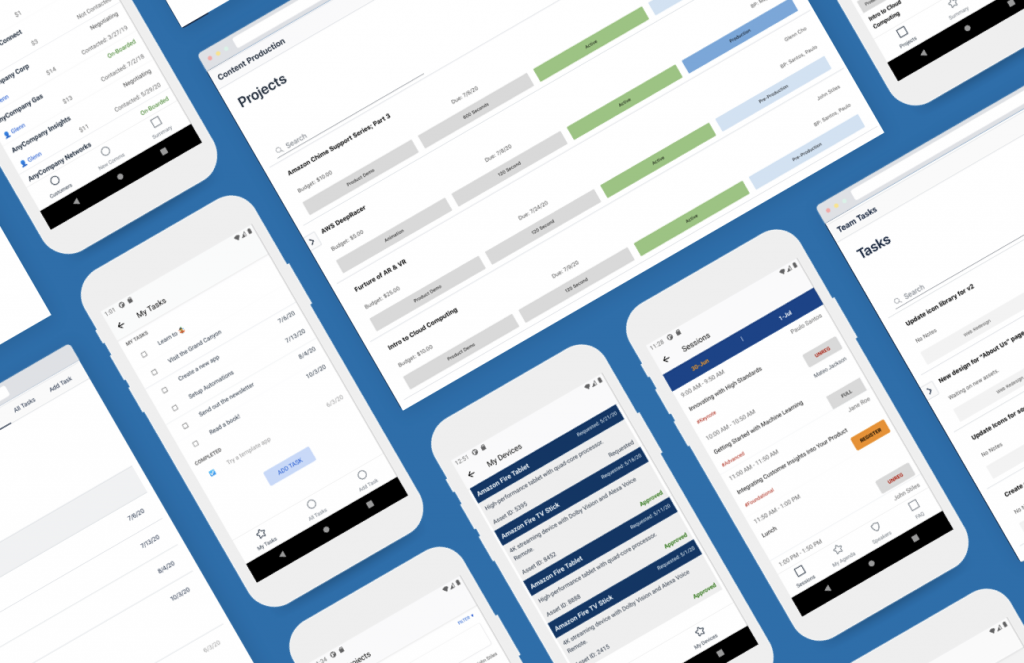
Honeycode
Image Souce: techcrunch.com

Amazon Honeycode over spreadsheets

The company also mentioned that it is better to build applications on your own than using spreadsheets and emailing them back and forth. It is because emailing documents or spreadsheets consumes a lot of extra time and accumulation of inefficiency takes place. Moreover, it also gives rise to data syncing and other forms of error slowing down the entire workflow.

This is the main reason customers would want service so that they can create applications on their own. They just need to get used to the user interface and don’t need to worry much about the AWS database or the infrastructural backbone. This way they can also stop hiring expensive developers to build the applications.

How Amazon Honeycode works?

Every user who wants to develop their applications is used to the way how spreadsheets work. This is the most important reason why Amazon Honeycode is also using spreadsheets as a part of its data interface. They can use the spreadsheet-style formulas to build the application and at the same time not worry about the AWS backend database.

The main reason AWS launched Amazon Honeycode service to keep things easier and simpler for the users or the “builders”. And, to maintain the smooth working of the service AWS is not allowing users to add any external data sources as it can complicate matters. But, the company’s plan for Honeycode is still uncertain. So, maybe if everything goes well, it might change the decision and allow outside data sources afterward.

Currently, Amazon Honeycode is only available in the US West region in Oregon. But eventually, AWS will expand its Honeycode services to other regions as well. You can create your application and it is free for twenty users, and then you have to pay for users as the application becomes larger.

The motivation behind building Amazon Honeycode

In an interview, Larry Augustin, AWS VP, and Meera Vaidyanathan, General Manager at AWS elaborately discussed the reason behind building Amazon Honeycode. They said that the services and products of AWS mainly concerned the developers around the world. But, this time they are shifting the audience base and focusing on non-coders. AWS is expanding its services and extending its helping hand to solve the shortcoming of non-coders as well. They said that they often received feedback from customers that they want the IT teams to better solve a problem by creating applications. But they lacked the number of developers needed to reach every customer and solve their problem. Hence, AWS came up with Amazon Honeycode to help build applications easily that concerns the basic line of business.

The no-code strategy of Amazon Honeycode will attract a lot of new users around the world. AWS is mainly targeting audiences like project managers, data analysts, etc who can easily create an application on their own and solve some of their problems. On top of that, the spreadsheet-like interface is the most common one so the users won’t face problems getting used to it.

Mercedes benz

NVIDIA and Mercedes-Benz to Team Up to Create New Platform for Vehicles

There’s some good news coming for auto enthusiasts and gaming enthusiasts alike. Reports have been coming out stating that Mercedes-Benz is planning on working with gaming legend Nvidia to create a state-of-the-art computing platform. This next-generation interface will help vehicles support everything from regular software updates to automated driving.  Here’s a look at what could be the next big revolution in the auto industry.

benz

New Age for Driving

The German auto industry staple recently said that it plans to release vehicles supporting this platform in 2024. It believes that by 2024, all Benz vehicles will support and have this technology, creating a new dawn for the way we drive cars. The new system will work via Nvidia’s Orin technology, which works as a system-on-a-chip device. Furthermore, the San Jose-based tech company will also use its full Drive AGX stack to develop this platform. 

The Orin first came out in December of 2019 and featured top-of-the-line specifications in all respects. It also has the power and capacity to deliver a performance that exceeds 200 trillion functions every second. Furthermore, the chip does all this, while utilising less power or battery than any technology before it, making it incredibly efficient. The chip will help develop a new system software stack that enables drivers to do everything from assisted driving and Autopilot to efficient parking, such as using Tesla’s Smart Summon function.

Benz Takes The Tesla Route

The new software system will also help users enable over-the-air updates for the vehicle software system, much like what we see in smartphones nowadays. Benz has been in the back foot for a while, trying to play catch-up to a more tech-savvy Tesla. However, with this new project, the legendary automaker wants to come out as the new tech-enabled car manufacturer. Tesla has always been superior when it comes to releasing and shipping OTA updates for their fleet of cars. This has helped them stay on top of their game, with regular updates such as Autopilot and new sensor technology. Just like how Apple and Samsung come out with new updates that help repair and rejuvenate their smartphones, Tesla has been revamping its electric vehicles through their updates.

Other Features Of The System

The new Drive System from Nvidia allows the software to track a driver’s motion, blinking, head movements, eye position, and so on. This information can then be used to calculate whether the driver is too drowsy, tired, or incapable of driving with efficiency. Once the system does this analysis, it functions as per the preferences set by the manufacturer. The system can take over and assist the driver with controlling the vehicle, or even alert the driver using warnings built into the vehicle. These visual and audio warnings will help the driver focus on the road again, and snap out of their drowsy state. Furthermore, this system can also monitor the driver’s external surroundings and environment, helping to keep the driver aware of everything happening around them. For instance, if a driver forgets to look at a cyclist approaching from behind and attempts to open the door, the system sends out a warning. As per the preferences set, it can also physically stop the door from opening, helping prevent hassles and accidents.

Major Companies Join In

Benz isn’t the only other automaker to take the plunge and start promoting an OTA system. Soon after Tesla came out with their system, GM followed suit and introduced their own OTA system. Recently, Ford too, has been coming out with their software updates, which help improve their 2020 models. The newest automaker to join in seems to be Daimler, who is set to start rolling out their own software updates and upgrades. Ola Källenius, who serves as Daimler’s CEO, stated that new upgrades would come into their cloud. Users will have the option to download such updates to improve their driving experience. The news that came out yesterday followed another critical update stating that BMW and Daimler were concluding their partnership. The legendary German automakers had announced a plan in 2019, to spend over $1 billion to improve their vehicle’s technological aspect.

The deal with BMW apparently fell through because Daimler wanted to upgrade their Mercedes vehicles quickly. The partnership with Nvidia serves as a much faster solution for the German automaker. However, we will have to see how the system designed by Nvidia turns out. When most companies are taking a probabilistic AI approach, Nvidia is focusing on neural network-enabled software. Whatever happens with the full stack system, it is quite clear that this partnership ushers in a new and exciting age for the auto industry.

IOS

With the onset of WWDC 20 Apple unveils iOS 14

Yesterday, on WWDC 2020, Apple revealed all-new iOS 14 and its top features. The users around the world will witness the biggest changes and updates to the Home Screen ever. Apple decided to modify a major portion of the display including new messaging styles, using Apple clips, redesigning widgets, etc.

The variation of widgets and customizing it accordingly is one of the best features of iOS 14. Users can go to the “widget gallery” and easily customize widgets from there. Moreover, the users can also create Smart Stack which uses AI to pop up the right widget around the clock.

The number of changes and new features that Apple has incorporated in iOS 14 seems unending. Craig Federighi, Senior VP of software engineering, Apple said that this is the biggest ever update they have ever made to a Home Screen. From automatically organizing apps with the App Library to a new experience with Siri, let’s have a better look at the iOS features.

Save time with App Clips

App Clips is a small but new feature that Apple is launching for the first time. The main function or purpose of the App Clip is to get the user access to a part of an app without installing it. Apple is designing an all-new App Clip code for this purpose that can use both visual code and NFC to get access to these App Clips. For example, if you are buying a coffee, sign in with your Apple account, get access to the app clip, pay, and enjoy.

The New Translate App

Apple is also adding its own translate app in the new iOS 14. This in-built app will work similarly to Google Translate. But, for the time being, it can only receive and process texts or audio to 11 languages. The languages include English, French, Spanish, Italian, Japanese, Korean, Arabic, Portuguese, Russian, German, and Mandarin Chinese.

Also Read: Larry Page and Sergey Brin: The Intellectual Friendship Behind Google

More engaged messaging

Become chattier with the new features of messaging. We all love chatting, don’t we? Especially with the global pandemic creating havoc in our social life, we have become more active participants of social media. Apple has taken care of it pretty well and introduced new Memojis to spice up chatting with friends and family. These new Memojis are very diverse with a lot of hairstyle options, face coverings, etc. Not only Apple has introduced this feature but also you can pin important conversations at the top of your message list. So, this saves a lot of your time by quickly getting access to important contacts.

iOS 14
Image Source: Apple.com

Better Map Guides

Apple is getting new features for Map and guides from companies like Zagat and AllTrails. This will take user experience to a whole new level. The new features of Map include proper cycling direction and guide which will take into account the amount of elevation, busy streets, etc. For electric vehicles, Map will show routes that have charging stops based on charger types. The Map will also show if there are any stairs on the route or not and will help the user choose the best option. For the time being, the cycling guide will only launch at NYC, San Francisco’s Bay Area, LA, Shanghai, and Beijing.

The new iOS 14 with the modified and curated Map guide is an information hotspot for any traveler or someone new to the city. This guide will help users explore new restaurants, top tourist places, cafes, etc. Brands like Complex, The Infatuation, Time Out Group, etc will provide guide recommendations to explore new places.

Other features

Apart from all these major upgrades, Apple has also made its security stronger. User permission will be now required for every app before it turns on the track. Apart from this, the user can now share his or her approximate location with the app developers rather than the precise location. This will make users feel safer and assure privacy at the same time.

Siri can now send audio messages and help find answers from the internet as well. The Home app has also been modified to make controls easier and quicker. Since the app has access to the information about a user’s home, everything is end-to-end encrypted in the Home app and HomeKit.

Also Read: Amit Agarwal- Journey to start Labnol of first-ever professional Technical blogger of India

spyware

Governments Using Spyware Technology to Snoop On People and Hack Their Phones

Most of us have data and vital information stored online. Most of us are of the opinion that such cloud storage spaces and our phones are only ours, and hence, safe. However, around the world, we are now seeing a rise in cybercrimes. As the years roll, the number of people who find themselves under the threat of a cyberattack, spyware, or malware attack is on the rise. It isn’t just individuals who fall prey to such attacks, but countries as a whole. Several reports filed last year talking about how governments use spyware software to track their people’s movements and actions. Here’s an in-depth look at the use of spyware technology by various governmental bodies.

Whatsapp Files Suit

In October of last year, the world’s most popular messaging app Whatsapp filed a case against an Israeli tech company by the name NSO. This little known company was thought to be the one behind a well-planned and executed cyber-attacks on over 1,400 Whatsapp users. Most of the people who were attacked were human rights activists, diplomats, and journalists. 

Stephanie Kirchgaessner, who at The Guardian investigated this piece worked with Citizen Lab, a spyware tracking company in Canada. After her studies, she concluded that NSO had helped the UAE, Morocco, Mexico, Bahrain, Kazakhstan, and even Saudi Arabia. The company, however, vehemently opposed the lawsuit stating that Whatsapp was drawing false parallels. NSO argued that it licensed Pegasus, their state-of-the-art spyware only to law-enforcement agencies and government bodies. 

Spying: An International Game

The lawsuit began a new fight against unlawful and uncalled for surveillance by the State on its people. It tried to hold the global surveillance industry accountable for its actions, which are left entirely unregulated. There have been several cases before against the Israeli NSO by people who have fallen prey to their cyberattacks. However, Whatsapp was the first tech company to take the spyware firm to court. 

How Spyware Infiltrates 

The lawsuit states that NSO helps government agencies spy on residents through simple Whatsapp video calls. The scariest thing about this spyware software being that it does not require the person to attend the call to infiltrate their phone. The extremely sophisticated malware began spying even if the target missed the call, making them very dangerous. The software could intercept all forms of communication, access, and share photographs, and activate cameras and microphones without the target knowing. Furthermore, it also had the power to track locations and access different forms of data.

Who Are Their Targets

The Whatsapp lawsuit includes targets from over 20 different countries. The spyware singles out and targets religious figures, lawyers, activists, diplomats, politicians, and journalists. Also, NSO’s Pegasus could have been the software used to spy on writer Jamal Khashoggi who was killed by Saudi Arabia’s security services. His friend, Omar Abdulaziz, filed a lawsuit against the company for infecting his phone for the Saudis.

While activists have claimed that surveillance technology is taking over our lives over the years, they have had little success in implicating such firms. Also, no one has been able to come up with remedies or solutions for this problem, as such agencies keep intruding on our lives. The lawsuit filed in a District Court in California will be the first of many lawsuits against such agencies that hack our phones and enter our lives. Though NSO rejected the claims by stating their technology helps government agencies fight terrorism and violence, they will still need to prove their innocence in court. The company also claimed that using their software for any other purpose was a violation of the product contract.

Whatsapp received help from Canada’s Citizen Lab, which works out of the University of Toronto. This agency helps with tracking and identifying spyware technology users around the world. John Scott-Railton, who works as a senior researcher at the Citizen Lab, stated that such a lawsuit is unprecedented. Regarded as a milestone in the field of privacy and digital protection, this lawsuit may help other agencies to come forward with their findings. Such lawsuits will also prompt governments to enact stricter laws regarding data privacy. As we move into the future, it will be imperative that our data also enjoys the same security that our houses and other belongings do. Over time, we may witness more such allegations coming out into the public, helping countries frame their own data privacy policies. Until then, all of us will have to be careful, and try to prevent such snooping from happening to us.

Rocket

Pushing the barriers Rocket Lab plans for its first lunar mission next year

With SpaceX making efforts for better and easier human spaceflight, more and more privately-funded space companies are dreaming bigger. Yesterday, Rocket Lab declared its first mission to the moon in collaboration with NASA. If everything goes well, the launch will take place in 2021.

Rocket Lab is a company most famous for launching small satellites that orbit the Earth. The company believes that the invention of the satellite has changed the perspective of humankind. Today, communication has become much easier, safer, and reliable with the help of these satellites. From weather forecasts to military purposes, satellites have a wide range of applications.

Big Plans

Peter Beck founded Rocket Lab in 2006 and 2009 it became the first private company in the southern hemisphere to reach space. The company has always been passionate about exploring deeper into space. They keep pushing themselves to the edge and every time hits a bigger goal.

Rocket Lab’s next big plan is to land on a unique lunar orbit in collaboration with NASA. This mission of Rocket Lab in 2021 will become a historic event in space history as it aims to land the first woman on the moon by 2024. By now, the company has launched 53 spacecraft in total which mainly targets the lower Earth orbit.

But, the Mission To The Moon will be something exceptional for the company. In this mission, Rocket Lab will use its Electron rocket and Photon Lunar Spacecraft to launch the CAPSTONE CubeSat of NASA. CAPSTONE stands for Cislunar Autonomous Positioning System Technology Operations and Navigation Experiment.

Aim of the Mission

The company has been eyeing to land on one of the unique lunar orbits for years. The contract with NASA and the spacecraft CAPSTONE will surely reach new heights. The primary goal of the mission is to examine and verify the stability of a near rectilinear halo orbit around the moon. This is the same orbit that is planned for the Lunar Gateway.

Apart from this, the CAPSTONE concerns about testing a navigation system which will measure its relative position to NASA’s Lunar Reconnaissance Orbiter. This navigation system will not rely on the ground stations.

More about the CAPSTONE mission

The combination of the Photon spacecraft and the Electron rocket acts as a satellite that is used to transfer various payloads into space. Rocket Lab’s Photon spacecraft has been used for a few years now. Though the company was using it as a customized satellite for orbiting the lower Earth orbits, it is time to test it for advanced missions.

The Photon spacecraft has undergone some major modifications for the CAPSTONE mission. The size of the propellant tanks has been increased to several folds and a new engine called HyperCurie has been installed. This engine will provide more thrust than the existing Curie engine. Apart from these, the installation of solar panels will take place and some changes to the Photon.

Rocket
Image Source: Rocket Lab

The CAPSTONE is planned to launch from Rocket Lab Launch Complex 2, Mid-Atlantic Regional Spaceport. It is located on Wallops Island, Virginia, USA. The mass of the satellite is 25kg and it will pass 1600km closest to 70000km furthest from the lunar surface. Currently, the team is engaged in building the Electron rocket for the mission. Since the mission is targeting a special lunar orbit; several launches might target the same orbit in the future with better planning.

Beyond the lunar orbit

The Mission To The Moon will be the first step of Rocket Lab for its journey towards deeper space. Once they successfully land of Moon, it will unleash its potential to explore Mars and Venus as well. Rocket Lab mentions that they are waiting to make this mission successful so that they can proceed with other plans to explore the space.

The company also says that these small space probes play a big part in these interplanetary missions. And, they are also looking forward to sending such small spacecraft into deeper space. This is just the first step, and once they proceed to the next mission, many new ideas and strategies will come up. It’s a dream for Rocket Lab to make the journey to space easier.

Audi

Audi Established New Office In Silicon Valley For the Development of Driver Assistance Systems

One of the most significant talking points in transportation for a while now has been driverless cars. However, most of the innovation has been led by fringe groups and research-based companies. There haven’t been a lot of auto-industry giants who have ventured into this field. All of that is about to change as Audi takes a dip into the area of driver assistance. Reports state that the auto-giant is setting up a new office in the heart of innovation, Silicon Valley, to aid with the development of driver assistance systems. Here’s a look at what impact the move will have on the industry, and why it is crucial.

New Office

The company has made it known that it will set up a new office called Audi Automated Driving Development Research & Development Block in San Jose. The facility will have around 60 employees, initially, and then expand again in the future. The A2D2 Block will be flexible and agile and will work towards developing new software by collaborating with startups nearby. It will focus on building production-intent applications that will help with creating smart-systems in cars.

Levels of Automation

This new research-intended office will focus on developing and advancing Level 2 systems. As per the Society of Automobile Engineers’ guidelines, Level 2 Systems are those in which at least two primary functions are automated. However, such systems still require a human driver to be present at all times to work efficiently. As per SAE standards, there are five levels of automation. At Level 4, the systems should handle all the duties, responsibilities, and functions that come with driving a car under specific conditions. At this point, it should be able to drive itself without human intervention. Stage 5 is often seen as a distant goal that the entire community is working towards and still requires a lot of research. In this last sage, cars will be able to handle all sorts of driving conditions and environments without the need of a human driver. Companies such as Aurora, Argo AI, Waymo, and Cruise are all working towards achieving Level 4 systems.

Audi’s Decision

Interestingly, Audi is focusing on creating and developing Level 2 systems, as this sets it apart from the others. In the past, the auto-giant had plans to come out with a Level 3 system, named the Traffic Jam Pilot. This application should have come out with the newest A8, that initially came out in 2017. However, the company ran into several production delays, and in May, finally decided to scrap the project. Therefore, it did not update the newest-version of the A8 with a Level 3 system. In theory, the Traffic Jam Pilot would have been able to operate on its own. While it has a human inside it, the Car would not require the driver to have his or her eyes on the road at all times. Such a system has never been practically tested on a large scale or commercially deployed.

Issues Faced By The Company

Audi had issued statements earlier this year to clarify why they were scrapping plans fr their automated system. One of the biggest concerns that they had was the large number of legal issues that could arise from their system. The legal framework regarding driverless cars is very tricky, and hence the company could have run into liability claims and other issues. Furthermore, their A8 was running through its life cycle. Therefore, the company was already pouring money into development to install and create new features. 

Hopes for America

However, the company has now turned its attention towards advancing driver assistance systems through Level 2 Systems. Audi stated that their A2D2 office would be the first to work solely on developing ADAS software and hardware for North American conditions. As North America is working hard on the advancement of such technologies, the company thought it best to set up shop here and be a part of the breakthroughs. They also get to work with leading technology startups focusing in this field and therefore attract the best talent.

This new office will help develop sensors and other systems that can improve the overall driving experience and safety. The office has also fixed sensors on the Audi Q7’s roof to collect data for their ADAS software. The system plans to drop by around 2023 to help make their cars safer and more efficient. All of their test vehicles are wrapped in QR codes, which lead to a page on automated driver assistance technologies. Furthermore, they are teaming up with a Volkswagen Group outfit named Car. Software, to build ADAS software. It will be interesting to see how far this partnership takes the future of automated driver systems.