Your Tech Story

News

Google One

Google One VPN Service Now Available on Windows and Mac

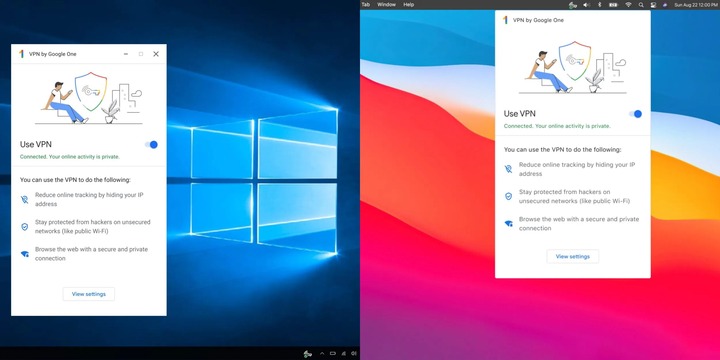
Google One subscribers who are utilizing the Premium Plan or higher, are granted access to the firm’s own VPN service without any cost.  Up until recently, the service was only available on Android and iOS devices, but Google is now making it available to desktop users as well. This means that if a user purchases a 2TB or higher plan, then VPN by Google One will be added automatically and without any additional charge.

Image Source: 9to5google.com

Google One VPN support has been brought for Mac and Windows devices and it was confirmed by the company. It is now available in 22 countries around the world, enabling the users to mask their IP addresses and restrict trackers.

“We remain committed to a high degree of transparency and verifiability of our privacy and security guarantees. We have recently completed an extension of this audit to cover the desktop implementations for Windows and macOS,” the company was quoted as saying.

Source: business-standard.com

The desktop version necessitates a minimum of macOS Big Sur or Windows 10. The Mac app supports both x86 and ARM users, whereas the Windows app does not support 32-bit or ARM-based systems.

It’s worth noting that, unlike most of the premium VPN services on the market, Google One’s VPN does not permit users to modify their location in order to access or unlock media content from other regions on streaming platforms. The Google One VPN, like Apple’s iCloud Plus VPN, automatically assigns an IP address within the area from which the user connects.

Google’s VPN service is also audited by third-party organizations. To ensure transparency, the firm also showcases the source code for its app libraries. The search engine behemoth has revealed that the desktop app audit will be publicly disclosed in the upcoming week time.

Google began offering their VPN service for free to Google One subscriber having a 2TB plan in the United States in 2020, but the firm has since decided to expand this free offering to 22 marketplaces, including Mexico, Canada, the United Kingdom, France, Germany, Spain, and Italy, among others.

tesla

Tesla Electric Vehicles To Soon Bring Zoom Video Conferencing Feature

On Tuesday, Zoom revealed a partnership with the world’s largest manufacturer of electric vehicles, Tesla, to enable video conferencing in cars. The news was revealed during Zoom’s yearly Zoomtopia conference, where the company routinely reveals upcoming features to assist remote calls.

tesla
Image Source: latestly.com

Zoom is collaborating with the Elon Musk-run Tesla to integrate video conferencing features into electric automobiles. Natasha Walia, group product manager for Zoom, made the revelation at the Zoomtopia 2022 Event on Tuesday and showed a quick video of it in action in a Tesla Model Y.

Zoomtopia is a conference where Zoom routinely reveals upcoming features to assist remote calls. The Zoom application is likely to utilize Tesla’s in-cabin camera, which is placed above the rear-view mirror. The camera would be as a live feed in the Zoom app and the driver can also what the camera is monitoring.

Nitasha Walia, group product manager at Zoom noted at the event, “You’ve been zooming from your home, your office, your phone and even your TV. We’re going to make it even easier for you to zoom from anywhere.”

Although the feature has earlier sparked worries over driver privacy, the cabin camera’s primary purpose is to monitor driver alertness while Autopilot is activated and allows the vehicle to offer aural alerts or warnings. Additional questions about the access privileges given to third-party apps may be raised if Zoom uses the in-car camera.

There is no set timeframe for the arrival of Zoom integration, but it will come to “all new Tesla models soon.” Other information, such as whether Zoom will only function on WiFi or whether Tesla customers who right now pay for the Premium Connectivity add-on will be allowed to make calls using the car’s data plan, is still unknown.

As per Verge, Zoom calls will probably be disabled unless the car is parked because the feature’s demonstration video doesn’t show the vehicle moving during a call.

Tesla has been considering the feature itself for years. Zoom calls in Tesla automobiles are “definitely a future feature,” Elon Musk stated in a tweet in May 2020. Drivers claimed it would provide them another private capacity to take calls and take advantage of the available in-camera, present in certain Teslas, and large display, In the initial days of the Covid-19 outbreak, Musk received a plethora of tweets asking for Zoom integration.

At the event, Zoom also unveiled several new features. Users can now access their calendars and emails without leaving the Zoom platform with the help of Calendar Clients and Zoom Mail. Prominent calendar and e-mail services will be directly integrated into Zoom, allowing users to access their conversations and appointments more quickly and collaborate more effectively.

The company stated that only users in Canada and USA would have access to the beta versions of the Calendar Clients and Zoom Mail. Zoom Spots, a persistent video-enabled place incorporated within the Zoom service, will launch in early 2023 to promote inclusive conversations and keep coworkers engaged.

When it launches in early 2023, Zoom Virtual Agent will be able to be used both as an independent chatbot and as a fully integrated part of Zoom Contact Center.

The Zoom news arrives as traditional automakers like General Motors, Ford, and Volkswagen, together with Tesla, confront increasing competition in the market for electric vehicles. Investors are worried that Musk’s acquisition of Twitter may cause him to become too preoccupied to properly solve Tesla’s issues.

Zoom and Musk’s businesses haven’t always had a cordial working relationship. For instance, in April 2020, SpaceX forbade its staff from using Zoom due to serious security and privacy concerns.

Signal

Signal launches Stories feature to compete with Instagram

A new Stories feature is now available to all Android and iOS users on the end-to-end encrypted messaging platform Signal.

signal
Image Source: financialexpress.com

Users will soon be able to share stories on Signal with their friends via a new feature being rolled out by the privacy-focused messaging platform.  Stories created on Signal will be immediately erased after 24 hours, much like Snapchat and Instagram, with users given the option to remove them earlier if they like.

Singal noted, “Today, stories have created a major shift in communication in the social media domain, and introducing such cool features is another dynamic to amplify content engagement in a hassle-free mode. There has been conjecture on maintaining privacy, and with the new feature introduced at Signal, it enables the user to have intimate conversations with the people who matter.”

Users have the choice to manually hide their Stories from particular individuals. One can make a custom Story if a user wishes to choose to share Stories with a more selective group of users. Users also have the choice to share Stories with already-existing group chats.

The app provides a feature that enables users to share stories with all the contacts on the app, even those with whom a user has had a one-on-one chat but whose numbers are not in the contact list. This is useful for individuals who wish to reach a bigger audience. The messaging app has also enabled users to share stories with a small group of people and track who has viewed them.

Anyone in the group can view and respond to a story that is shared in a group chat. Additionally, users can see if someone outside the group has viewed their story. Similar to read receipts for chats, users can turn off the seen receipts for their stories from the Settings menu. Users may also opt-out of the Story feature by turning them off in the Stories settings. 

The company will eventually make the feature available on desktops as well. The most recent Signal (v6.0) releases for iOS and Android include the new Stories features.

Signal’s dedication to end-to-end encryption is further demonstrated by the platform’s claim that the feature uses the same security measures to protect users’ privacy. The company stated, “Like everything we build in Signal, stories are end-to-end encrypted. The only people who will be able to see your stories are the people you’ve selected–not Signal, not anyone else.”

Although the launch of Stories may appear to be a “big shift” for the platform, the company claims that it is only an additional way for users to privately engage with others. When it pertains to Stories, which originally gained popularity through Snapchat, Signal is a touch behind the trend.

Nearly all well-known platforms, like Instagram, Facebook, TikTok, WhatsApp, Twitter, and LinkedIn, have incorporated the ephemeral function over time. Twitter discontinued its story feature called “Fleets” after admitting that its users never found the feature appealing.

Signal is a cross-platform centralized encrypted instant messenger service. It was developed by a non-profit organization called Signal Foundation and Signal Messenger LLC. The platform allows users to send individual and group messages including voice notes, files, and pictures.

The app can also be used to make individual and group audio/video calls. Standard cellular phone numbers are used by Signal as IDs, and end-to-end encryption is used to protect all communications with other Signal users. The client software has tools that allow users to independently confirm the legitimacy of the data channel and the identities of their connections.

Software Defined Vehicle

Google, Renault Group to build ‘software-defined vehicle’ for the future

Google has made breakthroughs in the automotive industry in the span of the last few years with Android Auto, which mimics the smartphone’s features for in-car news and entertainment, and Android Automotive which is an operating system particularly designed for cars that include Play Store support and a built-in Google Assistant. On Tuesday, Google and Renault Group revealed the expansion of their collaboration to produce the digital layout for the future ‘Software Defined Vehicle (SDV).

Software Defined Vehicle
Image Source: dtnext.in

The ‘Software Defined Vehicle’ will enable the car to receive new on-demand services and continuous upgrades, utilising the present Android Automotive Operating System with the Google Cloud technology participation.

“Our collaboration with Renault Group has advanced comfort, safety, and connectivity on the road. The announcement will help accelerate Renault Group’s digital transformation by bringing together our expertise in the cloud, AI, and Android to provide a secure, highly-personalized experience that meets customers’ evolving expectations,” said Sundar Pichai, CEO of Google and Alphabet.

Source: pgurus.com

Renault Group will broaden its utilization of Google Cloud technology for this SDV to effectively manage data capture and analytics, along with software development for the vehicle, securely and confidentially.

The companies will establish a set of SDV-specific onboard and offboard software components, as well as expand synergies and use cases that are in relation to the group’s “Move to Cloud” strategy.

The partnership on cloud computing, which began in 2018, is gaining momentum with the development of a Digital Twin, a virtual twin of the machine with the most advanced AI capabilities.

“Equipped with a shared IT platform, continuous over-the-air updates, and streamlined access to car data, the SDV approach developed in partnership with Google will transform our vehicles to help serve future customers’ needs,” said Luca de Meo, Renault Group CEO.“Our strategic partnership with Google will allow us to accelerate our end-to-end digital transformation, from the design of the car to its market launch through its production, and ultimately to bring added value to our customers, he added.

Source: pgurus.com
stolen bitcoin

US seizes over 50K Bitcoin worth $3.3 bn stored in a popcorn tin

The US Justice Department revealed Monday that it seized approximately 3.36 billion USD in stolen Bitcoin throughout an impromptu 2021 raid on James Zhong’s residence.

stolen bitcoin
Image Source: kalingatv.com

Zhong pled guilty to one count of wire fraud on Friday and it carries a maximum prison sentence of 20 years.

According to the DOJ, on Nov. 9, 2021, US authorities seized approximately 50,676 Bitcoin, which was then valued at more than 3.36 billion USD, from Zhong throughout a search of his residence in Gainesville, Georgia. 

It is the DOJ’s second-largest financial seizure to date, following its February unveiling of 3.6 billion USD in illegally obtained cryptocurrency connected to the 2016 hack of the crypto exchange Bitfinex.

Authorities claim Zhong robbed Bitcoin out of the illegal Silk Road marketplace, a dark web forum where drugs and other illegal goods were bought and sold with cryptocurrency. Silk Road was established in 2011, but it was shut down by the FBI (the Federal Bureau of Investigation) in 2013. Ross William Ulbricht, its founder, is currently serving his life sentence in a jail cell.

“For almost ten years, the whereabouts of this massive chunk of missing Bitcoin had ballooned into an over $3.3 billion mystery,” U.S. Attorney Damian Williams stated a press release.

Source: cnbc.com

As reported by the Southern District, New York, Zhong used vulnerabilities in the marketplace to carry out the hack.

Internal Revenue Service Criminal Investigation Special Agent in charge, Tyler Hatcher stated that Zhong used a sophisticated scheme to seize the stolen Bitcoin from Silk Road. Following the press release, Zhong generated nine fraudulent Silk Road accounts in September 2012, financing each with between 200 Bitcoin and 2,000 Bitcoin.

He then executed over 140 transactions in quick succession, fooling the marketplace’s withdrawal-processing system into releasing roughly 50,000 Bitcoin into his accounts. Zhong then deposited the Bitcoin to several wallet addresses that he controlled.

Law enforcement and blockchain analytic experts were able to recover more than 50,000 stolen Bitcoin from Zhong through blockchain assessment and good old-fashioned police work. Based on the press release, they even discovered crypto stored on a computer buried beneath blankets found in a popcorn tin placed in a bathroom closet.

According to public records, Zhong was the CEO and president of a self-made firm, JZ Capital LLC, which he enrolled in Georgia in 2014. As per his LinkedIn profile, his job there was focused on investments and venture capital.

His profile also states that he was a large early Bitcoin investor with deep experience and knowledge of its inner workings and also, that he had experience in software development in various coding languages.

Pictures of Zhong on yachts, in front of aircraft, and at high-profile football matches can be found on his social media profiles.

However, such types of cheats did not stop with the demise of the Silk Road. Criminals continue to target cryptocurrency platforms.

Binance, the nation’s biggest crypto exchange calculated by trading volume, was hacked for $570 million in October 2022. According to the company, hackers were able to exploit a cross-chain bridge, BSC Token Hub, due to a bug in a smart contract. As a result, the cybercriminals withdrew BNB tokens, the platform’s native cryptocurrency.

A different hacker discovered vulnerabilities in the decentralised finance platform Ronin Network in March 2022 and stole more than 600 million USD and became the largest hack to date. Private keys were compromised which act as passwords to secure cryptocurrency funds in wallets.

According to a Chainalysis report, through July 2022, $1.9 billion in cryptocurrency had been stolen in service hacks, compared to just below 1.2 billion USD at the same point in 2021.

hate speech

After Elon Musk’s takeover, hate speech spiked on Twitter

According to a new study, there has been an increase in hate speech on Twitter ever since Elon Musk officially acquired the social media platform last week.

hate speech
Image Source: ktvq.com

A study done by Montclair State University found that after Elon Musk acquired Twitter on October 27, hate speech tweets swamped the social media platform.

According to CBS News, the study indicated that “vulgar and hostile” speech immediately increased after Musk took control of Twitter. Prior to Musk’s ownership, the social media platform never reported more than 84 tweets containing hateful terms in a single hour, according to the study.

The Montclair State University study monitored the frequency of homophobic, antisemitic, and racial hate-related phrases used shortly following Musk’s takeover. Research revealed that, compared to the 84 tweets per hour in the week preceding Musk’s takeover, 398 hate tweets were sent out every hour in the first 12 hours following the acquisition’s conclusion. During that time, the average number of hateful tweets increased from 1,000 to 4,778.

The research also claimed that over 67% of the tweets after Musk’s acquisition had a negative tone to them, indicating a rise in negative sentiment. It noted, “In sum, the content and tone of Twitter posts became measurably more oriented towards hate speech on the day Elon Musk became CEO of the company with significant reach attained for this hate content.”

According to Forbes, research by the Network Contagion Research Institute reported that during the first 12 hours of Musk’s ownership, use of the N-word soared by 500%. The number of tweets using derogatory language toward LGBTQ people as well as anti-Semitic and racial derogatory terms also soared.

Although the research makes it clear that the Musk takeover resulted in an instant rise in hostile tone on the network, the precise cause of this is still unknown. Researchers said that it’s “speculative” to determine whether Musk’s possible changes in policy would have triggered the surge.

However, it’s possible that users turned to hostile language because they believed they would no more be suspended or barred from the network based on Musk’s previous statements on free speech. The Washington Post claims that his ownership appears to have led some accounts to believe that the previous rules against bigotry are no longer in effect.

As per Fortune, despite calling for greater speech freedom on Twitter, Musk told users in a Twitter post that he couldn’t allow the network to become a “free-for-all,” Another possibility, according to experts, is that having an “unmoderated platform was possibly a source of excitement.”

On October 27, billionaire tycoon Elon Musk, who also serves as the CEO of Tesla and SpaceX, assumed control of the social media network and pledged to relax its content regulations. In a statement last week, Musk stated that “free speech is the bedrock of a functioning democracy, and twitter is the digital town square where matters vital to the future of humanity are debated.”

The creation of a “content moderation council” to update and improve company standards under Musk was also announced by Twitter last week. Musk intends to create a moderation council with a range of viewpoints to oversee rules over content and accounts.