Your Tech Story

Founder

ahrefs

Bring in the Traffic : Success Story of Ahrefs

Today, the internet has become more accessible than ever. This has led to the formation of a whole new kind of marketing, i.e. digital marketing. Digital marketing has become an essential part of every business’s strategy and accounts for the highest conversion rates among the different types of marketing. Whether it be in the form of long blogs, short posts, drip email marketing or Social Media Marketing, having the right online presence makes a whole lot of difference in today’s world.

With so much content available for consumption online, businesses are finding it challenging to stay relevant. That is where SEO, the Search Engine Optimisation, plays an essential role, as it helps in raising your website’s visibility. Tools like Ahrefs allows you to leave your SEO woes behind, and in turn, raise your website’s visibility. Having grown their ARR by over 65% within just two years, it goes without saying that Ahrefs is one of the most preferred SEO tools in the industry.

About the Founders

Dmitry Gerasimenko is a Ukrainian by birth, having been born in Nizhyn, but now lives in Singapore to manage Ahrefs. Dmitry’s father handed him a computer when he was six, and ever since, he has been fascinated by computing ad programming. After school, he went on to pursue a degree in computing from the Kyiv Polytechnic University. He relocated to Singapore in 2012 to grow and expand Ahrefs, after having fallen in love with the place when he visited Singapore during one of his visits to Asia.

Ahrefs founder
Image Source: ain.ua

He began his career as a C# and PHP developer for a website design studio in Kyiv. Following this, he freelanced for an American company before turning entrepreneur. Dmitry’s love for the search engine’s started in school wherein he built a documentation search engine and even started making money selling books until he lost the project due to server issues. This love led to launch a web crawler almost ten years after graduating from University.

Founding Ahrefs

When starting Ahrefs, Dmitry had no partners, and hence bore all the risks alone. He invested his savings in the company and hired freelancers when he could afford to do so. The first $400,000 went into product development and was the amount he had saved while working as a freelancer. As the company grew, he went from handling simple projects to more advanced ones and built a team along the way.

In 2010, he recruited Igor Pikovets, who was a friend from university. A year later, the duo launched a link-index paid service. The tool started as a small fish in an ocean of other such tools, and slowly built their way up to becoming one of the most used SEO building tools available on the market now. That company grew into Ahrefs, which now has over 300 billion pages in the index, and updates over 8 billion every day, averaging at 100,000 every second.

Ahrefs acquired its first customers via ads on SEO forums and focused on building a quality product. One of the primary reasons that led to this exponential growth is that they provide a product that triumphs all comparison tests. The SEO growth market is one that is overcrowded with a lot of players; hence, standing out isn’t always an easy task. This is precisely where the company has been able to do so well because they provide a superior offering that consumers find to be the best in the market.

The company markets its product as its most important marketing tool and uses its existing customers as their company’s vocal advocates. When Ahrefs was just developing, Dmitry spent all his time, improving the quality of the application and accumulating data. That was what he focused on because he felt he could do that better than anyone else and that later became the company’s backbone. All that data which was built up, grew as the company grew, and soon, Ahrefs started gaining a reputation for having the best SEO related data.

The downside of this concentrated effort was that the tool’s design and usability weren’t that great because they weren’t areas Dmitry focused on. With the customers they had gained because of their extensive data, Dmitry built a team of web developers who over the years bettered the UI of the engine, and fixed user issues, making Ahrefs an all-in-one package.

A Resounding Success

As the business grew, Dmitry took in more employees. Hence, a team that had less than six members grew to become a close-knit family of over 30 employees. Ahrefs has always had stringent hiring policies, and they hired only when it was absolutely necessary. This is one of the main reasons why Ahrefs does with 30, what most companies do with over a hundred employees!

For instance, most employees at Ahrefs wear more hat than one, with the CMO also being in charge of the blog. Having let go of the freelance bloggers who handled the Ahrefs blog, Tim Soulo took over the blog and in doing so gained more control over the marketing strategy of the company.

Another interesting point is that Ahrefs does not have a dedicated HR team for hiring new recruits. Everything from looking for new employees to finalising the paperwork is done by the core team itself, with the person in the driver’s seat change according to the position being filled. As Dmitry has a background in programming, handles the technical hiring side and was the one who recruited Ahrefs’ present CTO, Igor.

Such a dedicated team of employees who are well-versed in their respective fields has helped the company achieve a YoY growth rate of over 65% and an 8-figure revenue. Ahrefs current has over $50M ARR and employs more than 45 people, with the team having kept 50 people limit for the company. They are still growing over 60% a year with predictions putting them at $64 million by November 2019 and $102 million by September 2020.

When Soulo joined Ahrefs, their blog attracted 15,000 visitors a month, and now over 250,000 go through their website every month. They have 8 to 10 employees handling marketing, and market-related research, around 7 taking care of customer support and the rest of the employees working on web development.

Ahrefs now has plans to create a search engine of its own. Dmitry has announced that the engine will work on principles similar to that used by DuckDuckGo. This means that it will not engage in the collection and sharing of personal user data. The fact that DuckDuckGo recently hit over 1 billion monthly searches goes to show that there is potential in this market, and Ahrefs is trying to be one of the first few to harness that potential. Ahrefs search engine strategy will also enable it to share profits with publishers, helping to foster more innovation.

duckduckgo

DuckDuckGo : A Search Engine Protecting the Searchers’ Privacy

After the internet has brought a mammoth size wave of revolution in this modern era, Google has become the most popular search engine since then. Many people also use Yahoo! but the popularity of Google among the population is unparallel. According to the statistics of 2017, only 46.8% of the world population had access to the internet and among this crowd raised 3.5 billion searches every day. It is pretty impressive, right? With the amount of response to the Google search engine, it ensures no competitors at least shortly. But, in 2008 a search engine called DuckDuckGo was launched by an MIT graduate, Gabriel Weinberg. In the past eleven years, the company has made impressive progress, and someday, it might give a toe-to-toe competition to the world’s most popular and dominating search engine.

Weinberg’s first step into his career life was with a different start-up and eventually, through thick, and then, his professional life started shining like a dazzling start in the entrepreneurial galaxy.

About Gabriel Weinberg

Weinberg went to Massachusetts Institute of Technology for both his bachelor’s and master’s degree. He acquired his bachelor’s degree in physics and graduated in 2001, followed by completing his post-graduation in 2005.

gabriel weinberg founder DuckDuckGo
Image Source: techspot.com

Apart from founding DuckDuckGo, Weinberg also served as a co-author at Traction for five years, and he is currently a co-author at Super Thinking. Weinberg is the present CEO of DuckDuckGo, but before founding this company, the journey wasn’t a bed of roses for him.

Facing the Failure

Right after acquiring his bachelor’s degree, Weinberg launched a company called Learnection. It was a software company that was built to enhance social networking and increase the interaction of parents with students and school as well. He invested all the money he raised from his family and friends and ended up nowhere. He realized that he made two major mistakes, one he hired his friends who weren’t suitable for the job and underpaid them, and second, that he worked day and night on a project that had zero market demand.

In the following years, he worked on another four to six start-ups, and among them, NamesDatabase was a success, and the main reason behind it was creating a demand for it even before launching the product. Weinberg later sold the company to classmates.com for $10million in 2006.

The Idea of DuckDuckGo

The most fascinating quality of Weinberg is that he did a lot of experimenting irrespective of the success of his products. One day, Weinberg found more than 10,000 searches a day for the pages, he created while trying things out. He completely forgot about these websites and noticed that though he wasn’t up to something solid, an audience has already been created.

He was intrigued by the number of searches per day, especially on something which had zero product development. So, Weinberg wanted to come up with something where he will dedicate most of his time to driving traffic and increasing users, and hence, searches and very little to the product development.

So, on 25th September 2008, Weinberg launched DuckDuckGo without any intentions to give competition to Google. He founded the platform only because he thought the users would like it better!

Success of DuckDuckGo

The company was founded in Valley Forge, Pennsylvania, and it was self-funded by Weinberg at the beginning. Since Weinberg didn’t create DuckDuckGo, thinking he would do business at least for some decades, but just as a modified version of Google search engine with features that would attract more users. The best part of the business didn’t arrive in the first couple of years, as he got involved more with his family and giving little time to his newly launched product.

But, Weinberg realized DuckDuckGo kicked off the ground quite hard, and it is having a vast potential to grow. He started focusing on the work, and at the end of 2011, the company raised $3 million from Union Square Ventures. The next year, the company recorded 1.5 million searches per day, and the number of visits per day escalated from 39,000 in 2010 to more or less 1,400,000 in 2012.

In 2014, Mozilla added this search engine to Firefox 33.1, and in July 2016, the company started a joint venture with Yahoo! Recently, Google has announced that DuckDuckGo has been added to its search engine in Chrome 73.

Strategies

Since Weinberg’s primary focus was on the interest of the people, and on how to attract more users, he made privacy modifications in DuckDuckGo. Unlike Google, DuckDuckGo avoids the feature of the filter bubble and doesn’t track the search history of the user. This is a very advantageous feature of DuckDuckGo that helped it drive the traffic because once the public feels secure success is bound to happen.

wix

Wix : Web Development Like Never Before

Wix.com Ltd, developed by the company Wix, which is based in Israel, is essentially a cloud-based network advancement and improvement platform. The platform enables customers to create their own mobile or HTML5 websites using just drag and drop tools. Users can use the platform to add plug-ins, facilitate e-commerce, perform online marketing, create contact forms, engage in email marketing and even create forums for their websites. The company has functioned on a freemium model, with significant revenue coming from premium subscriptions taken by people.

The company grew tremendously since its inception and now has offices around the world, including ones in Canada, Germany, India, Lithuania, the US, and even Ukraine.

About the Founders

Avishai Abrahami served in the Israeli Defense Forces in the computer intelligence unit from 1990 up to 1992. After his stint with the military, in 1993, Abrahami co-founded a software company called ALT Ltd and worked as its Chief Technology Officer until they sold it in1997. Later in 1998, he co-founded a company that dealt with data centre management software development, called Sphera Corporation, and served as the Chief Technology Officer for two years. He then shifted to the position of Vice President of Marketing for the next three years. He then left the company to work as the Vice President of Strategic Alliances between 2004 to 2006. Abrahami served as the CEO of Wix.com and since 2006 was a Board Chairman from 2013 to 2016. Following his break, he was designated the Honorary Chairman and currently serving as a Board Member of SodaStream International Ltd.

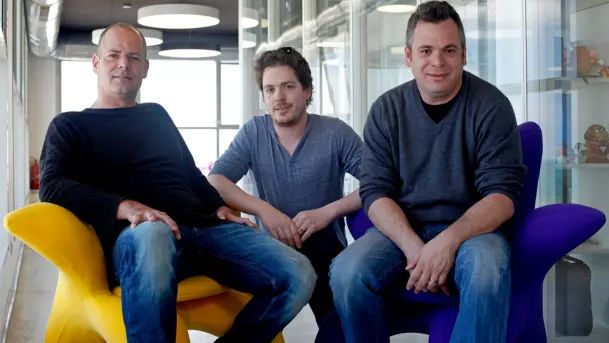
wix founders
Image Source: haaretz.com

Nadav Abrahami, who is Avishai’s brother, is the Vice President of R&D and is a programmer who had earlier worked at Oberon media.

Founding Wix

Avishai Abrahami, Nadav Abrahami, and Giora Kaplan founded Wix in 2006. Being Israelis themselves, they opened their first office in Tel Aviv with backing by venture capitalist investing firms such as Insight Venture Partners, Mangrove Capital Partners, Bessemer Venture Partners, and Benchmark Capital. Their first product was launched in 2007, via an open beta mode on Adobe Flash.

Due to the high functionality, ease of use and a large number of options made available, the product grew and gained momentum, and by 2010, the company had amassed 3.5 million users. Following this, Benchmark Capital and Bessemer Venture along with Mangrove Capital pushed for a Series C funding which brought in an extra $10 million. The money led to further developments in the software and by 2011, Wix had almost doubled in volume, with over 8.5 million active users. This, in turn, led to another round of funding, which was able to raise $40 million, making the total funds raised $61 million.

Wix: A Win-Win

By June of 2011, Wix had launched a Facebook module and hence entered the social media world. They followed suit in 2012 with a new HTML5 site builder and did away with their old Adobe Flash platform. Wix also launched an app market to sell applications in 2012 and introduced a software development kit that enables people to create web pages with ease. All these new developments helped push the company’s growth, and by 2013, they had over 34 million active and registered users. Once they hit this mark, they opened their IPO on NASDAQ and raised over $127 million. In 2014, Wix acquired an Israeli start-up which was focusing on mobile commerce applications called Appixia. They followed up this with the acquisition of an online restaurant delivery system OpenRest.

This merger paved the way for Wix Hotels, which was launched in August 2014, which was a booking system for hotels and rooms. This hotel booking software also became a part of the Wix Restaurants service which was launched later in 2016. To further their reach in the social media marketing sector, Wix acquired Moment.me in 2015, which was a website builder that doubled as a social media lead generator. The company further expanded its horizons by releasing Wix Music in 2015 to help independent musicians sell their work. By the time, Wix had acquired DeviantArt in 2017, for over $36 million, the company had multiple investments in multiple fields.

Wix is also renowned for its marketing strategies, having created several well-known SuperBowl advertisements, by teaming up with DreamWorks Animation several times. The advertisements were so popular that they attracted over 300 million viewers both through online platforms and social media.

Wix was valued at over $4.5 billion and was the first Israeli company to be valued above $4 billion. The company’s share value closed at a record of $95.8 in 2018, with an ROI of 480% having opened at $16.5 in 2013. Considered to be one of the largest cloud-based platforms in the world with millions of users across the world, Wix is a success story that highlights passion and determination. Abrahami is a true soldier who has weathered multiple storms to get to the position he is in now, and it is his skill, experience, and dedication that got Wix to where it is now. With 42 million users in over 190 countries in the world, it is safe to say that Wix is at a great place right now.

shopify

Shopify : The Ecommerce App Marketplace to Sell Online

There might be only a few people who haven’t yet heard of Shopify, but if you are one of them, then you might have missed out on a gem. A venture-capitalist backed company that grew exponentially to become a multi-million-dollar enterprise, Shopify is the success story that we all dream of.

Shopify brings together stores and includes everything from large MNCs to small hobby stores that belong to local retailers. It even counts little businesses that didn’t get the funding they required through Kickstarter and includes people left out by department stores and malls. With monthly subscription fees ranging between $14 to $179, Shopify provides all of them a chance to sell their goods and reach out to a maximum number of people. The tool grants them access to everything from design templates to analytic tools to monitor sales. The platform has become such a huge revolution that it recently crossed the $7 billion mark in total sales.

Shopify has over 120,000 customers across the world, and they all pay a monthly fee to use the e-commerce giant who has tie-ups with bigshots like eBay, General Electric, Gatorade, Wikipedia, CrossFit and Amazon. Read on to understand how Shopify grew from being another run-of-the-mill idea to an e-commerce stalwart which does sales worth more than $7 billion!

About the Founders

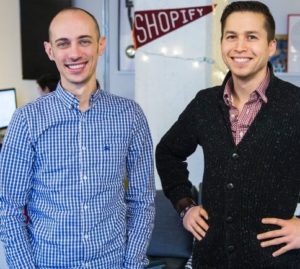
Shopify founders
Image Source: inc.com

Tobias Lütke exhibited an aversion to authority at an early age, and even while at school in Koblenz, Germany, he asked more questions back than answer the teachers. He always looked for shortcuts, putting in the least effort possible to pass, and spent most of his time on his computer. By the time he was 12, he was writing programs, fixing the machine itself and creating games for himself. It got to a stage where his parents were worried and took him in for psychoanalysis.

After Grade 10, Lütke chose to ignore studying at a university, and instead, joined an apprenticeship for computer programmers. He worked with Siemens during this period but found his work with Java to be repetitive and restrictive. He was also a passionate snowboarder, and on one of his trips, fell in love with a girl from Ottawa, prompting him to move to the city from where he would launch his company.

Meanwhile, Scott Lake was the polar opposite, being someone who looked like he would become a CEO. He had been a jock while at school and was an extrovert who was at ease around people. Lake was friends with Lutke’s girlfriend’s parents, and it was at their house that the two of them started talking. Being 12 years older than Lütke, was never a barrier, and soon enough the duo agreed to start a business. There were no large discussions, as the pair decided they would trade in snowboards and named their company Snowdevil.

Founding Shopify

Lütke enjoyed the idea, as, by 24, he was done with coding after having done it for the past 10 years. But looking at templates for their e-commerce website made him realise, they weren’t good enough, and he built their business website on his own. He wanted to use a Japanese programming language, called Ruby to build the framework and made use of Ruby on Rails, which was created by David Heinemeier Hansson.

Lütke used this framework to create Snowdevil’s software, and as Ruby on Rails was new, the website gained notice. As they were selling snowboards, Lütke and Lake both realised that their biggest product was the software itself! Hence, they coaxed 10 friends into investing in their company, named Jaded Pixel, and managed to raise about $200,000. Lake then named the software Lütke was building Shopify in 2006, setting the wheels in motion for an e-commerce revolution.

Soon they launched Shopify, added people, first of which was Daniel Weinand, who was a German programmer who was friends with Lütke. Shopify’s first office was a group of chairs around a table in a Bridgehead coffee shop, and in October, the same year, they made $8,000. In 2008, when Lake left the enterprise, the company had over 10 employees and was making over $60,000 a month.

Shopify: A Success

Soon angel investor John Phillips, who had founded Klister Credit Corp was interested in the company, valued it at $3 million and gave them $250,000. Until Lake left, Lütke had been in charge of product design and development and had never been involved with the finance side of things. When he became the CEO, he had to learn and learn quickly.

He flew to Silicon Valley, met with venture capitalists and read up on everything they told him, from conversion rates to marketing funnels. Slowly, yet surely, he picked on the finance, yet cash was hard to come by, and on several occasions, Shopify relied on Lutke’s girlfriend’s family to make ends meet.

Finally, in 2010, one of Silicon Valley’s most notable investment firms, Bessemer Venture Partners, found Shopify. Bessemer went on to purchase 20% stake in Shopify for $7 million, and in the next year, they raised $15 million. In 2013, OMERS Ventures and Insight Venture Partners invested $100 million in the company, and Shopify acquired Select Start Studios and Jet Cooper, hitting a valuation of $1 billion.

The Success

Shopify then grew exponentially, and now employs more than 500 people, with 400 of them being based in Ottawa, while the rest work from Toronto and Montreal. Most of the non-Ottawa based employees help with Research and Development and Customer support. The company is now regarded as Canada’s leading playing in the e-commerce and high-tech sector.

Since then, the company has grossed over $7 billion in sales and now has tie-ups with over 150,000 store owners. Shopify grew from a two-person storefront to a six-storey office building with clients from all over the world. During that process, Lutke grew from being an introverted coder to a remarkable leader, who led by example.

The New Office

Shopify’s new office in Ottawa is a huge structure, which took over 180,000 pounds of concrete to finish. Each of its floors has large staircases to connect each other, and every floor has its own theme, ranging from Urban Street to 1920’s Chicago! Intermixed with such a creative space that comes with a large slide, are traditional professional spaces comprises of meeting rooms and offices, with high-tech equipment, soundproofing and large-screen monitors. Much like Lutke itself, the building is some parts childish, and other parts professional, but all of it, much like the man himself, is genius!

The company is growing so fast that plans are already on for an expansion of its office. With market experts predicting Shopify to surpass $2 trillion in international sales, it goes without saying, that the company is gearing up for a bright and busy future!

toptal

Toptal : A No-office Startup for the Freelancer Community

In the recent wave of start-up fair around the world, many entrepreneurs have dedicated their work significantly to the start-up society. The condition of the freelancers have significantly improved in these past years, and there has been an increase in the number of freelancers worldwide. Moreover, the young generation does want to break the conventional pattern of a daily 9to5 job, but at the same time, a stable and continuous source of income is necessary, too. With all these freelancing platforms coming up, and along with that the increasing number of new start-ups that demand freelancers, are playing an ace for the rising community.

Toptal, a freelancing platform founded in 2010 by Taso Du Val and Breanden Beneschott, headquarters in Silicon Valley, California, US. The startup has brought a revolution for designers, developers, programmers and analysts, who were interested to work as freelancers.

Taso Du Val

Val had already been into different jobs and had enough experience before he co-founded Toptal. He worked as an architect in Fotolog for two years, followed by working for Slide and Art.sy as an advisor.

Toptal founders
Image Source: toptal.com

In the founding year of Toptal, Val was working on his start-up for coming up with a real-time chat engine something absolutely different from what he ended up developing. While working in this project, he needed a freelancer. But it was quite annoying to find a really dedicated freelancer with excellent skills. This was when he decided to bridge the gap between freelancers, the newborn start-ups and business firms that wanted to hire them.

Breanden Beneschott

Beneschott studied chemistry from Stanford University, and while he co-founded Toptal, he was a student in Chemical Engineering, Princeton University. Beneschott stepped into the professional world as an intern for Adam’s Group and then for Morgan Stanley. He also served as the CTO for Zandigo and director of technology for Snafue, LLC. He co-founded smsPREP in June 2007, and then, partnered with Val in 2010 to co-found Toptal.

Behind the scenes

After Val launched the company, he wasn’t really looking for a co-founder. But, he bumped into Beneschott, who was his old neighbour and had signed up in Toptal as a client. Val realized that it would be a nice deal for Toptal if they become partners as Beneschott was more of an expert, loved dealing with customers and strategies. So, Val decided to fly to Princeton as Beneschott was still a student when Val approached him. Both of them worked in a small dorm room in his university, and finally, came up with a bigger plan.

Strategies

When Val searched for a freelancer during the setup of his start-up, he really found it hard to find a skilled one. So, he wanted a thorough scrutiny process and selected only the top 3% per cent of the skilled freelancers to work on behalf of Toptal. After founding the company, he established a four-round process for selection of the candidates, though it was very time-consuming. He focused mainly on the quality as Toptal provides service to many reputed companies including Facebook, Twitter, Pinterest, etc.

The Success

Since Val and Beneschott lived miles apart from each other, they did not set up an office, but they were still pretty confident to cut through the noise and make it a reputed company. Since they scooped out the top 3% creamy layer amongst all the freelancers, they landed many big clients. They made $1million in revenue in the first year and worked with many talents across the globe, including Russia, Hungary and South America. Since Val was interested in working with the top-class potential stalwarts, he decided to fly to Hungary as the company spotted many excellent software developers from that area. So, in 2011 both of them fled to Budapest and started operating from there.

Initially, the company searched for software developers, business experts, programmers, but from 2015, it expanded and started hiring designers. In 2016, Toptal hired Skillbridge, a freelancer platform that offered services that marketing research, accountant, etc. related to business modelling. It eventually started adding more and more domains, and now, hires freelancers for more than 50+ sub-domains.

Funding Rounds

In the seed round, the company raised $1.4 million, Andreessen Horowitz, Quora and Adam D’Angelo, being the major investors. There was no further news of any other funding rounds since then, and the company has made impressive profits with time. In the year 2016, the company’s annual revenue turned out to be $100million.

dailymotion

The French Media Revolution : Success Story of Dailymotion

The Internet has drastically changed the way we communicate and share media. While, most media and documents were shared via email at first, due to lack of space and other such limitations, new platforms sprouted soon enough. Presently, we are all aware of the countless media platforms which are available on the World Wide Web, ranging from YouTube to Google Drive. But way back in the early 2000s, there weren’t so many options, and that is when Dailymotion came to the rescue, becoming one of the largest video-sharing platforms in the world.

Dailymotion is European video-sharing platform owned by the French media house Vivendi and has several partners such as BBC, Bloomberg and even VICE. Read on to see how two young French computer specialists changed the way we send and share videos, by turning Dailymotion from a small idea into an empire.

About the Founders

Benjamin Bejbaum was born in Paris, France on 20th November 1976 to doctor parents. He did his schooling from Gérard de Nerval High School, in Luzarches, from where he was suspended twice for being too lazy. Though most of the staff remember him as a lazy and laid-back student who preferred playing pinball to attending school, he managed to get good grades and passed his BA with Honours. He went on to attend the University in Villetaneuse, where he graduated in Mathematics and Information Sciences.

dailymotion founders
Image Source: millionnaires.net

He was an insomniac who found it difficult to sleep, and in 1994, he found an excellent way to pass the time, i.e. with the night- gaming. With the internet and computing still in its infancy, Benjamin fell in love with computing and started teaching himself how to code. He soon started making websites and games of his own, and this later turned into a lifelong passion.

After getting turned down by his college due to his rebellious streak, Benjamin started to pick up odd jobs around time. He helped tourists in Orly, tried his hand at teleshopping and even worked at France Telecom. While trying his hand at college for the second time, he was approached by a cafe manager who offered him a job, and Benjamin quit college to start working for him. Together, they created websites and e-commerce platforms. Finally, in 2000, at the age of 24, Benjamin, along with his cousin brother, started Iguana Studio, a design company which helps people host websites.

On the other hand, Olivier Poitrey was born in 1978, in France and served as Dailymotion’s technical director up until 2015. He has a degree in graphic design and had worked at the Internet Club, freshly out of college. He later joined Digiweb, and this was where he met Benjamin Bejbaum. The two of them hit it off really well, and in 2005 founded Dailymotion.

Founding Dailymotion

Five years later, in 2005, while vacationing in New York, Benjamin took a few videos of the snowfall in Manhattan. But he was unable to send them to friends as there was no effective video sharing platform at that time. As a means to fill this void, he starts Short.tv, which was the first free site with automated video encoding. Soon, the site picked up momentum, and Benjamin dropped Iguana Studio to devote himself fully to Short.tv along with Olivier Poitrey. After a quick fundraiser, they agreed to rename their service Dailymotion.

The website started in Poitrey’s living room in Paris, with six members investing €6,000, in March 2005. By September 2006, the business roped in Atlas Ventures and Partech International and made them invest in the venture by raising over 7 million euros.

Video Rush hour: Success of Dailymotion

In 2009, owing to the growing popularity of the company, the French Government invested in the venture via a Strategic Investment Fund. In 2011, the media house Orange bought 49% of the shares of Dailymotion for €62 million, pricing the business at €120 million. But the company did not stop growing, and as the user base expanded, Orange bought the remaining 51% for €61 million in January 2013.

In May 2013, the government prevented Yahoo from acquiring a majority shareholding position in Dailymotion. Orange further pushed for an expansion of Dailymotion, trying for partnerships with Microsoft to increase the company’s presence and popularity in the US. Finally, Vivendi bought out Dailymotion from under Orange in 2015 by acquiring 80%, which they upgraded to 90% by September of the same year.

The platform soon grew and made several deals with international media houses such as Hearst Media and Bloomberg. Presently, it is available in over 25 languages with more than 43 local version serving localised content. Since then, Dailymotion has opened offices in London, San Francisco, Singapore and even, quite recently in Abidjan.

In the early days of Dailymotion, Benjamin served as the CEO and handled the company’s strategy. In June 2008, he stepped down from his position but remained a significant shareholder. Finally, in 2013, he sold off his shares in the company. In 2009, after he had resigned from Dailymotion, Benjamin launched ArtDB, which was a database of artworks and monuments. Olivier left Dailymotion in 2015, and joined Lycos Hosting, later joining Netflix in 2016.

With over 300 million monthly users, it is safe to say that the two young French boys started a largely successful and unique media revolution that changed the way we share video content.