Your Tech Story

Sandhya Gupta

I am a law graduate from NLU Lucknow. I have a flair for creative writing and hence in my free time work as a freelance content writer.

quiet mode

Instagram rolls out ‘quiet mode’ for when users want to focus

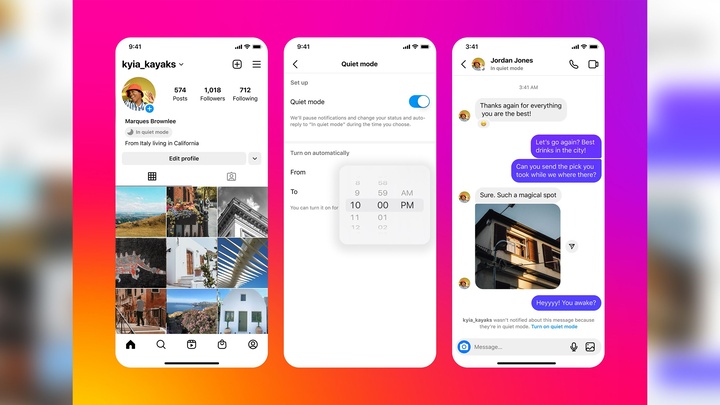
The “quiet mode” feature, which Instagram launched on Thursday, aims to assist users focus and establishing limits with followers and friends.

The profile’s activity status changes to “In quiet mode” when the choice is selected, pausing all alerts. During this time, if a direct message is sent, Instagram will instantly reply to the sender to let them know that “quiet mode” is active.

quiet mode
Image Source: cnn.com

Although all users can utilize the feature, Instagram seems to be concentrating on teenagers. Instagram encourages kids to enable the feature after they spend a particular “amount of time on Instagram late at night” and promotes it as a tool to aid in studying.

The upgrade is only one of several updates that are being released recently, along with new tools for managing suggestions and enhanced parental control options. The debuts coincide with Instagram’s efforts to lessen the likelihood that authorities and lawmakers will target the app because of possible risks associated with social media, especially for teenage users.

Up to this point, Instagram has added a number of teen safety features, such as those to safeguard teens’ privacy and lessen unwanted adult contact, restrict ad targeting, bar teens from accessing mature content, and other features to assist parents in keeping an eye on and managing their teens’ use of Instagram through parental controls.

The tool will be made available to users in the US, UK, Canada, Ireland New Zealand, and Australia, with intentions to expand to additional nations in the future.

After years of attention over how much time individuals – and especially teens – engage on different social media sites and the risks it might bring to their mental health, the tool is the most recent example of Instagram giving users more methods to regulate their usage.

The company stated in a blog post, “These updates are part of our ongoing work to ensure people have experiences that work for them, and that they have more control over the time they spend online and the types of content they see.”

Instagram users can opt to take a break with Quiet Mode to work, rest, or indulge in other activities. The app will provide a rundown of what users missed when they were in Quiet Mode to help them catch up.

The introduction of Quiet Mode coincides with Instagram coming under increasing fire for its impact on young people’s mental health, particularly teenage girls. Internal data published by Facebook whistleblower Frances Haugen in 2021 showed that the company had discovered that kids who were “addicted” to the app and that 1 in 3 girls who use Instagram have worsened body image concerns.

As part of its effort to placate parents, Meta is introducing a number of additional methods for managing Instagram recommendations. Instagram is developing its “not interested button,” which allows users to mark particular categories of content that users don’t want to see.

metaverse

Will the metaverse be good for society?

Our interactions with the outside world will be dramatically altered by the metaverse.

Life as we knew it was significantly altered by the worldwide pandemic and ensuing lockdowns. Ironically, as more individuals accepted the concept of staying home and engaging just online, the metaverse also received a major boost.

metaverse
Image Source: weforum.org

The Metaverse is intended to be a three-dimensional environment where people can communicate with one another in a more cutting-edge manner.

It essentially consists of a 3D platform with improved features that employ Virtual Reality (VR) and Augmented Reality (AR) technology to produce a more realistic experience.

It holds enormous potential for anything from social networking to business settings. However, the Metaverse encourages solitude and a disconnection from reality by its very nature. One reason the metaverse has sparked so many worries about society’s future is because of this.

Immersive learning, whether it be in the classroom or during corporate training, can have a longer-lasting effect on people by making topics more understandable and applicable.

A more comprehensive and all-encompassing approach to education will result from the metaverse’s influence on practical learning, which will involve witnessing the process as a component of the training. The eCommerce industry is already working to develop an integrated augmented reality that enhances the buying experience.

The influence will continue to grow and encompass more products. The experience that people want to have the most is how the metaverse will affect travel. Beyond just looking at images of the places we want to visit, metaverse will enable us to feel as though we are actually there, experiencing every second.

Although it has several advantageous effects, it also has some drawbacks. Our data has slowly turned into a precious asset for many marketing organizations because the majority of our professional and personal lives are now spent online. Our concerns about privacy have already increased with the emergence of intrusive technologies.

The more important query at this point is how the metaverse will regulate privacy. It can be quite tough to keep kids away from this cutting-edge technology. Therefore, it becomes crucial to shield kids from the negative effects of the metaverse. A complete virtual environment might be used to demonstrate the same in a more forceful manner.

Since metaverse requires rather advanced technology for the best VR experience, not everyone might be able to pay for the technology. The socio-economic divide might be directly impacted by and widened by the metaverse. Social media is frequently used by people to construct false identities.

This issue is certain to be prevalent, even in the metaverse.

The immersive internet would open up billions of dollars in wealth for society and let humans perceive the real and the virtual in ways they never could have before. To provide the maximum benefit for the community as a whole instead of a small elite, we should focus on creating an open metaverse as opposed to a closed metaverse controlled by Big Tech.

If we are successful, we may anticipate a constantly changing, decentralized, and creator-driven system that offers limitless chances to produce value.

Gabe Newell

Gabe Newell: The richest man in the video game business

American entrepreneur Gabe Newell is the head of the Valve video gaming company.

Gabe Newell oversaw the creation of Valve’s digital distribution platform Steam, which debuted in 2003 and by 2011 had the majority of the market for downloadable PC games.

Gabe Newell
Image Source: forbes.com

His net worth was assessed by Forbes to be US$ 3.9 billion in December 2021, making him one of the richest people in the country.

Early Life

Early in the 1980s, Gabe Newell enrolled at Harvard University but left to work for Microsoft, where he contributed to the development of the initial iterations of the Windows OS. As the principal developer for the first three iterations of the Windows operating system for 13 years, Newell amassed a million-dollar fortune.

One of the main factors in Newell’s decision to leave Harvard was that he claimed to have learned more during his initial 3 months at Microsoft than he did at Harvard. At Microsoft, Newell oversaw the creation of a Doom port for Windows 95, which is credited with establishing Windows as a competitive gaming platform.

Success Story

On August 24, 1996, Newell and another colleague, Mike Harrington, left Microsoft to create the video game firm Valve, inspired by Michael Abrash, who departed to work on the game Quake at id. The first Valve game, the critically acclaimed and financially successful first-person shooter Half-Life (1998), was developed thanks to funding from Newell and Harrington.

Half-Life, a first-person shooter with a science fiction theme, was Valve’s first game. It was praised for its excellent graphics and seamless story, and it deservedly won multiple “Game of the Year” awards. In 2000, Harrington resigned, leaving Newell as the sole proprietor.

Half-Life 2 (2004) was developed by Valve with no timeline and a nearly unlimited budget, with Newell offering to contribute himself if necessary. He spent months creating Steam, a digital game distribution service, in the interim. The majority of Valve’s revenue was derived from Steam, which in 2011 held between 50%-70% of the industry for downloadable PC games.

Forbes dubbed Newell “A Name You Should Know” in 2010 in part because of his work on Steam and connections with numerous important developers. The Academy of Interactive Arts & Sciences inducted Newell into its Hall of Fame in 2013. He was given the BAFTA Fellowship that March in recognition of his services to the video gaming industry.

With an assessed net worth of over 5.5$ billion, Newell was included in the top 100 richest Americans by Forbes in October 2017. According to a December 2021 Forbes assessment, Newell owned at least 25% of Valve and had a net worth of around 3.9$ billion. Newell was the richest individual in the video game industry as of 2021, as per Charlie Fish, author of The History of Video Games.

TikTok

Why Are US States Banning TikTok from official devices?

In response to growing security concerns, North Carolina and Wisconsin have become the latest US states to prohibit using TikTok on state-owned devices, following at least 25 other jurisdictions that have already taken some action.

Gov. Tony Evers of Wisconsin, a Democrat, raised privacy, security, and safety issues after discussing the app with the FBI and disaster management experts. With few exclusions, including criminal investigators who might be utilizing the app to follow particular people, Mr. Evers’ ruling applies to the majority of state agencies.

TikTok
Image Source: reuters.com

Additionally excluded is the University of Wisconsin System, which has 40,000 faculty and staff members on employment. Despite the exemption, a UW System representative said the institution was undertaking a review and working toward imposing limitations on the app’s use on devices in order to guard against major cybersecurity concerns.

Concerns that TikTok, a Chinese internet company owned by Bytedance, might be used to collect user information and data and give it to the Chinese Communist Party are a factor in the ban. Two-thirds of American teenagers use TikTok, making it the second most popular website around the globe.

But there has long been a bipartisan worry in Washington that the Chinese government may try to obtain American user data or spread false information by using its legal and regulatory authority. News allegations from last year that a Chinese team had inappropriately accessed the data of American TikTok users, namely two journalists, as part of a clandestine surveillance campaign to find the source of press leaks, fanned fears. Additionally, there are worries that the corporation is violating strict European privacy laws by sending vast amounts of customer data to China.

Some states, including Texas and Ohio, cited China’s 2017 National Intelligence Law, which obliges businesses with regional headquarters to cooperate with law enforcement by sharing user data with them.

Other Chinese-owned platforms and apps including Weibo, WeChat, Alibaba, and Huawei Technologies are also blocked in several jurisdictions. Chris Wray, the director of the FBI, issued a caution about the possibility of espionage using TikTok in December. He noted that China can “manipulate content, and if they want to, to use it for influence operations.”

In 2020, then-President Donald Trump and his government wanted to ban business with TikTok’s owner, compel the company to sell over its U.S. assets, and ban TikTok from app stores.

Courts had previously thwarted Mr. Trump’s attempts to outlaw TikTok. President Joe Biden reversed Mr. Trump’s orders after assuming office but requested a thorough investigation of the matter.

The sale of TikTok’s U.S. assets was postponed.  In December 2022, President Joe Biden signed a bill banning federal employees from using the TikTok app on government devices due to rising worries that the software would be used to spy on American users. As people became more aware of security risks, a number of jurisdictions started banning the app.

Jimmy Patronis, Florida’s chief financial officer, issued an order to the Florida Department of Financial Services in August 2020 prohibiting TikTok use on department-owned devices.

In August 2020, Nebraska was the second state to declare a ban on TikTok use on state-owned devices.

Apple

Is 2023 the year for Apple to launch its mixed-reality headset?

According to reports, the long-awaited AR/VR headset by Apple will be available this year. According to a recent Bloomberg article, the mixed reality device will finally be released in the fall of 2023 after a number of delays. The headset has apparently been under development for seven years, with Apple aiming for a 2019 release.

Apple
Image Source: macworld.com

Apple has been incorporating augmented reality into its products for years, but it appears that with the release of a long-anticipated mixed-reality headgear in 2023, the company will quickly advance into the area of Meta, Microsoft, and Magic Leap.

According to a previous story from The Information, the new gadget might resemble a set of ski goggles. It will have multiple cameras so the system can follow a user’s motions in real time and observe events outside of the home. Tim Cook, the CEO of Apple, has repeatedly said over the past few years that augmented reality is a viable technology.

However, it appears that Apple’s future device will provide a mixed-reality experience. Both augmented reality and virtual reality will be available to users. The new device, which Apple may call Reality Pro, will reportedly be unveiled in June during the opening keynote of the company’s Worldwide Developers Conference, according to Bloomberg.

The creation of apps for the new Apple platform has already begun by certain developers. xrOS could be the name of the new operating system for the Apple headset. Given how many developers are interested in this event and working on third-party applications for the iPhone, iPad, Mac, Apple TV, and Apple Watch, WWDC seems like the ideal venue for this type of product launch.

To ensure the long-term sustainability of the Apple headset, it will be crucial to have well-known games and apps for this latest Apple platform.

According to prior reports from Bloomberg, Apple’s mixed reality headgear would have a 3D video service and a unique take on the metaverse. The device’s built-in Mac-level M2 chip, over 10 cameras, and highest definition VR display, according to the report, will cost around $2000-$3000.

According to its most recent report, iOS 17 and iPad 17, the upcoming significant software updates for the iPhone and iPad, respectively, may contain fewer new features as a result of Apple’s concentration on the headset and its xrOS operating system.

Since it has been experimenting with augmented reality on its own iPhones and iPads for years, Apple has already left a tonne of hints about what its future in mixed reality might entail.

Probabilities are good that the headset will follow the same strategy as Meta’s most recent high-end headgear, the Quest Pro, with an emphasis on work, mixed reality, and eye tracking built in.

According to the majority of reports, Apple’s VR headset may likely be so costly and powerful that it will need to target a niche market rather than the general public.

If so, it may be aimed at the same commercial and creative workers as more sophisticated virtual reality headsets like the Varjo XR-3 and Meta Quest Pro.

Twitter

What Does Twitter 200 Million User Email Leak Actually Mean?

Researchers say that after reports surfaced at the end of 2022 that hackers were peddling data stolen from 400 million Twitter users, a widely publicized collection of email addresses linked to about 200 million users is likely a refined version of the larger collection with duplicate entries removed.

Although Twitter is yet to respond to the extensive disclosure, the cache of information underlines the extent of the leak and who may be most at risk as a result of it

Twitter
Image Source: techradar.com

A weakness in a Twitter application programming interface, or API, existed from June 2021 to January 2022 and allowed attackers to send contact information, such as email addresses, and receive the corresponding Twitter account, if any, in response.

Attackers used the vulnerability to “scrape” data from the social network before it was fixed.

The issue exposed the connection between Twitter accounts, which are frequently pseudonymous, and the email addresses and phone numbers attached to them, potentially identifying users, even if it did not allow hackers to access passwords or other sensitive information like DMs.

The vulnerability appeared to have been used by numerous actors to create various data sets while it was active. The email addresses and phone numbers of roughly 5.4 million Twitter users were contained in one that has been going around in criminal forums since the summer.

The vast, recently discovered cache appears to simply include email addresses.

The chance that the data will be used to support phishing attacks, identity theft efforts, and other forms of personal targeting is nonetheless increased by its widespread distribution.

Twitter is by no means the first platform to make data available for mass scraping via an API fault, and in such cases, it is typical for there to be a misunderstanding regarding the number of distinct data troves that truly exist as a result of criminal exploitation.

However, these occurrences continue to be important because they strengthen the vast volume of user-related stolen data that already exists in the criminal ecosystem by providing more links and validation.

As a result of the API vulnerability, Twitter expressed concern in an email to users in August that their pseudonymous accounts might be connected to their real identities. The organization said in a statement, “If you operate a pseudonymous Twitter account, we understand the risks an incident like this can introduce and deeply regret that this happened.

To keep your identity as veiled as possible, we recommend not adding a publicly known phone number or email address to your Twitter account.”

However, the advice is too late for those who weren’t already linking their Twitter accounts to burner email addresses at the time of the scraping. The social network announced in August that it was informing those who might be impacted about the problem. In light of the hundreds of millions of records that were exposed, the corporation has not indicated if it will send out more notifications.

The Data Protection Commission of Ireland announced last month that it is looking into the event that resulted in the collection of 5.4 million users’ email and phone numbers. The US Federal Trade Commission is also looking into whether Twitter broke the terms of a “consent decree” that required the firm to strengthen its user privacy and data protection policies.