Your Tech Story

Annasha

Annasha Dey is an NIT student, who apart from studying engineering is also a content writer. She has a great interest in photography, writing, reading novels, and travelling as well. She is a foodie who loves socializing and hanging out with her friends. She is also a trained Kathak dancer and a big fashion enthusiast. Dey also loves watching TV series, which includes F.R.I.E.N.D.S. and Big Bang Theory. To be a better writer she prefers to read more

fixcraft.in

Vivek Sharma : The Founder of Fixcraft.in who has Set the Indian Auto Sector on Fire

Talking about fancy expensive car companies, we can name hundreds of them, isn’t it? But what after you purchase the car? Do you get proper servicing at an affordable rate, or is it like spending your month’s half salary to fix the car? Indeed, the original equipment manufacturer (OEM) workshops are not affordable for everyone, but currently, they are dominating the market. So do you have any names in mind that are up for the game, but at cheaper prices? Well, we have one. Fixcraft.in it is!

Yes, Fixcraft.in is a fresh start-up in the automobile industry, established to improve the Auto After Sales services in India. Vivek Sharma, the founder of Fixcraft.in, founded the company on 10th October 2018 to make significant growth in the automobile sector and especially, to remove the burden of expensive garage costs for all the car owners.

Education and Early Career of Vivek Sharma

Sharma went to Marine Engineering and Research Institute and graduated with a B.E. degree in 2006. After passing out as a marine engineer, in 2006 he joined Seaarland Shipping Management B.V. as an assistant to chief engineer. He worked there for three years, and during this period, he was also exposed to the work culture of foreign countries. He travelled across 26 different countries and trained a team on how to act at the time of various emergencies. His major works included managing, operating and maintaining the schedule of the engine room of the ship.
Vivek Sharma Fixcraft.in
Image Source: crunchbase.com

He left the company in 2009 and joined Indian Institute of Management, Bangalore in 2010 and graduated with a Post Graduate Diploma in Management, Strategy and Marketing, in 2012. During his time in IIM, Bangalore he did a summer internship from the Philips Electronics India Ltd. He learned about the cluster analysis, competition analysis; develop a market strategy with information and data making and estimating market potential.

After graduating from IIM, Bangalore, he was again back to Philips Electronics as a Deputy Manager (Lighting) and worked there for a year. His main job there was to manage B2B sales in Delhi.

In May 2013, he joined the Hyderabad branch of the company as ASM, Andhra Pradesh (Lighting) and became the sales head for B2B Lighting Division of Andhra Pradesh.

In the next year, his career met huge success, as he joined Snapdeal as Associate Director. He was the founding member of the Account Management Team, and also, the Head for Sales and Strategy for key categories. He left Snapdeal in November 2016.

The last company he joined before founding his own was Droom Technology, a start-up by Sandeep Aggarwal. He joined the company as Senior Director of Business Development as was promoted to Associate Vice President of the same department after 9 months. He left Droom just one month before founding his own company.

Fixcraft.in

By the time Sharma founded Fixcraft.in, he had already gathered more than enough experience and knowledge in the automobile sector. The main motive of Sharma was to bridge the gap between local garages and OEM workshops for After Sales Services. Moreover, the market for After Sales Services was expected to reach a value of 20 billion in the next five years. And, this section of the industry includes both old and new customers, which means there will be possibly no drop-in rate of consuming services in this sector.

Fixcraft.in is the first Indian full-stack cloud-based garage which provides service starting from parts replacement to car painting at a very fair price.

Sharma’s biggest challenge while founding Fixcraft.in was to build a strong team and get it to work together. But with time, he has built a good core team and now working on expanding his business. Since Sharma’s main goal was to provide quality services at an affordable price, he is operating on the Cost Plus model of pricing.

In this very year, Sharma’s business received an undisclosed amount of money in seed funding, which included some significant angel investors, like Ranjan Kant, Former Director at the Furniture Republic and CBO at Ofbusiness; Rahul Taneja, ex CBO at Jabong, and from the other existing investors. The company also has Rishab Malik in the advisory team, who worked with Droom and GSF India.

Future Plans

With less than a year of its establishment, Fixcraft.in is doing well in the automobile sector. With its business running only in Delhi NCR, they are planning to expand it to Pune and Bangalore, within next few months. By the end of 2020, Fixcraft.in plans to establish a business in the top 15 cities of India.

Kobo

Michael Serbinis : A Significant Entrepreneur who Founded Kobo

There always doesn’t have to be a reason for reading. Reading has always been valuable as it only adds up to your knowledge. That is why the community of book lovers is expanding with every passing second. But, we do know that everyone can’t afford the highly expensive original editions of classic novels every time. So for such a crisis, the e-books become the true guardian angels in our life.

Kobo Inc. is a Canada-based platform that is famous for selling e-books and electronics. The company serves customers at a global level and has attracted more than 10 million readers by now. Its founder Michael Serbinis, who is an engineer, entrepreneur and an angel investor, is even more famous for founding more than just one company.

Where Michael Serbinis belongs?

Born on 28th October 1973, Michael Serbinis belongs to the land of maple syrup, i.e., Canada. His keen interest in science made him win gold at the Intel International Science and Engineering Fair, for which he designed a high-temperature superconductor propulsion system. So, his first big achievement happened when he was in high school, that led to big opportunities for working with NASA and Intel.

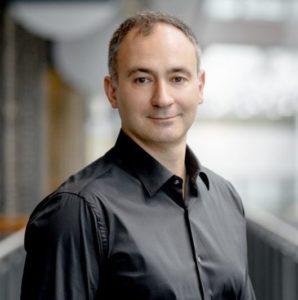
Michael Serbinis founder Kobo
Image Source: alejandrocremades.com

In 1996, Serbinis graduated from Queen’s University with a bachelor’s degree in Engineering Physics, followed by graduating from the University of Toronto with a master’s degree in Industrial Engineering. While he was a student, he entered into the Ontario Engineering Competition, and his creation of motor, that ran on an advanced software coding, helped him fetch a summer job at Microsoft. He also conducted thorough research on neural networks and artificial intelligence.

The Journey in the Late 90s

Serbinis’s journey into the entrepreneurial world started while associating the Musk brothers. He received a call from the Musk brothers, who were his university classmates to help them build a business. And thus, Serbinis was one of the first ten employees of Zip2, the company that was established by Elon and Kimball Musk.

Since Serbinis was already a very efficient programmer, at the age of twenty-four, he built a cloud-based document storage service called DocSpace. After a couple of years, it was sold to a San-Francisco based company for $530 million.

In 2000, Michael Serbinis joined Critical Path as CTO and EVP Marketing. It was then one of the largest companies which ran one-third of the world’s emails through their software. After he moved back to Canada, Serbinis joined Indigo as CIO and EVP Online, and this is the point at the juncture, where Kobo spun out to become an independent business.

Founding Kobo

At first, a global e-reading platform called Shortcovers was released in February 2009, under the main company Indigo. But, once they gained board approval and funding, they cut out from Indigo and established as an independent company. In late 2009, the company was rebranded as Kobo, an e-reading platform for worldwide customers. This was just the beginning for Serbinis to do great things in his homeland.

The Success

Kobo received a very good response from all over the world, shortly after its release. Kobo, today, attracts over 18 million users from more than 190 countries. It has over more than 3 million magazines, eBooks, and even, newspapers. Thus, creating the largest e-readers catalogue in the history of the e-reading platform.

In January 2012, Kobo came under the acquisition of a Japanese e-commerce company called Rakuten for $315 million. The catalogue of Kobo has e-books on 77 different languages, helping readers connect to their native land.

After Kobo

Since it was only the beginning, Serbinis founded 3 Angels Capital in 2014, to invest in a disrupted market and create a better world. Serbinis has always been a determined and optimistic man for sure. He mostly invests in areas, like the internet of things, digital content, digital health, etc.

Michael Serbinis is also the board director of MaRS Discovery District, an innovation hub in Toronto. He serves as a board director in another institute called Vector Institute, a non-profit research institution in Toronto.

In November 2014, Serbinis founded League Inc., an online platform that connects worldwide users to provide health benefits and much more.

After developing so much on his homeland and contributing to science, Serbinis still lives in Toronto with his family.

PHP

Rasmus Lerdorf : An Insightful Programmer and the Creator of PHP

The history of PHP programming language narrates the story of a programmer who prefers to be known as an engineer than a coder. Because according to this engineer, the end product is what matters the most and not the journey to it. Well, seems like his mind works more like a thermodynamic state function and less like a path-dependent parameter, isn’t it?

This remarkably excellent engineer is none other than world-famous programmer Rasmus Lerdorf. On one of his interviews, Lerdorf said that coding is quite boring and tedious, which is insignificant contrast to who he is and his occupation. So, let’s get to know more about this big guy and his ‘path’ to success.

Early Life

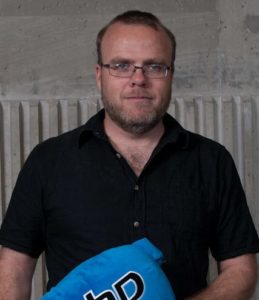
Rasmus Lerdorf
Image Source: staticflickr.com

Born into a family from Disko Island, Greenland, on 22nd November 1968, Rasmus Lerdorf moved to Denmark at an early age of three. At the age of fifteen, Lerdorf and his family moved to King City, Ontario. In 1988, Lerdorf graduated from King City Secondary School and pursued his higher studies from the University of Waterloo. He graduated from the university in 1993 with a bachelor’s degree of Applied Science in Systems Designing Engineering.

After he graduated, Lerdorf made significant contributions to the relational database management systems like Oracle Rdb.

Working With Programming Languages

When the programmers and the tech-savvies were working in the mid-90s with their main motive to make the internet more efficient and faster, he got hindered by languages like C and Perl. According to Rasmus Lerdorf, designing websites with these languages were too time consuming and needed to come up with a new one.

Lerdorf, along with some of the technical writers, assembled their ideas together and got them online as an HTML page. He wanted to take a step ahead, only when some companies asked for these documents or expand the idea and implement it in the practical world.

Creating PHP

He started working in CGI (common gateway interface), developed few libraries, wrote some programs in C, and finally, developed PHP, an entirely new language. Lerdorf created PHP (personal home page, now known as hypertext preprocessor) in 1994, and till now, many modified versions of the language has been released.

In a generalized way, PHP is a programming language that was designed for web development and can be used almost on every operating system. The most recent version of PHP is PHP 7.3 released on 6th December 2018.

After PHP became a very well known and useful language to big companies, Rasmus Lerdorf explained that he never intended to create a programming language, as he had no clue how to build one. He was making logical implementations to create something simpler than Perl, and one thing led to another. Finally, after forming a tech team to assist him with technical documentation, which followed beta testing, PHP/FI 2 was released in November 1997.

The Success

Today, PHP is a majorly used programming language, being used by websites like Etsy, Wikipedia, Tumblr, Yahoo, Flickr, Facebook, and many more.

Over the years, many features have been incorporated in PHP, but Lerdorf keeps telling one thing to every emerging engineer out there, that for a programmer, it is very important to understand C very well. Though he accepts that as compared to languages, like Python or C++, the user needs to put comparatively more effort using C, but it is the fundamental unit of learning for any programmer.

After releasing PHP, he worked with different big tech companies, and currently, he is working with Etsy.

Career of Lerdorf

In January 2000, Rasmus Lerdorf joined Linuxcare Inc. as a senior research engineer and continued for a year. In September 2002, he joined Yahoo! where he continued for seven years, as an Infrastructure Architecture Engineer. Lerdorf said that eventually, he became tired and kind of demoralized working in an ad centric web company, as it involves tricking your customers.

He joined Room 77 as an advisor in 2010, and then, it’s all about WePay and Etsy. It’s been eleven years, that he has been working in Etsy, first as an advisor, and then, as a distinguished engineer.

Lerdorf as every other enthusiastic programmer is very much interested in open source, and he attends the open-source conferences as a speaker throughout the world.

freelancer.com

Matt Barrie : The Founder of Global Freelancer Marketplace, ‘Freelancer.com’

The growing online marketplace has got the scope for every profession to flourish, and it’s a golden era for the freelancers. How many of you know about Fiverr? Well, I can bet a lot of you guys must be using it already to earn some extra cash, isn’t it? Fiverr was launched in 2010 as a two-sided platform for both the freelancers and the clients, to do any kind of job that is required to set up a company. But, just a year before the launch of Fiverr, Matt Barrie founded freelancer.com, an online platform to upload your projects and hire suitable freelancers to do the job. And today, it is the largest marketplace in the world in terms of the projects uploaded, and the number of users.

Matt Barrie founded freelancer.com in 2009, which is headquartered in Sydney, Australia.

Early Life

Barrie was born on 16 August 1973, in Adelaide, Australia. For his undergraduate course, he went to the University of Sydney to pursue a BSc Hons, and later, received a post-graduate degree in electrical engineering from the Stanford University in 1998.

Early Career

His first step into the professional world was right after he graduated and was hired by Kroll O’Gara Information Security Group. During his time here, he acquired an information security website, Packetstorm from Ken Williams.

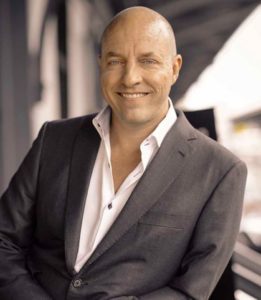
Barrie-Matt Freelancer.com
Image Source: icmi.com.au

In 2000, he joined Innovation Capital as an investment manager and left the company within a year. This was followed by joining Sensory Networks in 2001, where he became the chief executive officer. He left the company after five years, and in between, he attended the executive program for growing companies at Stanford.

In January 2008, Barrie joined as Non-Executive Director in Julius Finance followed by joining QuintessenceLabs as an Advisor in October 2008. Barrie also played a role as an Adjunct Associate Professor in the University of Sydney for 13 years, and finally, left the post in 2013.

Forming Freelancer.com

After joining and leaving many companies, since 1998, Barrie finally formed freelancer.com in 2009. But, the idea of forming an online platform, where freelancers and professionals could meet, wasn’t one of his perfectly planned start-up executed henceforth.

He saw the vast opportunity of this freelancing website when he needed a freelancer to get one of his data entry job done, but was unable to find anyone fit for the project. So, he searched for people online, especially, for college students and found GetAFreelancer where he could upload his project and find a suitable freelancer. After he registered, his job was done within a few days. This gave Barrie a very clear picture of what’s next in the online business trend, and what possibly can create an enormous potential market.

Success of Freelancer.com

Within six years of the company’s establishment, it has expanded the marketplace to over 247 countries, regions, and territories. The company now deals with more than 16million users with more than 8 million projects updated in various categories. Some of the categories of freelancer.com that lured most of the professionals to get their jobs done were software development, graphic designing, and digital marketing.

Freelancer.com became very popular quickly because the services were exchanged online, and the company was trusted enough. For many college students who belonged to remote areas, where finding jobs offline was very much difficult, got a fair opportunity to showcase their talent and earn money. Freelancer.com also created a global network and gave an ample of different options to choose from especially for the clients.

Once the company started expanding, it acquired many crowdsourcing marketplaces like GetAFreelancer.com, EUFreelance.com, LimeExchange, Freelancer.co.uk, etc. By 2016, Freelancer.com was operating in 34 different languages and 21 currencies. So far, some of the biggest clients of Freelancer.com are NASA, Airbus, and U.S Department of Energy.

What after Freelancer.com?

Barrie clearly didn’t hit a pause after the huge success of Freelancer.com. In November 2015, he joined Escrow.com as chief executive and president. Escrow.com is an online payment company, where he is still a position holder.

In November 2018, he joined Freightlancer as Executive Chairman. It’s a marketplace for shipping and transportation which also provides metro delivery through a network of freelancers from Freelancer.com.

spicejet

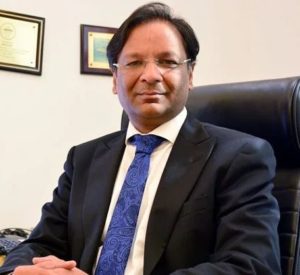
Ajay Singh : The Man Who Saved SpiceJet From Vanishing into Oblivion

What is good in doing business without risks? When one aims for something bigger and more profitable, it is reasonable to go against the odds and take the chances. But, what about the companies whose strategies are failing and going downwards in the spiral of destruction? Should it give up or just hope for a knight in shining armour to appear and be the lifesaver. Well, the story of SpiceJet clearly narrates a tale, where they well resurrected by none but Ajay Singh. After facing excessive loss through 4 consecutive financial years, Ajay Singh finally stepped in to take over the control once again and re-establish the reputation of the company.

SpiceJet is an Indian airline headquartered in Gurugram whose history dates back to 1984.

Early Life

Singh was born into an influential family from Delhi. His father was an established businessman, Vijinder Singh, and his mother was Kalpana. Singh’s family business was mainly about real estate and fashion accessories.

Ajay Singh SpiceJet
Image Source: indianexpress.com

Singh was kind of an all-rounder from a very young age. He went to St. Columba’s School and apart from excelling in his academics, he was very good at playing cricket, table tennis and football. He was also the caption of his school’s football team. After completing his school, he went to IIT Delhi and graduated from there in 1988 with a degree in textile engineering. And, like kids in the family of every other businessman, he went to pursue his MBA. He completed his MBA from Cornell University.

Early Career

At Cornell, he became the President of the Indian Association, and thus, showed a keen interest in the events of India related to government policies. He was also interested in political matters and thought that more educated people are needed in the Indian political system. So, he came back to India in 1992 and pursued law at Delhi University.

In 1996, Rajendra Gupta, a BJP leader who later became Delhi transport minister, hired Singh for Delhi’s transport corporation board. After joining his first responsibility was to stabilize an already bankrupted corporation, which had 40,000 employees. Singh implemented the global transportation strategies and expanded the corporation from 300 to 5000 buses within a span of two and a half years. This was his first achievement after returning to India and stepping into both the political and business world.

In 1998, Singh became an officer on special duty (OSD), where he played a major role in launching DD Sports and DD News. Singh had some plans and suggestions in his mind to reduce the cost of telephony, and thus, persuaded BSNL to drop the incoming charges on mobile. All these developments took place only up till 2004 when BJP lost the general election, and Singh found him unemployed.

Singh Acquired SpiceJet

After BJP lost the election, Singh decided to get back in the entrepreneurial world, and his first move was to acquire ModiLuft and carrying the business as SpiceJet.

Looking back to the history of ModiLuft, it was an airline company established in 1984 by S.K Modi. In 1993, it came into a partnership with Lufthansa, a German airline, but in 1996, it ceased the operations.

So, whatever was left of the company was acquired by Singh after eight years, and this time, he renamed it as SpiceJet and followed the low-cost model to provide a good experience and low fare to the public.

Initially, Singh’s stake was 20% in SpiceJet, but it came to 6% when media tycoon Kalinathi Maran acquired 37.7% in 2010. Eventually, Singh sold his remaining stakes too.

The Downfall of SpiceJet

After Singh stepped down, SpiceJet rocketed in terms of making consecutive losses in three years. In the year 2012, SpiceJet faced a loss of Rs 604 crore followed by Rs 192 crore, Rs 1,001 crore, and Rs crore, in the next three following years.

The market share dropped from 20.9% in 2014 to 9.2% in 2015. Increased number of employees also created a problem, as, after some time, the company was unable to pay them. The oil companies also refused to refuel them, and by 2015, the company was barely able to crawl on the surface with no chance of survival. This is when Singh stepped in.

Bringing SpiceJet Back to Business

Singh was back in the territory of SpiceJet in 2015 and acquired 58.46% stakes of the company. He spotted that over employment was a very big issue with the company and brought down the number of employees to 4,000 from 5,500. After facing crores of loss for four consecutive years, the company finally made a profit of Rs 450 crore in 2016.

Today, SpiceJet has become India’s fourth-largest airline in terms of passengers and operates 306 flights on a daily basis.

4004 Intel Microprocessor (1)

Marcian Hoff : An Electrical Engineer Who Co-invented the First Microprocessor

The modification of an already existing invention is much easier than proposing the idea of creating a new one. With time, advancement in technology and acceptance within mankind both took place, which seemed like far-fetched goals in the earlier days. Even though there were many obstacles in the past, many significant scientists emerged out on the surface with innovative innovations. And, today, these are the innovations that are helping us take a step forward towards building a smarter world.

Marcian Hoff, popularly known as Ted Hoff, is one such brilliant innovator who invented microprocessor in the early 1900s. Hoff started co-invented things while he was pursuing a PhD. But, in 1968, his life completely changed its course and became a roller-coaster ride, when he was approached by Robert Noyce, co-founder of Intel Corp.

Early Life and Education of Hoff

Marcian Hoff was born on 23rd October 1937 in Rochester, New York. He was lured by the scientific world from a very young age, especially when he received a subscription to Popular Science from one of his uncles at the age of 12. For his undergraduate degree, Hoff went to Rensselaer Polytechnic Institute and graduated in 1958 with a bachelor’s degree in Electrical engineering. As an undergraduate student, he worked at Rochester’s General Railway Company during the summer breaks. During his time in this company, he worked with magnetic cores and transistors, and also developed his first two patents during this time.

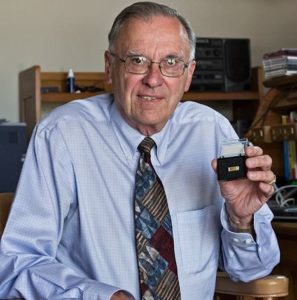
Ted Hoff aka Marcian Hoff
Image Source: blog.parrikar.com

After completing his college, Hoff received a National Science Foundation Fellowship which gave him the opportunity to attend Stanford University. In 1959, he received an MS degree and a PhD from the same university in 1962. During this time, he co-invented least mean square filter with Bernard Widrow, his guide and a professor of Stanford University. The algorithm they invented is still used in modems today.

Hoff chose to stay in Stanford to carry out his studies on neural networks and integrated circuits, hence, continued research for another four years. While he was learning about integrated circuits, he realized how hard it was to build one.

During this time, Noyce was hiring for Intel, and he contacted a professor of Stanford to know if there was anyone in the campus who had the potential to become an Intel employee. And this is how Hoff ended up as Intel employee in 1968.

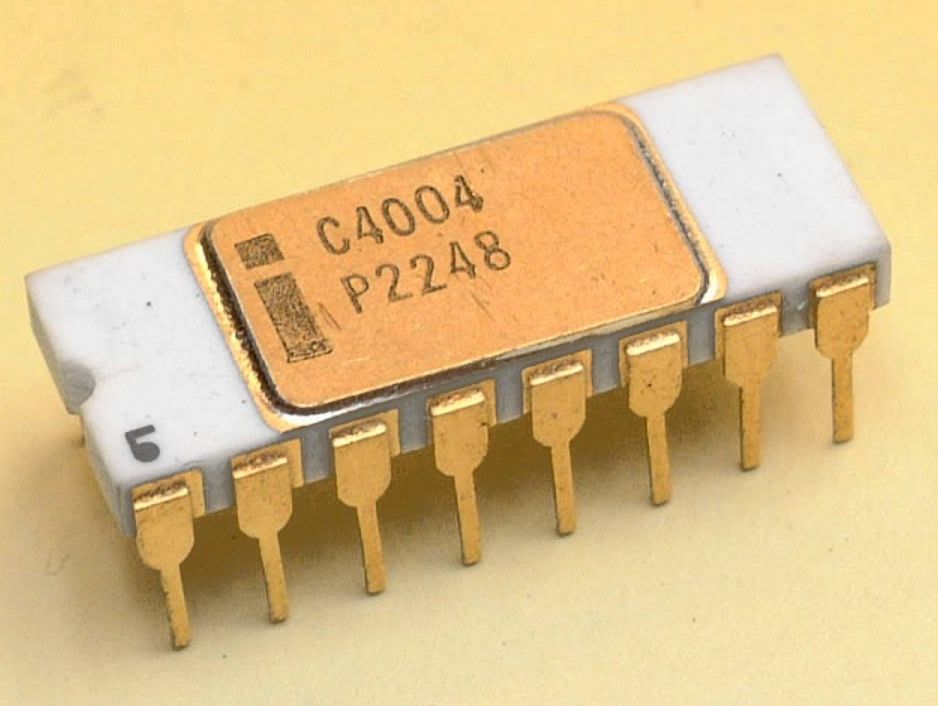
Intel 4004

Marcian Hoff joined Intel in 12th September 1968, as the company’s twelfth member. Intel was established with the main goal to replace all the magnetic core memories with semiconductor memories. Since, it totally diverted from the conventional idea about computer memory, creating a market demand was very tough. So, they decided to take up clients and develop memories as per their requirements. Intel’s first customer for this semiconductor memory was a Japanese company who sold calculators under the name Busicom.

They demanded different types of chips for performing various activities, and hence, both the companies signed a contract to create these chips in April 1969. After this contract, engineers were sent from Japan to work on this design, but at the same time, Hoff on behalf of Intel created another design, which used DRAM (dynamic random access memory). The company liked Intel’s approach better, as a lesser number of chips were able to perform more functions.

Intel, after successfully designing product for this client, wanted to expand the utility of silicon gate, and they hired Dr Faggin in April 1970 to conduct research and make progress on this area. Today, this metal oxide silicon (MOS) process is extensively used in what we call embedded system.

Hoff said that nobody in the company expected as much growth as took place in the following years.

What after Intel 4004 project?

After the 4004 project, Noyce’s next target was to implement their MOS technology in telephony. So, Hoff started working CODEC (a decoder working used in the telephonic industry to convert analog signals to digital and vice versa). Intel was able to come up with monolithic CODEC which could be used commercially.

Hoff left Intel in 1983 and joined Atari as it was working on some really advanced ideas. But, the business strategies of the company were very poor, which resulted in the dropping of the revenue from $2 billion to $1 billion within a single year. Hoff left Atari in 1985 when the company was sold.

From Engineering to understanding Business

Today, Hoff is the part of Teklicon, a company that deals with business and law; established by Gary Summers, who was the head of semiconductor designing in Atari, when Hoff joined the company.