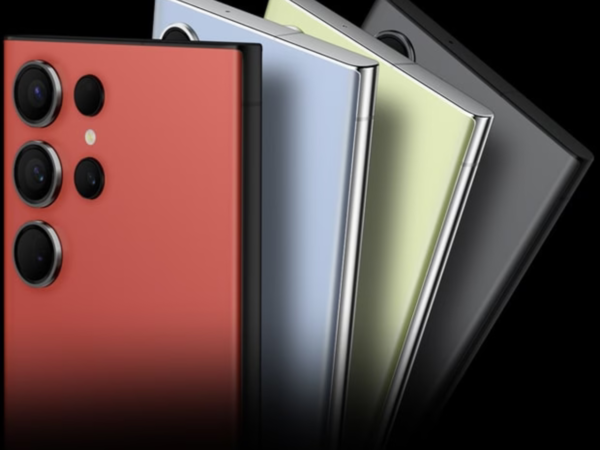
Samsung Galaxy S24 Series to Launch on January 17, 2024: Report

I am a law graduate from NLU Lucknow. I have a flair for creative writing and hence in my free time work as a freelance content writer.

I am a law graduate from NLU Lucknow. I have a flair for creative writing and hence in my free time work as a freelance content writer.

I am a law graduate from NLU Lucknow. I have a flair for creative writing and hence in my free time work as a freelance content writer.
After stopping losses at its chip division, Samsung Electronics Co. recorded a more gradual decline in quarterly profit, raising the possibility that the worldwide semiconductor sector had turned into a downward spiral.
A 78-cent reduction in operating profits was better than expected, according to some investors, and this helped Samsung’s shares rise as high as 4.4%, which is the biggest in more than a month. The biggest corporation in South Korea, along with its smaller competitors SK Hynix Inc. along with Micron Technology Inc., has been experiencing an industry slowdown. In response to sluggish demand for gadgets and an oversupply of chip inventory, dependable clients, such as manufacturers of personal computers and mobile phones, have reduced their purchases.
As per Samsung’s initial figures, operating income decreased to roughly 2.4 trillion won which is approximately $1.8 billion despite a decline of 13 percent in earnings in the three months leading up to September. The figures are better than the record 95 percent year-on-year decline in the previous quarter, which is in line with analyst predictions.
Expectations are rising that Samsung’s semiconductor business “has pretty much passed the bottom,” said Sanjeev Rana, head of Korea Research at CLSA. “And the recovery is underway in the fourth quarter.”
finance.yahoo.com
Samsung now aims to take advantage of the long-expected rise in AI-related technology expenditure, which is being driven by enthusiasm among investors and customers for OpenAI’s ChatGPT launch last autumn.
However, Samsung is lagging behind tiny Hynix, the primary provider of next-generation DRAM to artificial intelligence chip manufacturer Nvidia Corp., in building the tools required to train artificial intelligence models. By 2024, Samsung claims it will have doubled its production capacity for high-bandwidth memory, which has the capability required to accelerate AI training
Samsung is a leader in the memory market, which quickly increased production to satisfy demand brought on by the epidemic. The business continued to spend throughout the recession, burdening itself and its major clients with excessive inventory.
“The result was better than expected,” said Lee Seung-Woo, an analyst at Eugene Investment & Securities. “The bottom for the memory chip industry is behind us and Samsung’s results showed that.”
finance.yahoo.com
Also Read: BlackRock Invests in German Fintech Firm Targeting New Investors
However, Samsung and Hynix have stated they will withstand financial turmoil by reducing the manufacture of NAND chips used in personal computers and smartphones until AI-related demand turns into revenue.
Before trading on Wednesday, shares of Hynix had increased by more than 60 percent compared to Samsung’s rise of 20 percent earlier this year.

I am a student pursuing my bachelor’s in information technology. I have a interest in writing so, I am working a freelance content writer because I enjoy writing. I also write poetries. I believe in the quote by anne frank “paper has more patience than person
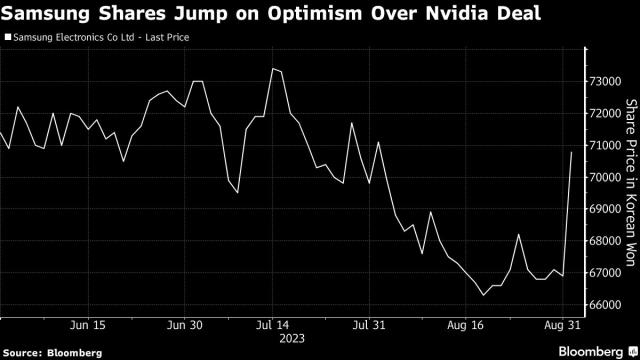
After news broke that Samsung Electronics Co. had been awarded the contract to provide cutting-edge memory chips to AI pioneer Nvidia Corp., It hiked by more than six percent.
The top electronics manufacturer in South Korea will begin selling HBM3, a new type of memory designed to operate with artificial intelligence acceleration devices, in the fourth quarter, according to Citigroup researchers which also involves Peter Lee. Since January 2021, its share price has gone up the highest. Until today, SK Hynix Inc., the arch-enemy of Nvidia, was the only supplier of high-bandwidth memory space for its artificial intelligence accelerators.
“Following its successful entry into Nvidia’s HBM supply chain, we expect Samsung to emerge as one of the leading suppliers of HBM3,” Lee and Josh Yang wrote in a report, “Citigroup’s Value for Samsung.” The target has been increased from 110,000 Won to 120,000 Won. “We see Samsung as a long-term beneficiary of the growth of the memory and AI computing markets.”
biz.crast.net
The Korea Economic Daily disclosed a report on Friday, quoting anonymous business sources, that Samsung reached an agreement to provide HBM3 to Nvidia shortly after its chips cleared the United States chip developer’s last-stage quality checks. According to the report, Samsung will begin providing the premium memory chips in as little as next month.
The arrival of Samsung as an extra HBM3 provider will be advantageous to Nvidia. As it broadens its possibilities, the Santa Clara, corporation based in California, whose stocks have quadrupled in worth to a total market capitalization of 1.2 trillion dollars, can see greater cost by performance as well as a more consistent supply.
A representative for Samsung turned down to comment on this topic.
On hearing the news, Samsung’s manufacturers also saw their stocks rise, with Hana Micron Inc., a company that tests and packages chips, increasing by an average per day of 30 percent. Dedak Electronics Co., a provider of printed circuit boards, increased 7.4 percent.
HBM3, which researchers believe is suited for bandwidth-hungry artificial intelligence (AI) applications, is a technology in which Hynix leads the world. The latest HBM chip will reportedly be released by Samsung sometime this year. Hynix’s stock decreased 1.5 percent on Friday after initially gaining.
I am a student pursuing my bachelor’s in information technology. I have a interest in writing so, I am working a freelance content writer because I enjoy writing. I also write poetries. I believe in the quote by anne frank “paper has more patience than person
Tenstorrent, a Canadian firm, has raised 100 million dollars from sponsors including Samsung Investment Fund, Hyundai Motor Group, and Kia to compete with Nvidia’s monopoly in the provision of processors for artificial intelligence solutions including ChatGPT by OpenAI and Bard of Google.
“With this investment, the Group expects to develop optimized but differentiated semiconductor technology that will aid future mobilities and strengthen internal capabilities in AI technology development,” Heung-soo Kim, executive vice president and head of the global strategy office at Hyundai Motor Group, said in a statement.
Source: tbsnews.net
Jim Keller, previously employed by Tesla, is the founder and chief executive officer of the firm, which has received 234.5 million dollars so far and has a current market value of approximately one billion dollars.
According to Reuters, Tenstorrent secured 50 million dollars from the Catalyst Fund of Samsung, thirty million dollars from Hyundai, and twenty million dollars from Kia, along with different investors including Eclipse Ventures, Fidelity Ventures, Epiq Capital, as well as Maverick Capital in the most recent round of investment.
Also Read: Uber Is Developing an AI-Powered Chatbot to Integrate Into App
Tenstorrent won’t technically acquire an added worth until it does a second round of equity financing, which the company says it hopes to complete next year. This is because the investment round was set up as a loan that would eventually be converted to shares. Regarding specifics of the convertible debt, Tenstorrent refuses to provide additional information.
In a statement about the new investment, Hyundai said, “Hyundai Motor Group today announced a strategic investment in Tenstorrent, an artificial intelligence (AI) semiconductor company based in Toronto, Canada, which will allow the Group to integrate AI into future Hyundai, Kia, and Genesis vehicles, and other future mobilities, including robotics and advanced air mobility (AAM).”
Source: livemint.com
In addition to manufacturing its own artificial intelligence chips, Tenstorrent, which was launched in 2016, also sells its proprietary rights and other technologies to clients so they may create their own artificial intelligence chips.
Tenstorrent is currently focusing on additional applications for AI chips, including the agreement unveiled in May where the firm would produce chips that might be utilized in smart televisions, in addition to taking against Nvidia in the data center.
In the meantime, Keller, who assumed control of the artificial intelligence chip manufacturer previously this year, has in the past produced chips for firms such as Tesla, Apple, and Intel. His tenure at Tenstorrent represents a comeback to the automotive technology industry.
I am a student pursuing my bachelor’s in information technology. I have a interest in writing so, I am working a freelance content writer because I enjoy writing. I also write poetries. I believe in the quote by anne frank “paper has more patience than person
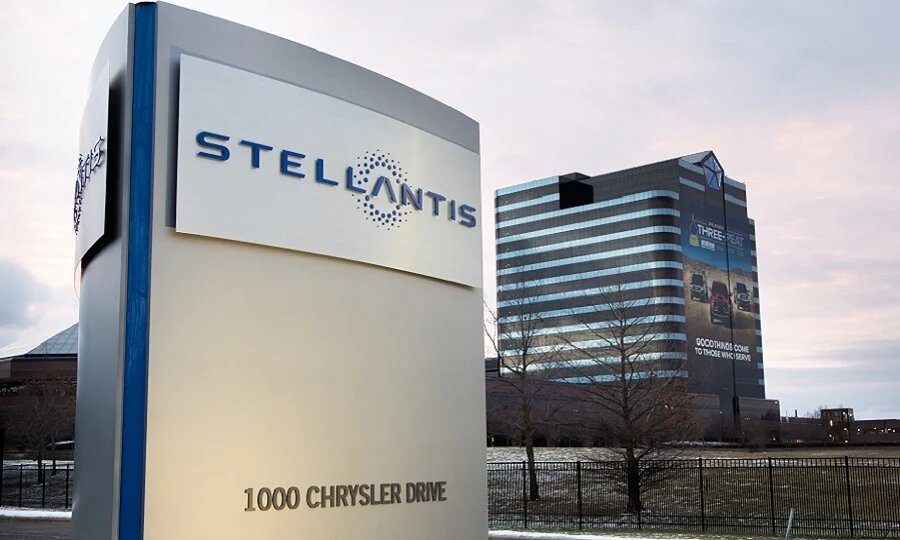
On Monday, the French-Italian carmaker Stellantis as well as the South Korean battery manufacturer Samsung SDI announced plans to establish a new joint-venture facility in the United States to produce batteries for electric vehicles. The project is assumed to start operations by 2027.
Both firms stated that the acquisition still has to be completed and that the location of the facility is still being considered. Additionally, later on, it will be revealed how much money is going to be invested in the location and exactly how many people will work there. The facility will initially be able to produce 34 gigawatt hours or GWh.
“This new facility will contribute to reaching our aggressive target to offer at least 25 new battery electric vehicles for the North American market by the end of the decade,” Stellantis CEO Carlos Tavares said in a statement.
“The second plant will accelerate our market penetration into the U.S.,” Samsung SDI CEO Yoon-ho Choi said in the statement.
Source: cnbc.com
By 2030, Stellantis, a company whose product lines comprise Citroen, Peugeot, Ram, Jeep, Alfa Romeo, and Opel, wants to sell only electric cars for passengers in Europe and a mix of fifty percent electric cars and light-duty trucks in the United States. It has stated that it needs to obtain 400 GWh of capacity for batteries in order to do that.
Stellantis stated in 2021 that it intended to invest a total of $35 billion worldwide until 2025 in electric vehicle manufacture and software. The second American battery factory, according to Stellantis, is going to be the sixth facility to help the business.
Also Read: Google raising price of YouTube Premium to $13.99 per month
Stellantis along with Samsung SDI announced in May 2022 that they will invest over two billion dollars to construct the initial joint battery production, which would be operational in Kokomo, Indiana, by the first half of 2025.
The initial capacity of such a facility will be 23 GWh, and it will gradually increase to 33 GWh.
At the time, the firms predicted that 1,400 employees would work at the Indiana factory, and investments might eventually reach 3.1 billion USD.
In addition, Stellantis is constructing a battery facility in Windsor, Ontario, Canada in partnership with LG Energy Solution of South Korea. 2,500 jobs will be created by the facility when it opens in 2024, and it will have a manufacturing capacity of more than 45 GWh per year.
To establish a collaborative battery facility in the United States with a 2026 opening and a 30 GWh yearly capacity, Samsung SDI along with General Motors announced in April that they will invest over three billion dollars. Additionally planned for Indiana, this facility will have 1,700 workers.
I am a student pursuing my bachelor’s in information technology. I have a interest in writing so, I am working a freelance content writer because I enjoy writing. I also write poetries. I believe in the quote by anne frank “paper has more patience than person