Your Tech Story

News

Google Tweaks Ad Auctions to Hit Revenue Targets, Executive Says

Google Tweaks Ad Auctions to Hit Revenue Targets, Executive Says

Alphabet Inc.’s tech giant, Google, has come under scrutiny as it was revealed in a federal antitrust trial that the company has been making adjustments to its advertising auctions to ensure it meets revenue targets. Jerry Dischler, the Vice President for Google’s advertising products, disclosed on Monday that these tweaks sometimes result in ad price increases of up to 5%, impacting advertisers and businesses relying on Google’s advertising platform.

Google Tweaks Ad Auctions to Hit Revenue Targets, Executive Says
Image Source: business-standard.com

While Google frequently fine-tunes the algorithms governing its ad auctions, it has been customary for the company not to inform advertisers about pricing changes. Dischler’s testimony shed light on internal communications, including a May 2019 email, in which he discussed the need to make changes to meet quarterly revenue targets set by Chief Financial Officer Ruth Porat. The fear of disappointing Wall Street was a strong motivator, as Dischler expressed concern about potential stock price losses and their impact on morale and the sales team.

The Justice Department has accused Google of maintaining an illegal monopoly in online search through agreements with web browsers and smartphone manufacturers. These arrangements ensure Google’s search engine is the default option for users, effectively limiting competition in the search market. A significant portion of Google’s revenue, over 60%, comes from search ads, amounting to more than $100 billion in 2020.

During cross-examination, Dischler emphasized Google’s commitment to delivering “honest results” and a clear separation between paid and organic search results. He maintained that financial incentives did not compromise the quality of search results.

However, Dischler did admit that some auction changes had led to price increases of up to 5% for typical advertisers, and in some cases, as much as 10%. Nevertheless, he expressed concerns that a 15% price hike might drive advertisers to competitors like Meta Platforms Inc. or TikTok.

Google currently boasts around 5 million advertisers, significantly fewer than Meta’s 10 million. Retail advertisements constitute the largest category, comprising approximately 35% of Google’s search ad revenue. Dischler acknowledged that Google faced increasing competition from newcomers like TikTok and Amazon.

Also Read: Microsoft’s Nadella and Oracle’s Ellison Discuss the Future of Cloud and AI

Interestingly, Amazon’s growing success in retail advertising is attributed to its ability to provide advertisers with superior data on ad effectiveness compared to Google. This has prompted some consumer goods makers to contemplate shifting their advertising budgets away from Google and toward Amazon.

One notable change that boosted Google’s revenue involved RGSP (Runner-Up Gets Top Slot), where the second-place bidder was given the top ad slot. This innovative strategy flipped the convention, often placing major advertisers like Amazon in the second position, thereby increasing Google’s revenue.

As the trial continues, the focus remains on Google’s practices in shaping the digital advertising landscape and its potential impact on competition and market dynamics.

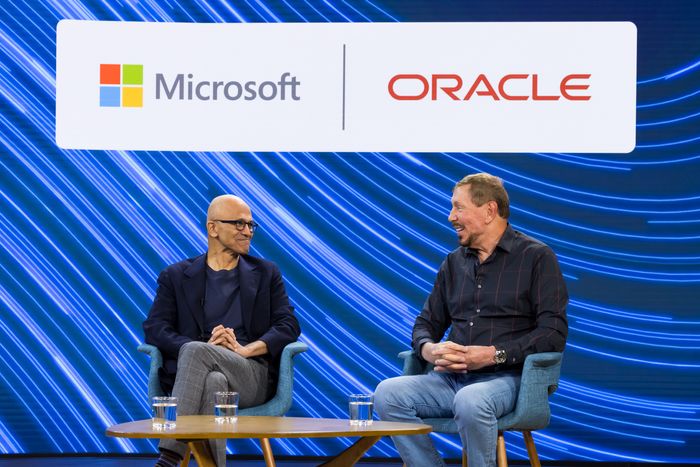
Microsoft’s Nadella and Oracle’s Ellison Discuss the Future of Cloud and AI

Microsoft’s Nadella and Oracle’s Ellison Discuss the Future of Cloud and AI

The most recent iteration of the cloud alliance between Microsoft and Oracle places a strong emphasis on efficiently integrating data and artificial intelligence. This is due to the fact that an artificial intelligence model’s effectiveness is directly correlated with the quantity, variety, and caliber of the training data.

Microsoft’s Nadella and Oracle’s Ellison Discuss the Future of Cloud and AI
Image Source: wsj.com

The firms have been working together in this sector for four years. Oracle, the world’s largest database company, will now physically place its Exadata technology in Microsoft’s data centers, accelerating customer-facing applications.

Customers will therefore have direct accessibility to Oracle database services that are installed in Microsoft Azure data centres and operate on Oracle Cloud Infrastructure.

Instead of running an independent Oracle dashboard, users would be able to manage certain Oracle services from Microsoft’s Azure Cloud dashboard. The goal is to increase application performance while reducing expenses.

From Microsoft’s headquarters in Redmond, Washington, Satya Nadella, the company’s chief executive officer, and Oracle Co-Founder and CTO Larry Ellison spoke with The Wall Street Journal about their collaboration. As stated by Oracle, it was Ellison’s first trip to Redmond.

The Oracle-Azure relationship is positioned to fundamentally alter how companies use AI, with an emphasis on bringing data closer to artificial intelligence (AI) capabilities and opening up previously unimaginable possibilities.

Nadella emphasized the paramount importance of data accessibility in the age of AI. He stated, “In the age of AI, for us, we do need to bring data to where AI is. And that’s what Oracle-Azure really represents.”

Ellison pointed out, “We can now design new drugs in a tiny fraction of the time. We used to be able to do it in a wet lab. We can do it on computers now with AI models, and we’ve seen some very exciting progress already.”

wsj.com

Despite the excitement around artificial intelligence, both leaders recognized that its implementation required caution. Ellison was aware of the worries about technological misuse, a typical worry with every ground-breaking breakthrough. The Oracle-Azure alliance, however, marks a big step towards using AI for the benefit of society and several businesses. This cooperation is positioned to usher in a period of exceptional technical developments that promise to enhance our lives and spur economic growth, with an emphasis on data accessibility, generative artificial intelligence, and ethical deployment.

Databricks Clinches $43 Billion Valuation, Plans More AI Tools

Databricks Clinches $43 Billion Valuation, Plans More AI Tools

Databricks Inc., a leading software provider in the field of data and analytics, has secured a staggering $500 million in new funding, skyrocketing the company’s valuation to a remarkable $43 billion. 

Databricks Clinches $43 Billion Valuation, Plans More AI Tools
Image Source: tradealgo.com

This significant funding round, led by T. Rowe Price and featuring participation from strategic investors Nvidia Corp. and Capital One Financial Corp., underscores Databricks’ unwavering commitment to advancing AI tools. Databricks’ CEO, Ali Ghodsi, expressed his enthusiasm for the strategic partnership with Nvidia, saying, “We’re very excited about this strategic partnership with Nvidia to build custom large language models.” These models are in high demand by corporations eager to harness their capabilities to work with vast data sets and respond to human-phrased queries effectively. Ghodsi added, “This investment lets us double down on our generative AI strategy.”

The company’s strategic shift towards AI is evident, as it has been actively developing its own large language model, which can be utilized by businesses to create their own AI-powered conversational agents, similar to ChatGPT. Nvidia, under the leadership of CEO Jensen Huang, has been a proponent of expanding the application of AI into new markets. The chipmaker has been investing in developing both hardware and software solutions to facilitate the integration of AI into various industries, potentially expediting the adoption of innovative products and services.

In this latest funding round, each share of Databricks is valued at $73.50, a noteworthy achievement that maintains the company’s valuation since its last funding round two years ago, after adjusting for a stock split.

While Databricks has been increasingly perceived as a strong candidate for an initial public offering (IPO), CEO Ali Ghodsi has clarified that there is no specific timeline in mind. Ghodsi’s focus remains firmly on the company’s growth, both organically and through acquisitions. In June, Databricks announced the closure of its $1.3 billion acquisition of Mosaic ML, further solidifying its presence in the AI landscape.

Also Read: Softbank-backed Arm raises $4.87 billion at $51 per share in biggest IPO of 2023

In a press release, Databricks disclosed that it is on track to achieve an annual revenue of $1.5 billion, marking an impressive 50% increase from the previous year. The company boasts a customer base exceeding 10,000 clients, with over 300 of them projected to invest upwards of $1 million annually.

Databricks’ dedication to advancing AI tools and its substantial valuation reflects the growing significance of AI in the tech industry. With this latest funding injection, Databricks is poised to continue shaping the future of AI-driven data and analytics solutions, cementing its status as a key player in this rapidly evolving field. While an IPO remains a possibility, for now, Databricks is content to concentrate on expanding its horizons and pushing the boundaries of AI innovation.

Softbank-backed Arm raises $4.87 billion at $51 per share in biggest IPO of 2023

Softbank-backed Arm raises $4.87 billion at $51 per share in biggest IPO of 2023

Seven years after SoftBank Group Corporation, the business’s owner, purchased Arm Holdings Plc for a price of 32 billion dollars, Arm Holdings obtained a 54.5 billion dollar estimate in its United States initial public offering (IPO) on Wednesday.

The estimated value of the company has dropped from the 64 billion dollars at which SoftBank last month purchased the 25 percent share it did not yet control in the business from the one hundred billion Vision Fund it oversees.

Even with this reduced cost, SoftBank still performs far better than its forty billion-dollar agreement to hand over Arm to Nvidia Corp, which it abandoned last year due to resistance from antitrust regulators.

According to the company’s announcement on Wednesday, Arm raised 4.87 billion dollars for SoftBank through the sale of 95.5 million stocks at a cost of 51 dollars per share, which was the top of its suggested range. The announcement of Arm’s valuing decision was originally made by Reuters.

On Thursday, shares of Arm are expected to begin trading in New York.

Numerous of Arm’s top clients have already agreed to participate as cornerstone investors in the company’s first public offering, which includes Apple, Alphabet, Nvidia, Advanced Micro Devices, Intel, as well as Samsung Electronics.

In an IPO, Arm secured enough support from financiers, according to Reuters, to guarantee at least the high end of the price spectrum between $47 and $51 per share, with the chance that the sale of shares would be priced above range.

Arm started advertising its IPO this week in an effort to persuade investors that it has growth opportunities outside of the mobile phone sector, which it now holds a 99 percent share of.

Also Read: Amazon, Alphabet, Microsoft, Meta Probed by Lawmakers on Use of AI ‘Ghost’ Staff

Arm’s sales have been flat since the global economy has been slowing down due to weak smartphone demand. In comparison to the previous year’s 2.7 billion dollars in revenue, the total for the 12 months ending in March was a price of $2.68 billion.

The cloud computing marketplace, of which Arm only holds a ten percent stake and thus has further room for growth, is anticipated to increase at a yearly pace of 17 percent through 2025, in part because of developments in artificial intelligence, Arm said interested parties in New York last Thursday. It is anticipated that the automobile market, which currently controls forty-one percent of global sales, will rise by 16 percent while the mobile sector is only anticipated to grow by six percent.

Amazon, Alphabet, Microsoft, Meta Probed by Lawmakers on Use of AI ‘Ghost’ Staff

Amazon, Alphabet, Microsoft, Meta Probed by Lawmakers on Use of AI ‘Ghost’ Staff

The chief executive officers of 9 companies, which include Amazon.com Inc., Meta Platforms Inc., Alphabet Inc., Microsoft Corp., as well as International Business Machines Corp., were addressed in a letter by a team of lawmakers led by Massachusetts Senator Ed Markey with Washington Representative Pramila Jayapal on Wednesday. In spite of the fundamental importance of this work, a lot of IT employees around the world carry out these demanding duties under constant scrutiny, with inadequate compensation and no benefits, the letter sent to the chief executives stated.

Amazon, Alphabet, Microsoft, Meta Probed by Lawmakers on Use of AI ‘Ghost’ Staff
Image Source: freetimelearning.com

“Workers are expected to screen out dangerous chatbot answers, but they may have little time to assess an answer’s safety,” they added. “Data workers are often given scant training or supervision, which can result in the introduction of bias.”

news.yahoo.com

The legislators question the executives on a wide range of issues pertaining to their data employees, such as the workers’ capacity to request leave, contest suspensions, or seek out mental health services when exposed to upsetting material.

The recipients of the letter include the more recent companies focused on Artificial Intelligence such as OpenAI Inc., Scale AI, Inflection AI, Inc., and Anthropic in addition to the well-known tech giants.

US corporations depend heavily on subcontracted workers to develop artificial intelligence (AI) products, whether they are based domestically or abroad. These workers are employed through external staffing services and frequently lack the perks offered to direct employees of the company. Companies also depend on similar services for other taxing duties like product quality assurance as well as content monitoring.

When confronted with disturbing pictures, some employees describe experiencing trauma as a way to block them out. According to a January Time article, OpenAI pays Kenyan employees less than $2 per hour to prevent that kind of information from appearing on ChatGPT.

Also Read: Binance US CEO quits as embattled crypto platform slashes one-third of staff

Senators are scheduled to meet with executives from companies like Tesla Inc., Microsoft, Meta, and Alphabet at a closed-door AI summit on Wednesday afternoon organized by Senate Majority Leader Chuck Schumer, who was not one of the politicians who signed the letter.

“These tech moguls are under-paying workers, failing to provide them basic protections and benefits, and subjecting them to an extensive web of surveillance in order to prop up their business,” Markey said in an emailed statement. “When they come to the Capitol to tout their innovation and excellence, I’d like to hear them answer for these disgusting labour practices.”

news.yahoo.com
Binance US CEO quits as embattled crypto platform slashes one-third of staff

Binance US CEO quits as embattled crypto platform slashes one-third of staff

According to a business spokeswoman, US Chief Executive Officer Brian Shroder of Binance has departed the cryptocurrency trading site and has been temporarily taken over by Chief Legal Officer Norman Reed.

The departure occurs as a governmental crackdown destroys the company run by troubled digital entrepreneur Changpeng “CZ” Zhao, which is cutting around one-third of its staff, or over one hundred roles. BAM Trading Services, the trading platform’s official name, was launched in 2019 for American customers who are unable to use Binance Holdings.

The company based in Miami has slashed jobs again this year as a result of a growing number of legal and operational issues.

The United States Securities and Exchange Commission (SEC) charged Zhao, Binance Holdings, and Binance.US in June with violating securities laws, mishandling customer cash, and deceiving investors and authorities. The claims have been refuted by Zhao and the businesses.

The US Commodity Futures Trading Commission accused Binance and Zhao of wilful defiance of federal law in March. The Justice Department is also looking into Binance; it has not charged the business with any violation.

Due to several banking partners suspending relations with the platform soon following the SEC action, consumers of Binance (United States) were incapable to make deposits or withdraw dollars. For users of Binance (United States) to change dollars into cryptocurrency, the company was forced to employ a different approach.

As reported by an analyst, Jacob Joseph, Binance US’s percentage of the worldwide market has decreased to about 0.6 percent from roughly 2.39 in April. According to him, the monthly volume of trading has decreased from early 2020 levels.

Also Read: Adobe Will Charge Less Than OpenAI for Image Generation Tool

“The actions we are taking today provide Binance.US with more than seven years of financial runway and enable us to continue to serve our customers while we operate as a crypto-only exchange,” a spokesperson said in a statement. “The SEC’s aggressive attempts to cripple our industry and the resulting impacts on our business have real world consequences for American jobs and innovation, and this is an unfortunate example of that.”

scmp.com

Following the Securities and Exchange Commission’s action, Binance US fired an unknown number of employees, based on a June Bloomberg story.