Your Tech Story

Tech Story

BlaBlaCar : A Successful Startup that Simplified the Long-distance Journeys


Travelling, for some people is not just moving from one place to the other, but is something which includes emotions. Whether it be homecoming or a trip to one’s dream place, it brings emotion with itself. But the thing is, when it comes to travelling, the fare and the comfort don’t come on the same page. If you need affordable rates, then comfort is something that you need to compromise with, and that goes the other way round when you need high comfort.

But, according to the famous saying, where there’s a will, there’s a way, people have found their way to comfort and affordable travelling through BlaBlaCar. Carpooling, certainly, is a way that gives you the comfort and the affordable rates at the same time. When it comes to carpools, BlaBlaCar is a name that arises from within.

BlaBlaCar is a platform for long distance carpooling. Its app and website connect drivers to passengers who are willing to travel long distances. The benefits of the carpooling service are that the cost of the journey comes into sharing that means you get to experience comfort at an affordable price. Also, the drivers with empty seats get filled in. As of now, BlaBlaCar reaches more than 10 million rides per quarter year. The success story of BlaBlaCar is certainly is the one that inspires depicting that a small picture can be changed into a bigger one.

The idea of the startup came up to the current CEO and the co-founder of the BlaBlaCar, Fredric Mazzella, who in the winter of 2003, decided to visit his home on Christmas. But eventually, he found himself left with no options to travel, as all the trains in France were booked due to the holiday season. He didn’t have a car either, so he was stuck. Luckily, his sister offered him a ride home and during that particular trip, he noticed that most of the cars that were around them, had empty seats. That’s when the idea clicked. He thought, “If I put all those cars with empty seats, in a search engine, such that people can search the available seats in those cars, just like they do while booking a train.” The idea in his mind was something that was unique, and soon after realizing it, he started to work on the same, with his friends Francis Nappez and Nicolas Brusson.
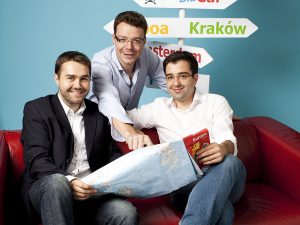
blablacar-founders
Image Source: indexventures.com

However, the journey to build this platform did not start smoothly. The problem that arose was in the implementation of the idea. Precisely, the implementation of a business model was the issue that the co-founders were facing.

In 2006, when the service was launched, it was the ‘Premium Model’ of the platform, that was released first. This model was free to use, but users could pay a monthly or annual fee to get their service higher on the search engine. But the model was discarded, as soon as the company realized that money won’t benefit in the long run and also, that the model could be unfair to many of the users.

Then, BlaBlaCar jumped to ‘Monthly Fee’ plan, but it too was eliminated. Then, they picked up an advertising model, but keeping users’ privacy at stake was unacceptable.

Then the company induced ‘Phone Bridge Model’ into their system. In this model, users could choose to hide their contact numbers while remaining reachable via a pay telephone bridge. But the catch here was that if the company wanted to go global, then the telephone operators all over the world were different. So, this effort also went in vain.

Once during this phase, Fredric asked his M.B.A. professor at INSEAD that whether it’s possible to run a business, without a business model, to which, he replied, “You need a business model or you’ll die!” Those words gave Fredric so much motivation that he ended up on the idea to take risks and learn. As a result, it took 5 years for the company to restructure itself.

Soon, the company saw that there were other companies, like Carrefour, IKEA, that wanted to give services of BlaBlaCar to their employees. After that, there was no stopping, as 200 more companies bought the BlaBlaCar service for their employees. But in 2012, this business model was again put to an end, as each company’s each employee had different requirements which made it difficult to give a collective solution.

But with today’s business model that BlaBlaCar has put into effect has helped them reduce their cancellation from 35% to around 2.5%.

The company has a motto of FAIL. LEARN. SUCCEED. As a result of its past experiences, the company is open to failures and openly says about them. But they ensure that once a mistake is committed, it won’t be repeated. BlaBlaCar has grown all over Europe, and Asia too. For now, the company serves in more than 22 countries, including India, the United Kingdom, Spain, Germany etc. BlaBlaCar, currently, is also in talks with France’s National Railway company SNCF for its bus division, so that the platform can provide bus services, too.

The startup that started as a minor one has gained more than $1.5 as funding. The company itself generates revenue of around $91 million. It’s worth, too, is $1.5 billion, which makes it the mater on its own.

The success story shows that personal needs can also be turned into a million-euro idea. It gives us the glimpse that how much innovative ideas our surroundings hold for us. Who knew that the startup which was such a unicorn sized, would grow up to such an extent that it will serve more than 22 countries. The success story of BlaBlaCar is certainly a one filled with eternal inspiration.

Min-Liang Tan : The Lawyer, Turned Billionaire Gaming Tycoon

Having your name ranked with leaders like Elon Musk and Jack Ma, in the Top 10 Most Influential Leaders in Tech, is a real achievement, and when you are a non-tech person, then it is huge. It’s the Singaporean entrepreneur, Min-Liang Tan, who got his name ranked ahead of these two tech savvies. Tan studied law and eventually, ended up starting up a tech company, i.e. Razer and became one of the most influential people in the Tech world. This billionaire from Singapore is in love with video games and shares an inspirational story with the world.

Early Life

Tan was born on 5 November 1977, in Singapore. His father, Tan Kim Lee, worked as a real estate consultant and his mother, Low Ken Yin, is a homemaker. He has three siblings, one of whom is the famous clinician-scientist Min-Han Tan. One of the other two is also a doctor, and one is a renowned lawyer.

He completed his primary education from Raffles Institution, and then, attended the Hwa Chong Junior College, to pursue high school education. Later, he went to join National University of Singapore Faculty of Law and received a bachelor’s and master’s degree in Law. He got ranked 20 in his master’s degree.

Early Career & Founding Razer

As soon as he completed his education, Tan started working as an advocate and solicitor for the Supreme Court of Singapore. But the future had held some other plans for him.

Tan, since his childhood, loved playing video games, as he was not much into outdoor games. His father had brought an Apple II computer, for him and his brother, upon which he played lots of games.

Image Source: alchetron.com

The idea of starting a video gaming peripheral manufacturing company came up to Tan, when he met the future co-founder of Razer, Robert Krakoff, through a social media website, in 1999. The two coincided on their interest for video games and started working together to design the world’s first gaming mouse – the “Razer Boomslang,” when Tan was still in college. Even, after graduating in 2002, along with his job as an advocate, he devoted most of the time on working for Razer.

Finally, in 2005, the two acquired the rights to the Razer brand and Founded the company Razer. The two headquarters of Razer are located at San Francisco and Singapore. Tan holds the post of the CEO of the company.

The company produces the peripherals for gamers, and the software for those peripherals, but does not publish games. The motto of the company is “For Gamers. By Gamers”, as both of the co-founders are avid video game lovers.

As one of the first products of Razer, the Razer Boomslang was more responsive, accurate, and faster than what tech companies were producing at that time, it attracted the attention of many venture capitalists. The company started obtaining funding from many investors, and it started manufacturing other gaming hardware, including headsets, a handheld gaming device, the Razer Edge gaming tablet computer and Razer Blade laptops, etc.

In 2015, Razer acquired software division of video-game company Ouya. It also acquired THX in 2016 and Nextbit in 2017.

In 2017, the company went public through an IPO in Hong Kong and was the 2nd most successful IPO of 2017 in Hong Kong stock exchange. In November 2017, the company launched its first Smartphone named Razer Phone.

Personal Life

Tan, currently, lives in Singapore in his family house with his parents. However, he keeps travelling back and forth from Singapore to San Francisco. Tan despite being an owner of a gaming hardware manufacturing company lives a life of a celebrity as many of Singapore people consider him as their idol. People get tattoos of the company logo, and one of them even tattooed Tan’s face on his arm.

In 2015, Tan was listed among the “Top 10 Most Influential Leaders in Tech” by Juniper Research. He was also named in the list of “The 25 Most Creative People in Tech” by Business Insider and was ranked one of the top 40 most powerful people in gaming by Kotaku. TechinAsia ranked him No 1 of the 30 top South East Asia tech founders and was also named the Asian of the Year in 2016 by the Straits Times.

In 2016, he was among the Forbes Singapore Rich List with a net worth of $600 million and was the youngest Singaporean self-made billionaire.

Tan is also in philanthropy and in 2014, he donated a US$10,000 to raise funds for ALS and a £10,000 to fight Motor Neuron Disease, in 2015.

Warby Parker : The Story of the Most Innovative Startup of America

Buying goods online is the most convenient way to get things delivered to your doorstep. At present, there is almost nothing that you can’t buy online. Food, grocery, clothes and air tickets, you can get all these things just in a few clicks. Although almost ten years ago, there were limited things that you could order online, slowly the list got enhanced. One such thing that added to the list of the online available items was the customized eyewear, that was introduced by the famous Warby Parker.

The online merchandise was founded by Neil Blumenthal, Andrew Hunt, David Gilboa, and Jeffrey Raider, four students from Wharton, in 2010. The company was founded in Philadelphia and its headquarter is located in New York City.

Image Source: pinterest.com

It was the time when the four friends were sitting in their college lab and discussing how and why the eyewear was so expensive, and there came up the idea of launching a website to sell eyeglasses online. All four of them were convinced that it will be really convenient for people to buy eyewear online. They also discussed the idea with their teachers and got motivated when they too liked the idea.

At the same time, their college hosted an event, the Venture Initiation Program, that was organised to grant money to the new businesses. Luckily, the four got the grant. The grant was worth $2500 which played as the seed money for the launch of Warby Parker.

The four launched Warby Parker after they went through a one-month marketing training. The name for the company came from a journal by author Jack Kerouac.

At the time Warby Parker was launched, the eyewear industry was already dominated by other big company named Luxottica. Luxottica sold the most stylish eyewear at that time and had every brand available at its stores. The problem with the company was that it was selling every brand, but was putting a big price on it.

It was a golden opportunity for Warby Parker, as it was an online store and was letting customers try on five pairs at their homes. The products sold on the site was also affordable, with a starting range of $95.

According to co-founder of Warby Parker, Gilboa, “The idea was really based on two simple premises. One is that a pair of glasses should not cost more than an iPhone, and two, that eyeglasses could effectively be sold online.”

The idea was unique and was providing people with affordable eyewear sitting at their homes. Within a year of its launch, Vogue covered the story. This helped the company with its marketing.

Later, in 2011, the company earned its first round of funding of worth $2.5 million. In the month of September, in the same year, it raised a Series A round funding of $12.5 million, following by a $37 million Series B round funding in the next year. In 2013, American Express and Mickey Drexler invested a $4 million in Webly Parker.

In 2011, the company had sold over 10,000 pairs of eyeglasses, and the company grew to 60 employees.

Next business move that the company took was to launch a physical store. In 2013, Warby Parker launched its first pop-up shop with the name ‘Holiday Spectacle Bazaar’ in a garage in SoHo, New York. Going offline from online was considered a crazy move by many, but it only raised the popularity of the company. Later, they also opened another shop in a school bus, which functioned for a long 18 months.

Now, the company has its physical stores in over 15 different cities. In 2015, the company was valued at $1.2 billion.

Then in 2016, following the footstep of its rival Luxottica, Warby Parker announced to launch its own optical lab in Rockland County, New York, to have its own manufacturing, in order to bypass the middlemen expenses. The company also announced that it would invest $16 million, to build the 34,000-square-foot manufacturing unit, and will employ over 130 people.

In 2018, Warby Parker raised $75 million in Series E funding, making its total funding about $300 million.

The Warby Parker also contributes in the philanthropic works, as it donates a pair of glasses on every pair of glasses sold by the company, under the “buy one, give one” model. In June 2014, Warby Parker reported the donation of 1,000,000 pairs of eyeglasses. The company also claims to be 100% carbon neutral.

The success story of Warby Parker is no less than any other inspiring story. From the story, we learn the importance of people, as the reason behind the success of this company was that it focussed on its customers and their needs.

Todd McKinnon : The Founder of Okta, a Company that Specializes in Enterprise Security

Taking risks, is what most of the people are afraid of, especially, when they are running in their late 30s. At the time when people are earning enough money by working under someone else, it was Todd McKinnon, who wanted to pursue his childhood dream of becoming an entrepreneur. Even he was heading a team of more than a hundred employees in his last company and was earning an adequate amount of money to survive in a place like Silicon Valley, he decided to leave the job and just work for his dream. Having years of experience and a great vision, today, he is the founder of a billion dollars company, Okta.

Early Life

McKinnon was born in Southern California and grew up in its bay area. His father was a VP of HR, who worked for various different companies, and his mother was a homemaker.

He completed his under graduation from Brigham Young University, and later, went to the California Polytechnic State University, where he completed a degree in computer science.

Career

McKinnon finds himself lucky, to be born and brought up in the capital of technology. Being a native of Silicon Valley, since his childhood, he was convinced that he would work for an IT company in Silicon Valley.

ToddMcKinnon
Image Source: sbnonline.com

During his graduation, he got recruited by PeopleSoft, in the campus placement, in 1995. At the time, he was building a database application for the recreation department on campus. Co-incidently, the recruiter from PeopleSoft was also working on a similar project and liked Mckinnon’s work and recruited him.

McKinnon was hired as an engineer in the company and received multiple promotions in the span of eight years.

After working for eight long years in PeopleSoft, in 2003, McKinnon left the job and started working at SalesForce. In 2009, he left SalesForce to start his own company, i.e. Okta.

Founding Okta

Besides the dream of working in a Silicon Valley company, McKinnon was also fascinated with the idea of starting his own business. The reason he gives for not starting a business earlier is that he always had good jobs in hand, and those were helpful in gaining good business experience.

In SalesForce, he was managing over hundreds of employees, and he had got a good reputation. He decided that it was the right time to start a business, as he was financially and mentally capable of doing that at the time.

At the same time, people got introduced to the cloud, and not many were sure how long it is going to last. But McKinnon saw an opportunity in the same. He started off developing with a macro product, and when he went out to talk and sell the product to people, he realized there was much more to the cloud, and finally, started working on identity management on the cloud.

McKinnon pitched the idea in over 75 meetings in a span of four to five months. He also asked a former SalesForce colleague, Freddy Kerrest, to join him for the startup, and finally, after seven months of hard, work was able to raise a million dollars seed funding to start the business and founded Okta in 2009. Okta provides cloud software that helps companies manage their employees’ passwords, by providing a “single sign-on” experience.

The company earned its first paying client, in December 2009. In 2015, the company was valued at $1.2 billion and raised $75 million in venture capital from Andreessen Horowitz, Greylock Partners and Sequoia Capital.

In 2017, the company went public, and in its IPO it raised $187 million. Okta has its offices in Bellevue, Toronto, London, Amsterdam, Sydney, San Jose and Washington D.C., and its headquarter is located in San Fransisco. In January 2019, the company reported a number of 100 million registered users on Okta and the company valued at over $7 billion.

Personal Life

McKinnon is married and has two children. He lives with his family in San Francisco. He is a fitness freak, and in 2017, he was named as the 14th fittest man on earth in the age group of 45-to-49, in the annual CrossFit Games, held in Madison, Wisconsin. Currently, he serves as the CEO of Okta.

Daniel Borel : Swiss Entrepreneur & Co-founder of Logitech

In any business, you must keep an eye on the upcoming opportunities and grab it as soon as it shows up. In business, the success comes to those, who keep the courage of doing the same thing in a different way. One of such business personality from Switzerland is Daniel Borel, who always knew that he wanted to do something big and that big thing resulted in a multimillion tech company, i.e. Logitech.

It was Borel’s capability to see in the future such that he was sure that starting a business of mice manufacturing, that was just arrived in the market and could be a risky one, surely will lead him to success. Today, Logitech is not only world’s largest mice manufacturing company, but it also supplies other products including remote controls, security cameras, keyboards, webcams, speakers, B2B video conferencing equipment, computer accessories, gaming products, etc. at a global level.

Early Life

Born, on 14 February 1950, Daniel Borel is a native of Switzerland. In 1973, he completed his graduation in Physics from Ecole Polytechnique Federale de Lausanne. Even being a physicist, he wanted to do something else, so he switched to computing and in 1977, did his masters in computer science from Stanford University.

Early Career & Founding Logitech

After his post-graduation, Borel moved to the Silicon Valley. It was a huge culture shock for him, as people were working on innovative ideas and the technology was changing at a rapid rate. This inspired him a lot, and he along with, Pierluigi Zappacosta, one of his friends from Stanford University, started working on word processing.

Borel Logitech
Image Source: itreseller.ch

The two were doing quite well in both software and hardware, and at the same time, they started Logitech. They started the company in a farm of Borel’s father-in-law in Apples, Vaud, Switzerland in 1981, along with a former Olivetti engineer, Giacomo Marini.

At the time, around the early 80s, the computer mouse had just arrived in the market along with the personal computer. Borel found an opportunity in the same, and as he was already in contact with big companies like Apple and HP, he decided to manufacture mice for those companies.

Borel, as already had made plans on manufacturing computer mice and its software interface, visited Taiwan and China, to look for companies that could help him manufacture them. At the time, Microsoft also had started using the mouse for its word processor.

Logitech was successful in developing mice for the personal computers, along with a software interface, and approached Microsoft in order to sell those mice to it. Microsoft also showed an interest, but the deal never happened. At last, Borel had to adopt another marketing technique. He published coupons along with an ad in the Byte magazine, where he offered a price as low as $100 for the Logitech mouse when others were selling the same at $170.

The marketing technique went quite well, and Logitech was showered with orders. Since then, the company is growing at a rapid rate and has developed many other products under its name.

In the year 2008, Logitech reported the manufacturing of over one billion mice since 1985. In the same year, the company acquired Ultimate Ears, a supplier of Bluetooth speakers and custom in-ear monitors for professional musicians. In 2011, it also acquired the mobile visual communications provider, Mirial and in 2017, it acquired Astro Gaming.

As of 2018, the reported revenue for the year was US$2.57 billion, and a number of its worldwide employees have grown to 7000 people since its inception. The the two of its headquarters are established in Lausanne, Switzerland and Newark, California, USA.

Personal Life

Borel worked as the chairman of the company between 1982 to 2008, and as the CEO of the company from 1982 to 1988 and 1992 to 1998. Currently, he serves on the board of directors of Logitech and Nestlé. He has also founded Defitech, a foundation to make computer technology for handicapped people, where he also serves on the board of the company.

YouTube Seeking for Creator’s Suggestions for the Perfect Fix Against the ‘Dislike Mob’

YouTube has given some simple options for its users, including liking and sharing the videos, and if they do not like one, they can just hit the dislike button. But from quite some time now, some of the users are misusing the dislike button, and YouTube is well informed of it.

youtube
Image Source: tubefilter.com

YouTube has been noticing that people are weaponizing the dislike button, and now have decided to act on the issue with the help of its development team. Currently, it is seeking ideas through its creator’s feedbacks and advice from its development team, on how to stop people from misusing the dislike button. Tom Leung, the director of project management at YouTube, in the recent issue of Creator Insider, talked on how the ‘dislike mob’ is harming the content on YouTube.

The ‘dislike mob’ is a group of people, who dislike the videos of a certain YouTube channel or creator, in order to attack their reputation, or just because they are upset with the creator, even without watching the videos.

YouTube has provided its users with the facility to make their videos private on their channel, or they can make the other matrices, including total likes and dislikes on the videos, invisible. Leung has suggested YouTube must make the hiding the likes and dislikes options as default, and the users who want to display the ratings can make the changes from the settings.

Leung has also advised adding a comment box, where the person who wants to dislike a video, has to give a reason behind disliking the video. The user also can opt for the ‘don’t want ratings’ option.

Since the ratings of the videos help in the channel growth, we cannot expect that all YouTubers will support the same. But many of the creators, after they got to know about hiding the ratings, have adviced that the dislike button should appear only after the video has played for at least half of its time.

Currently, YouTube is looking for more and better options to avoid the activities from the ‘dislike mob’, and has not decided on what it will be doing in the same matter, but soon we can see YouTube getting rid of this issue.