Infosys Bucks Global Trend, Asks Some Staff Back in Office 10 Days a Month

I am a law graduate from NLU Lucknow. I have a flair for creative writing and hence in my free time work as a freelance content writer.
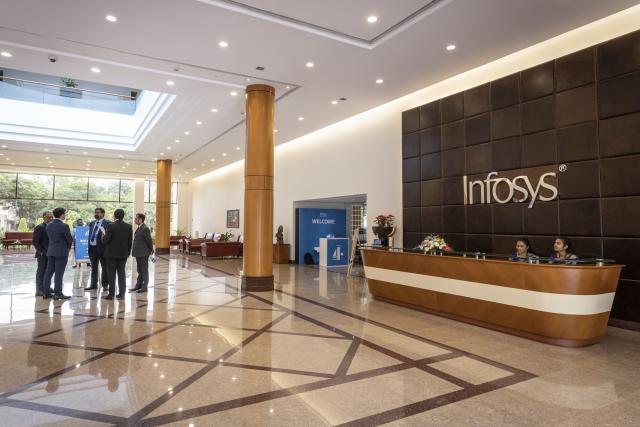
Indian tech giant Infosys Ltd. is making headlines by defying the global trend and asking some of its employees to return to the office for a minimum of 10 days a month. This decision comes in stark contrast to many of its global peers who are moving towards greater remote work flexibility.
Image Source: ca.finance.yahoo.com
This change follows a controversial statement by Infosys co-founder Narayana Murthy, who suggested that young Indians should work 70 hours a week, a stance that is at odds with Infosys’s official position on providing complete flexibility to its employees.
Infosys is not the only Indian IT services provider to ask employees to return to the office. Its larger Indian rival, Tata Consultancy Services Ltd., had already requested many of its employees to return to the office for five days a week, starting from October 1. This shift is driven by the desire to enhance efficiency as demand for their services faces challenges amidst a global technology spending slowdown.
On the global stage, major tech companies are also opting for office-centric approaches. Amazon.com Inc. in the United States has been taking measures to ensure that employees adhere to its mandate, requiring them to work in the office for three days a week. Alphabet Inc.’s Google faced backlash for its similar office return policy.
Infosys’s Chief Executive Officer, Salil Parekh, emphasized during an earnings call that the company is witnessing an increase in employees returning to the office, despite maintaining a flexible work policy. He explained, “There are some instances, for example, with specific client work or specific types of engagement where we feel it’s better that everyone is working together. But in general, our view is we want to support this flexible approach. It’s something that we believe is appropriate given how we’ve set up the work-from-home infrastructure.”
As Infosys deviates from the prevailing global trend toward remote work, it remains to be seen how this move will impact its workforce and whether it will influence the wider Indian IT services industry’s approach to office work in the post-pandemic era.

I am a law graduate from NLU Lucknow. I have a flair for creative writing and hence in my free time work as a freelance content writer.
Setting up an HP printer with Wi-Fi usually involves a few steps. These instructions will guide you through the process for most HP printers, although some specific models may have slight variations.
Image Source: amazon.in
Insert the CD that came with the printer into your computer and follow the on-screen instructions. If you don’t have a CD:
If you want to print from a mobile device:
Following these steps will help you set up your HP printer with Wi-Fi. If you encounter any problems, refer to the specific user manual for your printer model or visit the HP Support website for more assistance.
Vodafone Group Plc has announced an agreement to sell its Spanish business to Zegona Communications Plc, a London-based acquisition vehicle, in a deal valued at up to €5 billion ($5.3 billion), including debt. This strategic move reflects the evolving landscape of the telecommunications industry in Spain, where Vodafone has faced challenges and seeks to capitalize on new opportunities.
Image Source: rte.ie
To finance this significant transaction, Zegona has successfully raised debt of €4.2 billion and secured a committed revolving credit facility of €500 million. Additionally, Vodafone will provide up to €900 million in financing through an investment vehicle that will acquire new shares of Zegona, further cementing their commitment to the deal.
The market reaction to this transaction has been mixed, with Vodafone shares declining by 1.1% to 75.9 pence at the time of the announcement. Some experts, such as Karen Egan from Enders Analysis, have characterized the deal’s valuation as potentially disappointing. Egan cites factors such as higher interest rates, the uncertain competitive and regulatory environment in Spain, and Vodafone’s eagerness to close the deal as contributors to this perception.
Vodafone’s move to divest its Spanish unit comes after the company’s acquisition of Spanish cable operator Ono in 2014 for €7.2 billion, leading to a reported €2 billion loss on that transaction alone. Zegona’s decision to acquire this unit indicates their belief in the potential for a turnaround and profitability in the Spanish market.
Zegona’s Chief Executive Officer, Eamonn O’Hare, stated in an interview that the company plans to raise between €300 million and €600 million in equity on the market to reduce its leverage to less than three times its earnings. This strategic shift aims to strengthen Zegona’s financial position and position the company for further success in the Spanish telecom market.
Notably, Zegona has previously played a pivotal role in reshaping the Spanish telecom landscape. Founded in 2015 by former Virgin Media executive Eamonn O’Hare, the company has previously bought and sold Spanish operator Euskaltel SA to Masmovil Ibercom SA, which reduced the market from five players to four. This acquisition significantly impacted the industry and paved the way for further consolidation.
However, the merger between Masmovil and France’s Orange SA is currently under examination by the European Commission. If approved, it would reduce the market to three major players, potentially opening the door to more telecom consolidation across Europe.
Zegona is embracing this uncertainty as an opportunity, indicating that if the Orange-Masmovil deal proceeds, Zegona-owned Vodafone could emerge as an alternative merger partner for Masmovil. Additionally, Zegona plans to explore wholesaling on Vodafone’s fixed network and consider network sharing or combining strategies to maximize infrastructure efficiency, a move that could enhance the industry’s competitiveness.

I am a law graduate from NLU Lucknow. I have a flair for creative writing and hence in my free time work as a freelance content writer.
The tech-savvy population in the finance sector is getting ready for a new age driven by artificial intelligence, but they aren’t quite willing to accept the technology completely just yet.
Sixty-two percent of quantitative or systematic financiers with US$22.5 trillion under management responded to an Invesco study predicting that artificial intelligence (AI) will be as essential as conventional analysis in ten years, and 13 percent said that it would be even more so.
Image Source: finance.yahoo.com
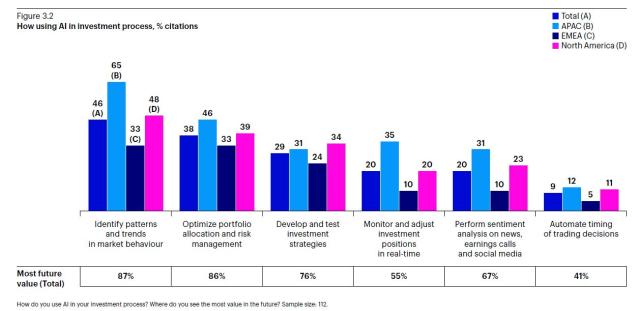
However, people were divided when asked how they currently use the technology, only nine percent said they utilise it thoroughly, thirty-eight percent said they utilise it to a certain extent, and the other respondents indicated they don’t use it at this time.
The difference illustrates the dismal rate of adoption of artificial intelligence on Wall Street at the same time as the technology’s hype reaches a fever peak.
While financiers have resorted to using machines to do activities like analysing market trends or searching the news for trade signals, they have mostly refrained from using them to make real allocation choices.
“People don’t believe this is an easy thing,” said Bernhard Langer, chief investment officer of Invesco Quantitative Strategies. “Yes, AI is a huge toolbox. Big data is opening new horizons. But I have to be careful and understand what I’m doing.
Despite their hesitation, the majority of participants in the yearly quantitative poll proposed using AI to detect patterns and trends in the market, highlighting the technology’s enormous potential to improve the performance of portfolio.
Proponents claim that artificial intelligence (AI), or its information-driven offspring machine learning, would prove more adaptable to shifting markets due to the fact it is more adept at identifying complicated correlations between various factors.
The study revealed that the quality of accessible data was the second most perceived problem of artificial intelligence, behind the complexity and comprehensibility of the models.
In the meanwhile, almost all responses stated that people choose their stocks using factors, which is a conventional method of doing so that takes into account a security’s attributes.
However, the majority stated that people anticipate increasing their adjustments to these transactions in the upcoming years as the market climate evolves.
“We are living in difficult times,” Langer said, citing the political environment and rapid rate increases. “People are looking for ways to weather the storm and to be more dynamic is an answer – if this answer is successful.”

I am a student pursuing my bachelor’s in information technology. I have a interest in writing so, I am working a freelance content writer because I enjoy writing. I also write poetries. I believe in the quote by anne frank “paper has more patience than person
Meta Platforms Inc., the parent company of social media giants Facebook and Instagram, is set to introduce a new subscription service in Europe, offering users the option to enjoy ad-free access to these platforms. The move comes as Meta seeks to adapt to the ever-evolving landscape of data privacy regulations and user expectations in the European Union (EU), European Economic Area (EEA), and Switzerland.
Image Source: businesspost.ie
Starting from November, European users will have the opportunity to subscribe to ad-free versions of Facebook and Instagram. There will be two pricing options available: a web-based subscription at €9.99 per month and a mobile subscription via Apple Inc.’s and Android’s operating systems, priced at €12.99 per month. This initiative marks an important step for Meta in providing its users with a choice to experience their favorite social media platforms in a new, uninterrupted way.
The decision to introduce these subscription services is in response to the escalating regulations surrounding the collection and utilization of user data in Europe. A key factor influencing this development was the ruling by the EU Court of Justice in July, which emphasized the importance of companies providing alternative, privacy-respecting services, “if necessary for an appropriate fee.” In line with this decision, Meta is now offering its European user base a paid alternative that excludes ads.
Meta intends to maintain its existing ad-supported services in these regions at no extra cost to users. This means that individuals who choose not to subscribe will still have access to the familiar ad-supported versions of Facebook and Instagram. The company emphasizes that this move is about offering greater choice to users, allowing them to decide how they prefer to engage with these platforms.
Ad-free subscriptions have become an appealing option for users who value their online privacy and want to have a more streamlined and uninterrupted social media experience. By introducing these subscription plans, Meta is addressing the demand for enhanced privacy options and demonstrating its commitment to adapt to the changing regulatory environment in Europe.
This announcement follows Meta’s broader efforts to enhance data privacy, including its plans to move user data from Ireland to the United States, which is driven by the EU’s concerns about data transfers. The introduction of ad-free subscriptions is yet another step in the company’s strategy to navigate the complex web of privacy regulations while ensuring a positive user experience.
As the world of online privacy and data protection continues to evolve, Meta’s decision to offer ad-free subscriptions in Europe is a proactive response to the shifting landscape. It represents a crucial step in providing users with a choice that aligns with their personal preferences and respect for their digital privacy. The subscription services set to launch in November signal Meta’s dedication to maintaining a strong presence in the European market and ensuring the satisfaction of its diverse user base.

I am a law graduate from NLU Lucknow. I have a flair for creative writing and hence in my free time work as a freelance content writer.

As the pre-winter leaves turn orange and the evenings grow longer, comes the opportunity to embrace the unsettling spirit of Halloween. Whatever the case, in this advanced age, it’s not just about pumpkins and costumes. With a mix of novelty, the current year’s celebrations can be more grand and spectacular than any time in recent memory. Following are 5 unique Halloween tech tricks and treats to redesign your spooky fun.
While old-fashioned ghost stories around open-air fires retain their appeal, the 21st century offers a technological twist: AR ghost hauntings. Some applications allow you to place virtual ghosts, devils, and other terrifying animals in your real environment. Welcome mates and challenge them to a ghost chase on your lawn or front room. As they investigate with their cell phones, they will encounter tormenting spirits that appear to be very real.
Image Source: digitalbodies.net
Gone are the days of relying exclusively on candles for that funky glow. Amazing bulbs can transform your home at the push of a button. Use them to create a ghostly vibe by programming the lights to brighten, turn a deep red, or even sync with a hair-raising soundtrack. Their fantastical examples may antagonize and shock uninformed visitors, generally speaking, instilling fear in them.
Stand out from the group with a custom Halloween frill made from a 3D printer. From extraordinary covers to esoteric gems, the potential results are overwhelming. Plan your own pieces or download formats from online networks. You can create pieces that perfectly complement your Halloween troupe, guaranteeing your participation at any party or gathering.
For those looking for intense terror, computer-generated reality takes care of you. Plunge into shocking situations, from scary places to dystopian scenes full of corpses, without leaving your home. Do a VR headset and immerse yourself in these cool worlds, making it a Halloween experience you’ll probably remember forever.
Rethink trick-or-treat insights with a human-made intelligence-fueled sweets dispenser. Instead of a traditional bowl of sweets, this tech-infused treat machine can prompt youngsters to take action, answer a puzzle, or even identify their group type before giving them candy. It adds a touch of spontaneous fun to the process of sorting sweets, which has a lasting impact on the stunt.
Overall, as innovation is progressing and permeating every part of our lives, why not integrate it into our festivals too? These Halloween tech tricks and treats offer a blend of the traditional Halloween spirit with a cutting-edge twist, promising a supreme and novel experience for all. So this year, move beyond the norm and allow novelty to intensify the creepy silliness!