Your Tech Story

Tech News

basic with ads

Netflix to charge $6.99 a month for ‘Basic With Ads’ Plan

Beginning in November, the American streaming provider Netflix will launch a new, inexpensive tier subscription “basic with ads” that is supported by advertisements.

basic with ads
Image Source: financialexpress.com

In twelve nations, Netflix will launch a subscription model in November that is subsidized by advertisements as the company attempts to increase sales and subscriber numbers. The subscription, dubbed “basic with ads,” will cost $6.99 in the US, $3 cheaper than the country’s basic option without advertisements.

Netflix battled user churn after suffering the largest-ever quarterly decline in subscribers recently in June. This new model will soon launch in Brazil, Australia, Britain, Britain, Canada, Japan, Germany, Italy, South Korea, Mexico, France, and the United States. This ad-supported subscription is a first for Netflix. This move is a significant change for a company that pioneered the concept of ad-free membership-based streaming.

Users of Netflix’s “Basic with ads” tier won’t be able to download films and television shows, and there will often be four or five minutes of adverts every hour. Due to licensing limitations, a few TV shows and films will initially be inaccessible.

Before and throughout Netflix’s content, there will be 15-30 second advertisements. Firms will be able to stop adverts from showing up on content they consider objectionable or nasty. Nielsen, a rating business, will start using its Digital Ad Ratings in the United States in 2023 to assist marketers in understanding its reach.

When Disney+’s ad tier debuts in December, it will cost $7.99 per month, while Hulu will cost $7.99. Netflix is less expensive at $6.99 per month. The monthly cost of HBO Max with advertisements is $9.99.

Netflix has set the price of the service such that any customers who convert from the ad-free standard plan to the ad-supported plan will have a “neutral to positive” impact on the business’s income. This indicates Netflix will earn at least $3 in advertising income per customer each month.

Instead of 1080p, the resolution of Netflix’s normal plan, which costs $15.49 per month, the video resolution for the ad-tier plan will be 720p. The company’s entry-level plan, which features 720p resolution but no advertising, costs $9.99 per month.

Netflix referred to the new tier as “pro-consumer” during a press conference where it unveiled it. It also revealed that its inner content tagging specialists were charged with locating natural breakpoints in numerous series and movies to insert adverts in.

As reported by The Verge, Netflix’s ad tier is a reaction to an unexpected slump for the streaming service, which earlier this year lost over a million users in the United States and Canada. The company also saw a decline in its stock price as a result of investor doubts that its phase of significant growth has come to an end.

Although the company has stated that it aims to roll out the new ad tier in more countries over time, India is not among the 12 countries wherein Netflix is first introducing the ad-supported plan. Given the price-sensitive character of the Indian market, it is important to note that Netflix offers some of the most affordable subscription plans when compared to its offerings in other regions.

Netflix plans in India start at Rs 149, or roughly $2 per month for phone devices only. The cheapest Netflix subscription in India starts at Rs 199 per month, which translates to about $2.6 per month for other devices such as smart televisions. The “regular” version of the streaming service costs Rs 499 per month in India, offers high-definition content streaming across two devices, and is ad-free.

ad space for TV+

Apple to sell ad space for TV+ next year

Tech behemoth Apple is allegedly in talks with executives from media companies and networks about the prospect of offering ad space for TV+ streaming platform, possibly as early as next year.

ad space for TV+
Image Source: siasat.com

According to media reports, Apple intends to sell video ad spaces in early 2023, presumably for its Apple TV+ platform.

As per reports, Apple wants to increase its advertising revenue from its current level of $4 billion annually to double-digit numbers through this ad space for TV+. Apple executives believe TV+ has untapped potential. The company’s advertisements are currently dispersed throughout display adverts for applications in the App Store, News and Stocks applications, and other apps on iPhone, iPad, and Mac. While some shows on Apple TV already have featured adverts, these did not come for Apple.

Ad-supported tiers also aid in curbing price rises as streaming providers put more emphasis on profitability than subscriber growth. In December, Disney+ will introduce an ad-free tier for the same $7.99 monthly fee as the current ad-free tier.

Apple’s involvement in live sports is also tied to the availability of its video ad inventory. On the TV+ platform, MLB Friday Night Baseball has already generated some advertising revenue, but so far, MLB Network, not Apple, has been the seller of these commercials.

Eddy Cue, Apple’s executive VP of services, claimed to have reorganized services management in May to put a greater emphasis on streaming and adverts.

In order to entice users on a budget, streaming providers Disney and Netflix are also attempting to develop ad-based monetization strategies. They are expected to unveil their plans within the next few months.

By 2022, Netflix also plans to introduce an ad tier for subscribers. The decision was taken after the company experienced a significant decline in revenue for the very first time in ten years.

Comparatively speaking to Netflix and Disney, Apple’s customer base in the streaming industry is modest. The tech giant has nonetheless received praise for its high-end, award-winning shows and its expanding sports coverage.

In a period of rising inflation and economic insecurity around the world, an ad-based tier might attract more price-conscious users to the company. Next year, Apple will also broadcast Major League Soccer events. Apple is also expected to secure the rights to broadcast NFL Sunday Ticket along with other major sports events.

Millions of prospective viewers will watch these live sports programs, which will increase advertising sales. Currently, an Apple TV+ membership in the United States costs $4.99/month or $49.99/year.

Apple, though, is fully committing to the “premium content” brand. It might adopt a price increase for its ad-free membership along the lines of Disney+ and launch an ad-supported tier at the existing $4.99 pricing. Additionally, Apple TV+ features a tonne of acclaimed, brand-friendly programs like “Ted Lasso” and “The Morning Show” that marketers would undoubtedly want to capitalize on.

Some of Apple’s Big Tech competitors have expressed disapproval of the company’s growing ad presence. However, since so many streaming platforms are entering the ad-tier market, Apple TV+’s decision will be considerably simpler to defend.

Apple Inc. owns and runs Apple TV+, a paid streaming service available in the United States. It debuted in 2019, and it offers a variety of original movies and TV shows under Apple Originals production.

5G enabled

Smartphones above Rs 10,000 to be 5G enabled soon

Representatives of mobile phone manufacturing firms held a meeting with top government officials on Wednesday and assured them that they would gradually discontinue production of 4G phones priced at Rs 10,000 and above and are going to switch to 5G enabled phones.

5G enabled
Image Source: mysmartprice.com

Top officials from the Department of Telecommunications (DoT) and the Ministry of Electronics and Information Technology (also known as MeitY) met with mobile operators and smartphone manufacturers, telling them to launch 5G services with 5G enabled smartphones within three months.

Highlights

  • Smartphones estimated to cost more than Rs 10,000 will soon switch to 5G.
  • The government met with mobile operators and smartphone manufacturers.
  • Bharti Airtel has initiated launching 5G in eight cities.

On Wednesday morning, top officials from both ministries met with representatives from the country’s mobile operators and smartphone manufacturers. On the condition of anonymity, a smartphone company official told ANI that smartphone makers will gradually shift to 5G phones priced at or above Rs 10,000.

According to him, India has approximately 750 million mobile phone users and among which, 100 million subscribers have 5G-ready phones, but more than 350 million people use phones that are only 3G-4G compatible. He stated that they have informed the ministry that our company will gradually phase out 3G-4G compatible phones priced above Rs 10,000.

The meeting, which lasted more than an hour, was attended by top executives from smartphone manufacturers such as Apple and Samsung, as well as telecommunication operators, to discuss issues related to providing seamless access to 5G services.

Another official from a smartphone company told ANI that the meeting was called to fine-tune the relationship between mobile operators and smartphone manufacturers in which Smartphone manufacturers agreed to begin testing their devices together with mobile operators providing 5G services.

He clearly asserted that over 100 million subscribers in India have 5G-ready phones already, but many devices, including Apple, are not compatible with 5G services at this time. We will figure out the problem that consumers with 5G phones are experiencing once we begin testing, according to the official.

The official stated, “Once we begin the testing, we will determine the issue that 5G phone users are experiencing.”

Source: timesnownews.com

Bharti Airtel has officially started 5G implementation in eight cities which are Delhi, Mumbai, Chennai, Bengaluru, Hyderabad, Siliguri, Nagpur, and Varanasi, while Jio has finally started beta trials in Delhi, Mumbai, Kolkata, and Varanasi.

The agenda of this meeting consisted of a discussion regarding preparing customers’ handsets for 5G services launched on 5G networks by telecom service providers.

The meeting also addressed handset manufacturers’ and telecom service providers’ active participation in rolling out several software FOTA upgrades for all 5G handsets. It was also decided to prioritize software upgrades for early 5G implementation in the country.

Qualcomm also stated that it will collaborate with some of the leading smartphone manufacturers to enable 5G in their devices by 2019. Qualcomm is collaborating with these companies to bring 5G smartphones to market. In addition, the company has developed 5G New Radio (NR) technology, which will allow for faster and more efficient 5G connectivity. Qualcomm has also created a 5G modem known as the Snapdragon X50.

Chromebooks for cloud gaming

Google to introduce Chromebooks for Cloud Gaming

It’s only been a few weeks since Google announced that its cloud gaming service Stadia will be discontinued next year. And now, the company has made a new cloud gaming announcement that it is launching Chromebooks made by various manufacturers that are optimized for cloud gaming.

Chromebooks for cloud gaming
Image Source: techviral91.com

To bring users marquee titles, Google has also partnered with cloud gaming services such as Nvidia GeForce Now, Microsoft Xbox Cloud Gaming, and Amazon Luna. Furthermore, Acer, Corsair, HyperX, Lenovo, and SteelSeries have collaborated with the company to create “Works with Chromebook” certified peripherals for these devices.

“Chromebooks have always been known for being fast, secure, and easy-to-use devices. Since their launch more than a decade ago, we have improved their capabilities and expanded the variety of devices for people to choose from,” the company said in a blog post.

“Today, we are taking that effort a step further by introducing the world’s first laptops built for cloud gaming along with our partners Acer, ASUS, and Lenovo,” it added.

Source: business-standard.com

Hardware specifications

This first generation of Chromebooks for cloud gaming from Acer, Asus, and Lenovo includes numerous gaming-related features. High-resolution displays with refresh rates of 120Hz or higher, Wi-Fi 6 or 6E compatibility, high-quality audio, and RGB keyboards with anti-ghosting are among them. Anti-ghosting is a feature that registers all the key presses accurately even when you press multiple keys at once.

The first set of devices is priced between $399 and $799 to appeal to a wider audience. These laptops use Intel processors ranging from Core i3 to Core i7, depending on the price. Here’s a quick rundown of the three launch models’ specifications.

Lenovo IdeaPad Gaming Chromebook

It sports a 16-inch display with a WQXGA screen (2560 X 1500), and a 120 Hz refresh rate and has a 12th Gen Intel Core i3/i5 processor and 8 GB RAM. There are two versions with storage of variations of 256 GB/512 GB SSD and 128 eMMC. It features 4 X 2W speakers with Waves Audi and supports 2 X 2 Intel Wi-Fi 6E, and Bluetooth 5. Lenovo IdeaPad Gaming Chromebook contains 2 USB 3.2 gen 2 type C ports, 1 X USB 3.2 Gen 1 type A, 1 X HDMI 2.0, 1 X audio combo jack, 1 microSD card reader, and a battery backup of 71 Wh.

Acer Chromebook 516 GE

Acer Chromebook 516 GE features a display of 16-inch WQXGA screen (2560 X 1500) with a 120 Hz refresh rate. It contains a 12th gen Intel Core i5 processor with 8 GB RAM and 256 GB SSD. It sports DTS audio with quad-force vibration cancellation stereo. Some other features are 2 X 2 Intel Wi-fi 6E, Bluetooth 5.2, 2 x USB 3.2 gen 2type C, 1 x USB 3.2 gen 2 type A, 1 x HDMI 2.1, 1x audio combo jack, 1 x Ethernet RJ-45 port and battery backup of 65 Wh.

Asus Chromebook Vibe CX55 Flip

Asus Chromebook Vibe CX55 Flip sports a 15.6-inch Full HD (1920 X 1080) IPS touchscreen with 144 Hz refresh rate, 11th Gen Intel Core i3/i5/i7. It is available in 128GB/256GB/512GB SSD. It sports 2X Harman/Kardon certified speakers. Other features are 2X2 Wi-Fi 6, Bluetooth 5, 2 x USB 3.2 gen 2 type C; 1 x USB 3.2 gen 1 type A; 1 x HDMI 2.0; 1x audio combo jack; 1 x microSD card reader and a battery backup of 57 Wh.

Google does not currently have a set of requirements or certification for Chromebooks for cloud gaming. So, we don’t know if future devices must meet certain specifications to be included in this initiative, but Google will prioritize future devices with high refresh rate screens and good Wi-Fi connectivity.

However, the company stated that GameBench independently tested all three launch devices to ensure they provide a consistent and smooth gaming experience at 120 frames per second with a latency of less than 85ms.

All of these devices will be available for purchase in October. Acer, Corsair, HyperX, Lenovo, and SteelSeries supported accessories including headsets, mice, and controllers.

Meta Quest Pro

Meta releases new $1500 Meta Quest Pro VR Headset

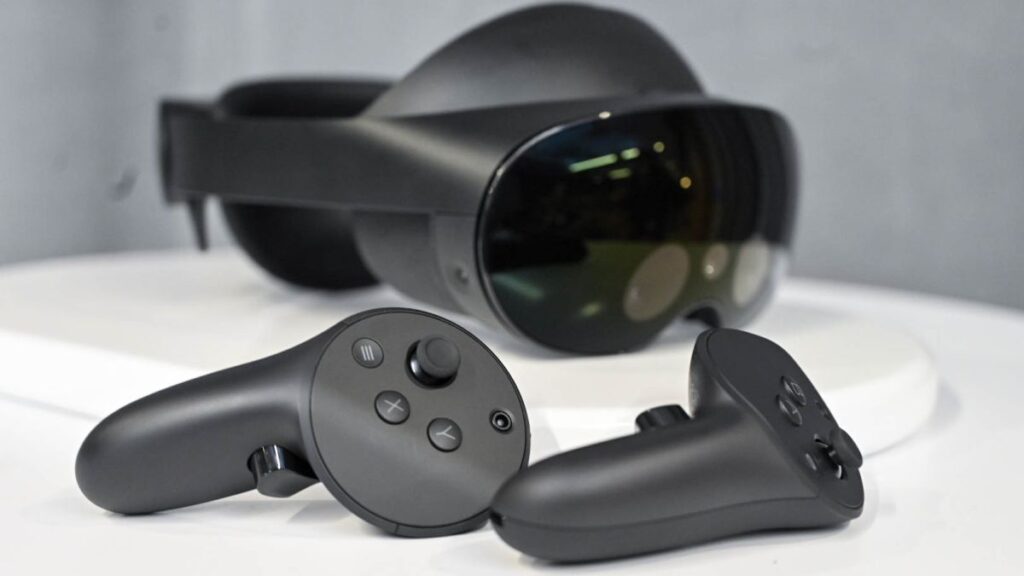
Meta CEO Mark Zuckerberg has unveiled the all-new Quest Pro(formerly Project Cambria), a premium $1500 Meta Quest Pro VR Headset, at Meta’s annual Connect conference.

Meta Quest Pro
Image Source: laptopmag.com

The $1,500 headset, which was presented at Meta’s Connect Conference, will be available to buy from October 25. Users can also place pre-orders on the Meta website. The launch is a part of Meta’s strategy to grow its user base.

Since its release in 2020, the Quest Pro’s predecessor, the Quest 2, had a sale of around 15 million units. Unlike its predecessor, Quest Pro supports mixed reality, allowing users to view digital content overlaid on the actual world.

Mark Zuckerberg, CEO of Meta, called mixed reality “the next major step for VR.”

Meta Quest Pro is the first in a lineup of cutting-edge headsets designed to increase the potential of mixed and virtual reality. The headset’s pancake lenses compress light multiple times, resulting in smaller overall dimensions and crisper sights. Overall, the Meta Quest Pro headset is more ergonomic and balanced because of the new, flared battery on the back.

The device is powered by the Qualcomm Snapdragon XR2+ processor. It offers 256GB of internal storage and 12GB of RAM. In order to provide users with a full-color mixed reality and virtual environment, it features ten high-resolution sensors, five of which are located within the headset and five outside.

There are two LCD panels that provide richer, more vibrant colors due to the local dimming and quantum dot technology. Meta Quest Pro’s design enables users to switch between the physical and virtual worlds while using their peripheral vision. If the user desires an immersive experience, magnetic partial light blocks are included in the box. It contains sensors for detecting the eyes and capturing facial expressions.

For a richer virtual experience, if the person raises an eyebrow, grins, or just engages in eye contact with somebody, their avatar does the same. To track the user’s position in 3D space independently of the headset, the headset contains three built-in sensors for each controller. In comparison to Meta Quest 2, Meta Quest Pro provides 10% more pixels per degree and 37% more pixels per inch.

Additionally, users will notice a 50% improvement in the periphery of the screen and a 25% rise in full-field visual acuity in the center. The color spectrum has also increased by 1.3 times from the previous version. The device comes with rechargeable batteries and a TruTouch Haptics system.

The Quest Pro has a battery life of one to two hours, though users can also use the device while it’s charging. According to Meta, a complete battery charge will take about two hours.

Microsoft CEO and Chairman Satya Nadella also joined Zuckerberg to reveal a brand-new partnership that will bring potent new work and productivity features to Meta Quest Pro and Meta Quest 2 in the coming years. These tools include apps for Microsoft Teams and Windows 365 as well as the capability to attend a Teams meeting from within Meta Horizon Workrooms.

Most likely, Apple’s rumored AR/VR headset will compete with Meta’s newest headset. The advancement of Meta’s headsets is essential to the company’s plans for the Metaverse, wherein Mr. Zuckerberg envisions a brand-new internet where users can play and work together.

Metaverse is a virtual environment where users may both conduct their daily lives as avatars and explore fantastical virtual worlds. Although several IT companies are developing their metaverses, it will probably be years before any are materialized. There have been conflicting reviews of Meta’s current virtual reality environment, Horizons, and there have also been allegations of sexual assault and violence committed by avatars there.

1024 users

WhatsApp reportedly tested to increase group size up to 1024 participants

There is good news if you enjoy WhatsApp groups but believe that their biggest drawback is that they never get big enough. The messaging service WhatsApp, which is owned by Meta, has announced a number of new features and is now enabling the addition of up to 1024 users to groups for certain beta testers.

1024 users
Image Source: androidcentral.com

When it pertains to group chat capacity, WhatsApp has traditionally been a bit stingy, but it’s getting better. The company expanded the group chat size to 512 individuals in May and added the capacity to exchange files with up to 2GB in storage. Users of WhatsApp’s most recent beta for iOS and Android can form groups with up to 1,023 members.

Only a small group of beta testers have access to the feature for now, but it’s reasonable to anticipate that it will soon be made available to more people to add 1024 users in groups. With this minor upgrade, WhatsApp moves a bit closer to the Telegram messenger, which supports big groups of thousands of users.

Pavel Durov, the developer of Telegram, recently claimed that the system’s encryption standards are pointless if it constantly has security problems and that WhatsApp has been utilized as a surveillance tool. He made these remarks after WhatsApp delivered a critical update that, as per reports, contained security weaknesses that exposed users to hackers,

Large groups are useless if one can’t effectively manage them, but there is also positive news in that regard. WaBetaInfo claims that WhatsApp is creating new capabilities that will provide administrators with additional choices for handling huge groups. To examine all of the applicants and approve them all at once, they include a membership approval process and a list of group members who are presently awaiting permission.

The move would improve the recently introduced Communities feature, which enables several groups to all be placed underneath a single Community umbrella. The messaging app has undergone a tonne of changes and additions this year, including emoji reactions, the option to hide the “Last Seen” status for specific contacts, more features for group phone conversations, and an enhanced native Windows client, in addition to the increased group chat member limit.

WhatsApp unveiled a new calling function for its app last month. With its new Call Links feature, users may now join an audio or video call with just one tap. On the messaging network operated by Meta, users can post links to the corresponding calls for their family and friends. This virtual call service functions quite similarly to Google Meet or Zoom.

In the meantime, the platform launched WhatsApp Premium, a new tool for business accounts. Right now it is only available for beta testers in some nations.

Through WhatsApp Premium, businesses may take use of several cutting-edge features, including a better way to connect with clients and some advantages when connecting new devices. WhatsApp has recently started testing features that restrict users from taking screenshots of photographs transmitted with the “View once” option but only with a small group of beta testers.

WhatsApp Group has become the go-to spot for users to connect with various individuals on a single topic. The new update will increase its popularity and has a lot of potential.