Your Tech Story

Tech News

WhatsApp now allows users to share HD images; check how to use this new feature

WhatsApp now allows users to share HD images; check how to use this new feature

In an exciting update, WhatsApp has introduced a brand-new feature that lets users share high-definition (HD) images, enhancing the visual experience of sharing moments with friends and family. 

WhatsApp now allows users to share HD images; check how to use this new feature
Image Source: droidvillablog.com

The announcement was made by Meta CEO Mark Zuckerberg, signaling a step forward in the evolution of the popular messaging platform. This enhancement falls in line with WhatsApp’s commitment to delivering a seamless and secure user experience.

The HD image sharing feature, like WhatsApp’s other message formats, ensures the utmost security through end-to-end encryption, safeguarding users’ privacy even when sharing high-quality images. Building on this innovation, Meta is also set to introduce HD video sharing, adding another layer of visual richness to the user experience in the near future.

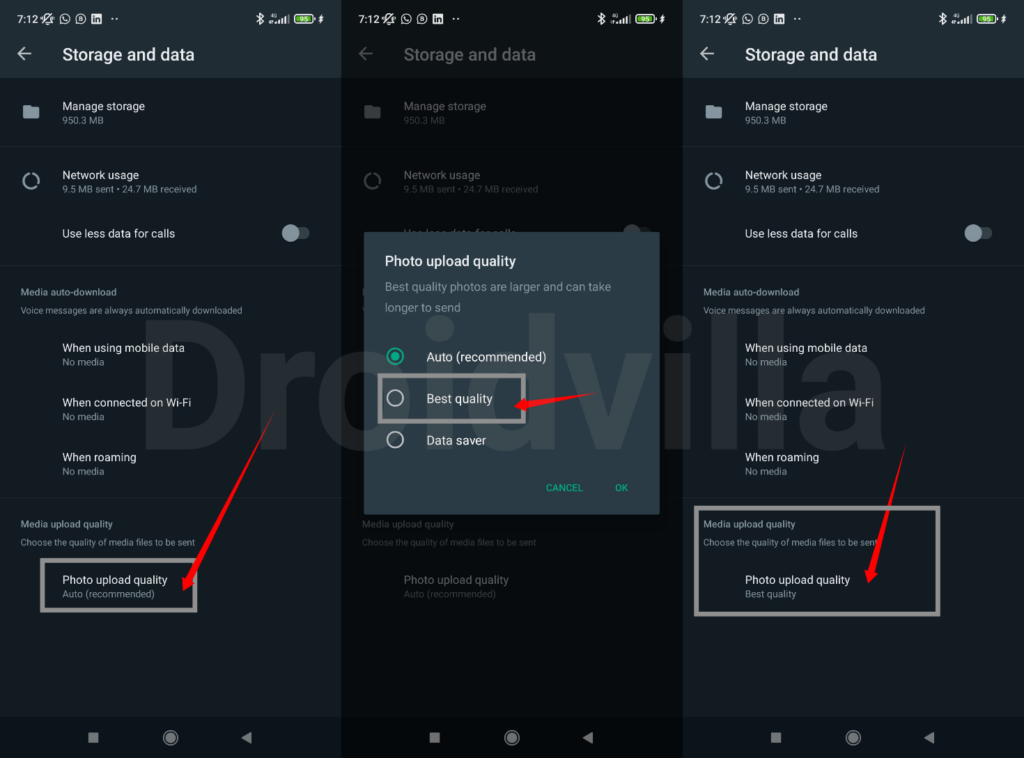
For those concerned about data usage and connectivity, rest assured that the default option for photo sharing remains the Standard Quality. However, for moments that deserve a higher level of detail, users can now opt for HD quality on a photo-by-photo basis. This intelligent design choice ensures that sharing photos over WhatsApp remains swift and reliable, even in regions with low bandwidth.

The rollout of HD Photos will be a gradual process, with availability expanding globally over the coming weeks. Users can anticipate the introduction of HD Videos as well, further enhancing the platform’s multimedia capabilities. To enjoy these exciting updates, ensure your WhatsApp application is up to date.

The process of sharing HD images largely mirrors the familiar steps, with just one additional action to share in high quality. After selecting the image to share, tap the ‘HD’ option displayed at the top center of the screen. A choice between standard and high quality will then be presented, allowing you to tailor your sharing experience based on the moment and your preferences. Once your selection is made, simply hit the share button to spread your high-definition memory.

Also Read:  Tesla Rolls Out New Base Model S and X for $10,000 Less

In tandem with these enhancements, WhatsApp is rumored to be working on an innovative generative AI feature. This feature, centered around AI-generated stickers, will empower users to prompt the application to create stickers based on short prompts, providing a novel way to express emotions and thoughts in conversations. A sneak peek of this feature was shared by WABetaInfo, a platform known for tracking beta features, revealing yet another dimension of WhatsApp’s evolving capabilities.

In conclusion, WhatsApp’s latest HD image sharing feature is set to revolutionize how users share visual moments, maintaining the platform’s commitment to security and user experience. As this exciting update rolls out globally, users can also look forward to the arrival of HD video sharing and the potential for AI-generated stickers, marking a dynamic and innovative chapter in WhatsApp’s journey. Stay tuned, update your app, and elevate your messaging experience with these cutting-edge features.

Tesla Rolls Out New Base Model S and X for $10,000 Less

Tesla Rolls Out New Base Model S and X for $10,000 Less

As competitiveness heats up, Tesla Inc. has released two lesser specification models of its less widely popular Model S as well as Model X electric cars to the United States and Canadian market, cutting their cost by ten thousand dollars.

Tesla Rolls Out New Base Model S and X for $10,000 Less
Image Source: elfordon.se

Compared to the base models, the more affordable variants have a little shorter range and slower acceleration. As per the automobile giant’s website, the ‘Standard Range’ Model S sedan has a price of 78,490 USD, whereas the less expensive Model X sport utility is priced at 88,490 USD.

Just under five per cent of Tesla’s shipments in the second half were of the Tesla Model S and X, which represent a small portion of the company’s revenues. The S and X do not receive any price reductions, which lessens the appeal of them. In contrast to the 3 and Y, which are qualified for a 7,500 dollars US tax credit.

Elon Musk, the company’s chief executive officer, indicated in July that if interest rates kept rising, Tesla was going to keep cutting its pricing and that he was prepared to give up more profit to increase production and sales.

The cost of Tesla’s higher-spec Model Ys in China was reduced on Monday by 14,000 yuan which is approximately $1,900, raising fears of a fresh pricing war in the fiercely competitive Chinese market.

A competing attempt by Tesla to lower pricing once further in China’s mainland caused shares to fall up to as 3 per cent in early Monday trade.

Shares somewhat recovered from their initial losses to trade in the red, finishing Monday down about 1.2 per cent. The company made the announcements late on Sunday night in a Weibo post.

Sold at 299,000 & 349,000 yuan in China, two Model Y crossovers from Tesla have been marked down by 14,000 yuan, or almost two thousand dollars.

A limited-time insurance subsidy for the Model 3 will be available for 8,000 yuan, which is approximately 1,100 dollars. According to Tesla’s statement, the insurance subsidy will keep running through the end of September.

Also Read:  ChatGPT Creator OpenAI Is Testing Content Moderation Systems

The second half of 2023 saw a fierce pricing battle between Tesla and indigenous Chinese automakers including BYD, Nio, as well as Xpeng that severely reduced Tesla’s profit margins. Even as it increases output in its Shanghai Gigafactory, Tesla has fallen behind domestic rivals.

Tesla reduced pricing numerous times in 2022 and 2023 to reduce inventory and increase delivery, the closest estimate of sales the firm provides.

ChatGPT Creator OpenAI Is Testing Content Moderation Systems

ChatGPT Creator OpenAI Is Testing Content Moderation Systems

One of the trickiest problems on the web for years has been content management. Given how subjective it is involved in deciding what information should be allowed on a certain platform, it is a challenging topic for anybody to approach. OpenAI, the company that created ChatGPT, believes it can be of assistance and has been testing GPT-4’s capacity for content moderation. To develop a content management platform that is scalable, uniform, as well as customizable, it utilises the big multimodal model.

ChatGPT Creator OpenAI Is Testing Content Moderation Systems
Image Source: thestar.com

In a blog post, the business claimed that GPT-4 can, not solely assist in content moderation choices, but also in the development of rules and the speedy iteration of modifications to existing policies, lowering the process’s duration from months to hours.

It proclaims that the model can quickly adjust to any adjustments and interpret the numerous rules and nuanced aspects of content restrictions. According to OpenAI, this leads to more consistently labelled material.

OpenAI asserts GPT-4 moderating technologies enable businesses to complete about six months’ worth of work in a single day.

“We believe this offers a more positive vision of the future of digital platforms, where AI can help moderate online traffic according to platform-specific policy and relieve the mental burden of a large number of human moderators, ” OpenAI’s Lilian Weng, Vik Goel and Andrea Vallone wrote. “Anyone with OpenAI API access can implement this approach to create their own AI-assisted moderation system.”

Source: engadget.com

Manually assessing distressing information may have a major negative effect on human reviewers’ mental health, especially when it involves graphic content, as has been thoroughly documented. More than eleven thousand moderators will get a minimum of one thousand dollars in compensation from Meta in 2020 for any mental health problems that may have resulted from analysing content that was uploaded on Facebook.

Also Read:  Amazon Is Imposing Fee on Sellers Who Ship Products Themselves

“Judgments by language models are vulnerable to undesired biases that might have been introduced into the model during training. As with any AI application, results and output will need to be carefully monitored, validated and refined by maintaining humans in the loop,” OpenAI’s blog post reads.

Source: engadget.com

AI algorithms are not flawless. Major businesses have long used artificial intelligence in their moderation procedures, yet even with the help of technological advances, they frequently make poor content selections. It will be interesting to see if OpenAI’s technology will prevent many of the big moderation pitfalls that we have observed other businesses making throughout the years.

Amazon Is Imposing Fee on Sellers Who Ship Products Themselves

Amazon Is Imposing Fee on Sellers Who Ship Products Themselves

In a significant shift that could impact third-party sellers on its platform, Amazon is reportedly introducing a new fee for merchants who choose not to utilize the company’s fulfillment service. 

Amazon Is Imposing Fee on Sellers Who Ship Products Themselves
Image Source: cnet.com

According to reports from Bloomberg and CNBC, this fee will come into effect on October 1st, targeting sellers enrolled in Amazon’s Seller Fulfilled Prime (SFP) program.

The SFP service, introduced by Amazon in 2015, allows third-party vendors to offer Prime products directly from their own warehouses, bypassing Amazon’s logistics process. While this offers sellers more control over their shipping operations, they are required to uphold Amazon’s stringent delivery standards, including one- to two-day shipping and weekend deliveries.

The timing of this fee imposition has raised eyebrows, especially considering the current regulatory environment. Reports suggest that the Federal Trade Commission is preparing an antitrust lawsuit against Amazon, adding to the company’s challenges. Additionally, this fee compounds the existing 8 to 15 percent commission that Amazon already deducts from orders on its platform.

The 2 percent fee could potentially serve Amazon’s strategic interests. By encouraging sellers to opt for its in-house fulfillment service, Fulfillment by Amazon (FBA), the e-commerce giant gains tighter control over the logistics process while also capitalizing on rising FBA expenses. However, this move might attract regulatory attention, as it echoes accusations made against Amazon in 2019, alleging the company forced sellers into using FBA.

Amazon initially halted new enrollments in the SFP program in 2019, resuming the waitlist only in June of this year, purportedly to appease regulatory concerns. The exact reasoning behind this fee implementation remains unclear, as Amazon has yet to respond to requests for further information.

Also Read:  Amazon’s Robot Workers to Help Run Australia’s Largest Warehouse

For third-party sellers who have been enjoying the flexibility of the SFP program, this added charge could prompt a reassessment of their selling strategies. Some might see the fee as an incentive to shift towards Amazon’s fulfillment services, while others might be prompted to explore alternative platforms or shipping solutions.

As the e-commerce landscape evolves and competition intensifies, Amazon’s actions are being closely monitored by both sellers and regulators alike. While the fee introduction might be an attempt to consolidate Amazon’s control over its ecosystem, it could also spark fresh concerns about the company’s influence and practices within the industry. As the October 1st deadline approaches, sellers will need to carefully evaluate their options and consider the potential implications of this new fee on their business operations.

Apple Plans Major ‘Watch X’ Overhaul for Device’s 10-Year Anniversary

Apple Plans Major ‘Watch X’ Overhaul for Device’s 10-Year Anniversary

Apple is gearing up to celebrate the 10th anniversary of its groundbreaking smartwatch with a significant redesign of the iconic device. While the upcoming 2023 models are expected to be a modest upgrade, Apple enthusiasts can look forward to the launch of the highly anticipated “Watch X” in the near future.

Apple Plans Major ‘Watch X’ Overhaul for Device’s 10-Year Anniversary
Image Source: i.ytimg.com

The yearly refresh cycle of Apple’s flagship smartwatch has seen incremental improvements, often focusing on a specific feature enhancement. For instance, the Series 8 model introduced a body-temperature sensor, while the previous iteration boasted a larger display. Despite these consistent upgrades, industry insiders note that Apple hasn’t provided consumers with compelling reasons to frequently upgrade their watches, unlike the rapid innovation seen in the iPhone lineup.

The imminent 2023 Apple Watch Series 9 lineup, set to be unveiled alongside the latest iPhone on September 12, is projected to retain its current size dimensions. However, the notable advancements will be in the form of enhanced processors and a variety of fresh colors. While these updates may not excite recent Apple Watch buyers, they serve to attract first-time smartwatch adopters and those who are using older models.

The steady pace of incremental improvements has led Apple’s internal discussions about the potential benefits of deviating from this strategy. The company has historically adhered to a yearly upgrade cycle for the smartwatch, consistently releasing new models since the category’s debut in 2015. Yet, the recent evolution of the device has sparked internal deliberations about the necessity of such frequent updates.

However, Apple’s plans for its upcoming 10th anniversary “Watch X” model signal a bold departure from its established upgrade cycle. The company is already in the works to design a thinner watch case and explore novel methods of attaching bands to the device. The current mechanism, which involves sliding bands into the sides of the chassis and securing them with a locking mechanism, has proved functional but constraining in terms of utilizing available space for other components like batteries.

To address these design limitations, Apple’s engineers are reportedly experimenting with a magnetic band attachment system. While it remains uncertain whether this system will make its debut in the “Watch X,” it signifies the company’s commitment to pushing the boundaries of design to create a more efficient and versatile product.

Also Read:  Foxconn Starts Production of Upcoming Apple iPhone 15 in Tamil Nadu Ahead of September Launch

Beyond the band attachment, “Watch X” is expected to feature transformative upgrades, including a microLED display that offers superior color and clarity compared to existing OLED screens. Additionally, insiders reveal that the company is working on incorporating blood pressure monitoring technology, positioning the smartwatch as a potential health and wellness companion.

As Apple moves towards the launch of the “Watch X,” it not only demonstrates its dedication to innovation but also marks a pivotal moment in the evolution of its smartwatch lineup. With this significant overhaul, the company aims to provide users with a compelling reason to upgrade, further cementing its status as a trailblazer in the tech industry.

Foxconn Starts Production of Upcoming Apple iPhone 15 in Tamil Nadu

Foxconn Starts Production of Upcoming Apple iPhone 15 in Tamil Nadu Ahead of September Launch

In a significant stride towards bolstering the “Make in India” initiative, Apple Inc. is poised to kickstart the production of its eagerly anticipated iPhone 15 in the southern state of Tamil Nadu. A recent report has unveiled that the Foxconn Technology Group’s manufacturing plant in Sriperumbudur is gearing up to roll out the latest iPhone iterations merely weeks after they commence production in Chinese factories. This strategic move aims to bridge the gap between Indian and Chinese manufacturing operations.

Foxconn Starts Production of Upcoming Apple iPhone 15 in Tamil Nadu
Image Source: gumlet.assettype.com

Anticipation is rife as Apple aficionados await the grand unveiling of the iPhone 15, anticipated to be announced on September 12, 2023. This upcoming iteration is slated to usher in the most extensive array of updates to the device in the past three years. The scale of production hinges largely on the availability of crucial components, many of which are imported. In view of this, production lines have been ramped up at the Chennai facility to facilitate seamless assembly.

Prior to the iPhone 14, Apple’s manufacturing footprint in India was limited, lagging behind China by a considerable six to nine months in terms of output. However, this disparity was considerably narrowed down last year. As of March-end, Apple managed to produce 7 percent of its iPhones in India, signifying substantial progress.

Apple is currently focused on aligning shipment timelines from India and China, aspiring to reach parity in this aspect. While sources remain cautious about achieving this goal, the push is evident and promising.

The spotlight isn’t solely on Foxconn, as other key Apple suppliers in India are also set to contribute to the production of the iPhone 15. Companies like Pegatron Corp. and the Wistron Corp. factory, which is on the brink of being acquired by the Tata Group, are gearing up to assemble the highly anticipated device.

In tandem with this development, reports have emerged indicating that Apple is primed to initiate the production of its iconic AirPods wireless earbuds at Foxconn’s Hyderabad facility. With an impressive $400 million investment by Foxconn, the Hyderabad plant is slated to commence large-scale manufacturing by December 2024.

The Foxconn Hyderabad factory is poised to churn out AirPods, marking the second product category, following iPhones, to be manufactured in India. Apple’s AirPods have etched their dominance in the TWS (true wireless stereo) market globally, making this strategic shift a pivotal move.

Also Read: Apple is working on its most powerful MacBook chip yet, the M3 Max

Having already established a manufacturing foothold in India through partners such as Foxconn, Wistron, and Pegatron, Apple’s expansion of product categories showcases their commitment to local production. As was the case with iPhones, there are whispers that AirPods production might extend to other facilities in the future.

With these groundbreaking developments, Apple is steadfastly ushering in a new era of localized production, underscoring India’s importance as a vital market and production hub.