Your Tech Story

Story

Danaher Corporation

Danaher Corporation – A Fortune 500 Company That Develops Products For The Medical And Industrial Sector.

Danaher Corporation is a multinational conglomerate based in America. The headquarters of the company is in Washington, D.C. This year, Danaher ranked 130th on the Fortune 500 list. Steven M. Rales and Mitchell Rales founded the company in 1969 when it was called DMG. Danaher is one of the largest companies in North America and it adopted the principles of “Kaizen”, a Japanese philosophy to continuously improve and eliminate waste. Danaher has three platforms, namely, Life Sciences, Diagnostics, and Environment & Applied Sciences.

The Founding Story Of Danaher Corporation

In 1969, Steven Rales and Mitchell Rales organized the company as a Massachusetts real estate investment firm. They established the company under the name DMG which was changed to Diversified Mortgage Investors Inc in 1978. In 1984, the name of the company was again changed to Danaher Corporation and it was reincorporated under the Delaware General Corporation Law. The name Danaher was given by the Rales when they went on a fishing trip to Danaher, a tributary in Western Montana.

In 1986, Danaher merged with multiple companies when it bought Chicago Pneumatic. The Jacobs Manufacturing Co and Matco Tools Corp were under the acquisition of Chicago Pneumatic when Danaher bought the company. But, after a year, Danaher sold off CP and retained Matco and Jacobs at the same time. In the 1990s other divisions of Danaher were established. After Danaher Corporation was established in 1984, it acquired 12 companies to enter the manufacturing market within two years. In the Instrumentation Unit of Danaher, the company added Qualitrol and Gilbarco Veeder-Root. The company also acquired Kollmorgen, a company based in Virginia.

Danaher Corporation
Image source: rodpub.com

Early Growth And Expansion

The acquisition spree of Danaher kept continuing as it acquired red Easco Hand Tools in 1990. Next year, Danaher landed a big contract for Sears and it became the main supplier for hand tools. After it landed this contract, Danaher acquired multiple tools companies like Armstrong and Allen. It also expanded its presence in the chemical industry after acquiring Hach company in 1999 followed by a German company called Lange.

In 2005, Danaher announced that it will acquire Leica Microsystems which was known for manufacturing a broad range of products for microscopic imaging, measurement, and analysis. Eventually, Danaher entered the market of life science and started providing management systems in the healthcare sector. In 2007, the company acquired the Australian Pathology Instrument and Engineering company called Vision Systems Limited. The same year it acquired Tektronix Inc which is the company’s largest acquisition till today. The deal was closed for $1.1 billion. In 2009, Danaher acquired the analytics technology business unit of the Canadian-based company, MDS Inc.

Present Days

In the last decade, Danaher acquired Beckman Coulter followed by Navman Wireless in the next year. During this time, the company also sold its joint venture with Cooper Industries to Bain Capital for $1.6 billion. Danaher carried out another big acquisition in 2013 as it acquired Nobel Biocare for $2.2 billion. In 2014, Danaher and NetScout agreed to combine the communication unit of the former company with NetScout Systems. Many other companies were also acquired in the past years which includes Pall for $13.8 billion, Phenomenex for $700 million, Integrated DNA Technologies for an undisclosed amount, and many more.

In 2018, Danaher decided to spin off its dental segment and make it an independent company. Next year, it sold numerous business units to Sartorius AG for $750 million. The same year, Danaher appeared on the Forbes list for becoming one of the best employers for diversity. Last year, Tom Joyce retired as the CEO of the company and he was replaced by Rainer Blair.

Rainer M. Blair – CEO

Rainer Blair is the President and CEO of the company. He joined the Danaher Corporation in 2010 and held various leadership roles in the company. He has 30-years of industrial experience. Before joining Danaher, he was the CEO and President of MAPEI Americas, and before that he spent fifteen years with BASF Group.

Qualtrics

Qualtrics – A 19-years Old American Company Funded By Top Venture Capitalists.

In 2002, Ryan Smith along with his brother, father, and a friend co-founded Qualtrics. Qualtrics is an experience management company that is spread across the world. It has two headquarters in the US, one in Washington and the other one in Utah. Qualtrics is a public company listed on NASDAQ and it has more than 4,000 employees. The company specializes in experience management and provides a cloud-based platform for the same on a subscription basis.

About Qualtrics

In 2002, the company was founded by Ryan Smith, Scott M. Smith, Jared Smith, and Stuart Orgill. Currently, Ryan Smith is the executive chairman while the other members have departed from the company. Zig Serafin is the present CEO of the company. After a decade of founding the company, Qualtrics landed funding from the top two venture capital firms in the US, Sequoia Capital, and Accel. They invested consecutively in two funding rounds and the valuation of Qualtrics became $1 billion in 2014.

In 2018, SAP announced that it would acquire company for $8 billion and the deal was completed in 2019. Two years later, SAP expressed its intention to take Qualtrics public, and thus in January 2021 it was listed in NASDAQ. This year, an executive member of Microsoft, Brad Anderson left the company to join Qualtrics. In 2016 and 2017, the company appeared on the Forbes 100 Cloud List ranking 12th and 6th respectively.

Qualtrics
Image source: phenompeople.com

History of Qualtrics

When the Smiths along with Stuart Orgill started the company it was mainly a single-product survey company. The academics used this product to conduct research and it was not an ideal business model for a fresh start-up. They were initially serving a very small market with customers who weren’t willing to pay too much. As a result, Qualtrics was unable to land any investors in the early days.

One way to turn the future of the company was to make it a multiproduct company and by 2010 company was able to expand in various sectors. The products of the company helped many organizations to manage customer experience, perform market research, and get employee insights. The change in the business model of Qualtrics helped it attract two top venture capital firms in the country. The series A funding round took place in 2012 where Sequoia Capital and Accel jointly invested $70 million followed by another round of investment in 2014 by the same firms. After these two rounds, the valuation of the company reached $1 billion.

Recent Years

In 2017, Company launched its first experience management platform (XM) to help companies oversee the main four business experiences which are customer, employee, product, and brand. After launching this successful product, SAP showed interest in acquiring the company and the deal was closed in 2019 for $8 billion. In early 2021, the opening price of Qualtrics valued the company three times the amount. Throughout the journey of Qualtrics, the company has rigorously rebuilt the teach stack, replaced codes, and rearranged the company’s structure. It has taken many huge risks and reached its highest potential.

After becoming a multiproduct company, Qualtrics has made two acquisitions. In 2016, it acquired a startup called Statwing and after two years it acquired Delighted. The sum for the acquisition was not disclosed for either of the company. Qualtrics has also received several awards and accolades. Last year, the company earned the designation of “Leader” in Gartner’s Magic Quadrant for Voice of Customers. The Core XM platform of Company was chosen by Edison Awards in the Applied Technology category for the gold winner.

Zig Serafin – CEO

Zig Serafin is the present CEO of the company. He joined Qualtrics in 2016 as the Chief Operating Officer and contributed to the development and launch of the Qualtrics XM Platform. Under his leadership, Qualtrics experienced very rapid growth and increased its customers to more than 13,000. Before joining Qualtrics, Zig worked at Microsoft for 17 years. He was the Corporate Vice President when he left the company.

BMC Software

BMC Software – An American Software Company Founded By Former Shell Oil Employees.

BMC Software is an American company and it is one of the leading developers and providers of independent system software. The company’s headquarters is based in Houston, Texas, and has several offices both in the state and overseas. BMC Software operates worldwide and some major markets include Tel Aviv, Israel, Germany, France, Indian, and Singapore.

The company mainly offers Software as a Service (SaaS) and on-premise software and services. It has a great impact on today’s cloud computing and IT management and automation sector. BMC Software is a privately held company and it generates annual revenue of more than $2 billion. It has around 6,000 employees and made many significant acquisitions between 1994 and 2000.

The Founding Story of BMC Software

The three founders of BMC Software are Scott Boulette, John Moores, and Dan Cloer. All three co-founders were former employees of Shell Oil when they started working on this new project. They kept the name of the company after the initials of their surname. Moore got the idea of developing a new software when he worked as a programmer with Shell Oil. During those days, the software that dominated the market and business was mainly written for IBM mainframes. Moores wanted to develop a more efficient version of this software that would compress data streams and speed up the compression process.

He was successful in building the software and he named it 3270 Optimizer. This was the first product of BMC Software and to make this a huge success, Moores hired the best software developers and paid them generous packages. But this is also one of the reasons why profit margin was very low for the company. But, Moores brought in a very powerful team and within few years with innovative marketing methods, it started catching the interest of many venture capitalists.

BMC Software
Image source: wikimedia.org

Growth and Expansion

In 1982, a venture capitalist called Jacqueline Morby took interest in the company and gave Moores some direction on how to increase the profit. After four years, BMC started making 20 percent profit of the annual revenue and 30 percent of its total customers were international clients. In 1988, BMC Software announced its IPO and it was listed on NASDAQ. The business became very profitable and by the next year, the sale jumped from $93 million to $139.5 million.

During this time, BMC Software hopped into an acquiring spree and started with Trimar Software Systems Ltd and Trimar Software International Ltd. In 1991, the company acquired Integrity Solutions followed by Patrol Software in 1994. In 1996, it acquired two companies, namely, HawkNet and PEER Networks but the price was not revealed. In 1997, it acquired Data tools and in 1998 bought Boole & Babbage and BGS Systems. It acquired New Dimension Software in 1999 and Optisystems in 2000.

Privatization

In 2013, BMC Software announced that it was selling the company to a group of major private equity investments groups. The deal was closed at $6.9 billion. In September 2013, the process was finally complete and BMC became a privately held company. In 2018, BMC was acquired by a global investment firm, KKR & Co Inc.

John Moores – The Mastermind Behind BMC Software

John Moores is a famous American entrepreneur and philanthropist who is well-known as the founder of BMC Software. He went to Texas A&M University but dropped out and became a programmer at IBM. Later he went to the University of Houston and completed his bachelor’s degree in economics. Apart from co-founding BMC Software, he was also the lead venture capital financier for Peregrine Systems. After Moores founded BMC Software in 1980 he was the CEO of the company till 1987.

Ayman Sayed – CEO

In 2019, Ayman Sayed became the new president and CEO of the company. Before joining BMC Software, Ayman served as the president and CPO at a Fortune 500 company called CA Technologies. He also has prior work experience at Cisco Systems where he was given the position of senior vice president.

Xero

Xero – A New Zealand-based Cloud Software Platform For SMEs.

Xero is a cloud-based software platform that was founded in 2006. It provides Software as a Service (SaaS) and it is a public company listed in the Australian Securities Exchange. Rod Drury is the founder of the company and Steve Vamos is the present CEO. Xero mainly develops accounting software and it is based in Wellington, New Zealand. Apart from the headquarters in Wellington, the company has two other offices in New Zealand. Xero’s products are sold by subscription and are used in more than 180 countries.

About The Company

In 2006, Rod Drury along with Hamish Edwards founded Xero. When they founded the company, it was originally called Accounting 2.0. With time company has grown beyond New Zealand and it has established offices in Australia, United Kingdom, United States, Canada, Singapore, Hong Kong, and South Africa. In 2017, Xero crossed the mark of having 1 million customers worldwide. It has also landed more than one million subscribers in Australia and New Zealand. From 2006 till 2018, Rod Drury acted as the CEO of the company and he was placed by Steve Vamos in early 2018.

Xero
Image source: wikimedia.org

Origin Of Xero

Before founding the company, Rod Drury explored a lot of other opportunities in the entrepreneurial ground. He tried bespoke software development in Microsoft Access and SQL Server but it was sold off in 1999. Then he started a documentation management startup followed by building an RDBMS for Microsoft Exchange and selling it to Quest Software. Selling the software gave Rod capital for starting Xero. He was also one of the board members of Trade Me that was sold for half a billion US dollars. With the total capital he raised, he was ready to launch Xero.

Xero As a Public Company

The idea of opening a business for cloud-based accounting software clicked in Rod’s mind when he was working at Arthur Young (now part of Ernst & Young). So, eventually, he started planning and raising money to launch the company. In 2007, Xero became a public company and got listed on the New Zealand Exchange (NZD) with a $15 million IPO. For the first few years, the company mainly focused on expanding and strengthening its presence in the New Zealand market and then entered the Australian market and went public there in 2012. In 2018, the company removed its name from NZD and was only listed on the Australian Securities Exchange. After one year, Xero became the third most valuable publicly traded company from New Zealand.

Fundings

In 2009, Xero received funding of $23 million and it was led by Craig Winkler, founder of MYOB. In 2010, it raised $4 million from Valar Ventures, and again in 2012 raised $16.6 million from the same firm. Xero raised $49 million in late 2012 and the major investors were Peter Thiel and Matrix Capital. In May 2013, the valuation of the company became $1.4 billion on the NZE. In October 2013, the two main investors invested another $180 million and with this, the total funding received by company became $230 million. In 2015, a new investor, Accel provided funding of $100 million to Xero. The company bagged the award of the best hybrid deal by Finance Asia in 2018.

After Xero became a public company it acquired a series of businesses. In 2011, Company acquired Paycycle, an Australian online payroll provider, and next year it acquired Spotlight Workpapers. In 2018, Xero established a joint venture with the US payroll platform, Gusto and acquired a data capture solution company called Hubdoc. The company acquired an Australian startup called Waddle that does invoice financing. This year, Xero acquired two companies till now which are Planday and Tickstar AB.

About The Founder

Rod Drury is a famous entrepreneur based in New Zealand. He became famous after founding Xero where he also continued as the CEO till 2018. Rod went to Victoria University of Wellington and started his career with Arthur Young, an accounting firm. Apart from founding Xero, Rod has also co-founded Context Connect and AfterMail.

New Relic

New Relic – A Cloud-Based Software Company Specializing In Application Performance Management.

In the 21st century, cloud computing has become a real catch in the IT industry. With large data to store securely and transfer between different employees in a company, cloud storage has become quintessential. Many existing businesses have expanded their solution range to provide cloud storage as a service and startups exclusively providing cloud-based software have also been established. New Relic is one such startup that develops and delivers cloud-based software. Lew Cirne established New Relic in 2008 which is headquartered in San Francisco, CA, United States.

About The Company

New Relic is a cloud-based software company that develops a range of innovative software to help different companies help their performance. With the help of New Relic software, a company can track the performance of its service, website, and application. This helps the companies to understand the problem and fix it more efficiently to create a better user experience. Apart from the real-time monitoring of the web and application data, the software also provides support for custom-built plugins. New Relic appointed its new CEO this year, Bill Staples who replaced Lew Cirne, the founder and former CEO of the company.

New Relic
Image source: solutionsreview.com

Success In The Second Attempt

In 2008, Lew Cirne founded the software company New Relic and he named it so after an anagram of his name. Lew Cirne, from a very young age, had an entrepreneurship niche and wanted to start his company. While he was in high school, he planned and attempted to start a company to productize a game but unfortunately, it wasn’t successful. Later, when he went to college at Dartmouth, he successfully landed a job at Apple. But, the fever of entrepreneurship still bugged him and he left Apple after three years.

Lew thought it will be better for him to join a small company and learn about the length and breadth of an early-stage startup. So, he joined a company called Hummingbird which then was a team of 300 members. Being part of a small company allowed him to explore other divisions of the business apart from engineering. After a couple of years, Lew successfully founded Wily but it wasn’t a full stop. On the search for new technology, Cirne ended up starting another successful startup, New Relic.

History of New Relic

After founding New Relic in 2008, the company hosted its first round of funding five years after and raised $80 million. Some of the major investors included Benchmark Capital, Allen & Company, Insight Venture Partners, Trinity Venture, Tenaya Capital, etc. After this funding round, the valuation of New Relic became $750 million. After receiving this fund, the company invested in launching Android and iOS native mobile apps for its software analytics platform. Next year, New Relic landed another $100 million funding from BlackRock Inc, Passport Capital, and Wellington Management. In late 2014, New Relic became a public company.

Last year, the company hired Bill Staples as the new Chief Product Officer whose responsibility of leading the product management team, engineering, and driving the company’s platform strategy. After Bill Staples joined the New Relic team, restructuring of the costing model took place which resulted in some layoffs. Only after a year of joining the company, Bill Staples got promoted to CEO and took the place of Lew Cirne.

About The Founder

Lew Cirne is a Canadian-American technologist and entrepreneur who is famous for founding Wily Technologies and New Relic. He majored in Computer Science from Dartmouth College and joined Apple straight after graduating. Being in Silicon Valley, his dream to become an entrepreneur was triggered. He realized he can barely teach himself any entrepreneurial skills by being part of such a massive company. So, he joined a small company called Hummingbird Communications and after two years founded Wily. He is one of those entrepreneurs who broke the myth that startups are not for post-thirty people.

Bill Staples – CEO of New Relic

Before joining New Relic as the CPO in 2020, Bill Staples had working experience in Adobe and worked for 17 years at Microsoft. In both companies, Bill led teams of a huge number of employees to create transformative products and implement innovative strategies.

DATEV

DATEV – A Data Center That Emerged As A Successful German Registered Cooperative Society.

DATEV is a German-based registered cooperative society. The primary role of DATEV is in the IT industry as it provides technical information services to the accountants, attorneys, and members of the tax department. Founded in February 1996, DATEV was originally a data center that is now famous in the IT industry. Currently, DATEV is known for developing and delivering software directly to end-users. The company is also known for providing consulting services for these occupations. Though DATEV is a leading technology provider in Germany, its main interest lies in the tax market.

About The Company

DATEV mainly provides software for accounting, tax computation, personnel management, business consulting, and company organization. It was founded in 1966 and currently has more than 400,000 customers. The headquarters of DATEV is based in Nuremberg and apart from that, it has 23 other subsidiaries in Germany. More than 8,000 people work for the company in their main office and subsidiaries.

DATEV is a very popular company in Germany such that around 2 million enterprises in the nation use their software to perform financial accounting. More than 11 million payslips are generated every month using the DATEV software. The company also has a data center that is used by both the members of the company and its clients. Data security is the prime focus of every employee of the company.

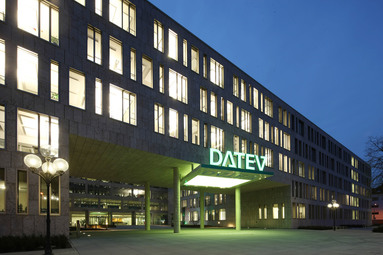
DATEV
image source: www.datev.com

History of DATEV

On 14th February 1966, 65 tax consultants from Nuremberg founded DATEV. It was founded as a cooperative self-help organization whose main focus was to facilitate bookkeeping tasks. The main five founding members of the company are Edmund Rudolph, Horst Preißner, Joachim Mattheus, Heinz Sebiger, and Klaus Hartmann. The company initially founded a data center where the accounting data of the members were processed. This was a step up from the primitive punch tape. The DATEV center was opened after the number of members in this organization started increasing rapidly and was finally inaugurated in 1969.

In 1974, Company introduced remote data transmission. First, the data was recorded on magnetic tapes, and then from the employee side, it was transmitted to the DATEV data center via the telephone lines. After a couple of years, the company established its first personal network for transmitting electronic data between tax consultant offices and the DATEV data center. But, the company dismantled the career network in 2002 because by then it was no more an economically viable choice.

Business Growth

In 1972, DATEV formed a joint allegiance with the Japanese company TKC and it was after ten years both the companies document the alliance. TKC is also a data processing service company and the joint partnership aimed to support more tax consultants with electronic data processing. Even today both the companies are tied up through business exchange programs. In the 1990s, Company started establishing its first Information Center starting in Dresden followed by Schwerin, Leipzig, Magdeburg, and Erfurt.

In 1996, one of the founders of DATEV, Dr. Heinz Sebiger retired from the company after 30 years of successfully monitoring the administration. By this time, the company started generated revenue in billions and employed more than 4,000 people. For the next two years, employers and clients in DATEV witnessed the transformation from the DOS system to 32 bit Windows OS.

The 21st century brought several opportunities for DATEV to explore and establish itself in the European market. The company established itself in the Czech Republic, Austria, Hungary, Spain, Italy, and many more. In 2003, the company expanded to Poland as it started a joint venture with Poland-based software manufacturer Matrix. pl S.A. In 2011, the company expanded its data center and included new trending services like cloud computing and data security. In 2021, a new management team was formed at DATEV with Dr. Peter Krug as the new CMO and Prof. Dr. Christian Bär as the new CTO of the company. Dr. Robert Mayr is the present CEO of the company.

Robert Mayr – CEO of Company

Robert Mayr joined DATEV in 2011 as a member of the board of directors as well as head of finances, purchasing, production, and internal data processing. Robert Mayr became the CEO of the company in 2016. Before joining the company, he was the managing partner at Solidaris Revisions GmbH. He also has seven years of working experience at Deloitte, one of the Big Four companies.