Your Tech Story

Story

Zilingo

Zilingo – Indian Entrepreneurs Create New Style Statement

We all love talking about fashion. Many of us have the urge to recreate their wardrobe every season. From a 5-years old little girl to a 60-years old man, we all want to look classic. A perfect fashion icon speaks through the language of style.

Brands can never define fashion. The idea behind fashion is creative and one can get inspiration from anywhere. It is a form of art that seeks ideas from a high-class designer dress to some really cool street style. Ankiti Bose and Dhruv Kapoor proved that in front of the entire world.

Who are they?

Ankiti Bose and Dhruv Kapoor are the founders of Zilingo, an online commerce platform for fashion. Though they are from different career background they hit it off pretty well.

Zilingo-Founders
Image Source – Google Images

Ankiti Bose

Before founding Zilingo, Ankiti Bose worked as an investment analyst Sequoia Capital. She worked at the Bangalore office. Bose studied Economics and Mathematics from St. Xavier’s College, Mumbai.

She is a fashion enthusiast. Her trip to Bangkok and witnessing their magnificent street fashion is what inspired her to create something of her own. She has also worked for McKinsey & Company.

Dhruv Kapoor

It is true that Engineers can be anywhere. One might get a B. Tech degree but for most of them, interest lies somewhere else. Dhruv Kapoor is an engineer who graduated from IIT, Guwahati. He studied Electrical and Electronic Engineering.

After graduating in 2012, Dhruv Kapoor joined Yahoo as a Software Engineer. After working there for a year, he joined Kiwi. Eventually, he met Bose, decided to quit the job and start a business.

The Back Story

None of them had the perfect plan to start a business. It happened all of a sudden. They trusted their guts and took the risk.

The story begins when Bose went on a Bangkok trip with her friends. It was back in 2014. She went shopping in a market called Chatuchak. According to her, it was the largest weekend market worldwide.

She witnessed more than 10,000 independent retailers with really inspiring designs. Unfortunately, none of them knew how to take their business online. This is when Bose thought of creating a platform where these powerful talents can be showcased and earned as well.

With the idea in her mind, she knew it would be better if she had a tech guy in her team. Because irrespective of the idea technology has a bigger role to play. After a few days, she met Kapoor at a party in her own flat. She shared her idea and Kapoor found it really interesting. They decided to take the next step.

The Beginning

They started with quitting their jobs. There wasn’t any second thought about their plan. Initially, they spend $30,000 each from their savings. Sequoia India backed Zilingo since Bose was a former employee. The company provided Zilingo the seed funding.

In 2015, Bose and Kapoor established Zilingo in Singapore.

What is Zilingo?

The company is a dream place for any potential designer who lacks a source. Zilingo is a fashion company that connects wholesalers, retailers and help them reach out to customers. It provides technical and financial support.

Within four years, the company has expanded to Hong Kong, Indonesia, Thailand, Philippines, Australia, India, and the U.S. Every company or the independent retailer who wishes to do sell their products go through strict scrutiny. Zilingo charges a commission of 10%-30% for all of them.

The Success

From the very beginning, Zilingo raised a good amount of funding. It raised around $8 million in Series A funding followed by $18 million in Series B funding. Zilingo’s Series C funding round took place in 2018 and it raised $54 million. The amount almost quadrupled in the Series D funding round.

Zilingo has become one of the highest capitalized start-ups in South East Asia. The company’s valuation became $970 million in February 2019.

Zilingo, today, has more than 600 employees working over eight nations. The company’s valuation is on the course to become $1 billion. Bose is the first Indian woman who co-founded a start-up of such valuation. She has become a role model for all young women entrepreneurs out there.

The company has created a sign of dignity for both its business strategy and technology. What can be a better combination than an economist and a software engineer? Zilingo’s team is full of creative, inspiring and passionate people.

Nikesh Arora – A Man from being jobless to lead Palo Alto Networks

There are very fewer people in the world who steps down from a higher position. Most of the successful people run behind more power and fame. In this world, it’s rare to find someone who quits and not chooses to compete.

Nikesh Arora is one such legendary figure who stepped down twice from an honorable position. He chose to leave Google and joined SoftBank. He resigned from SoftBank as well. Last year, Arora became the Chairman and CEO of Palo Alto Networks.

Childhood

Born on 9th February 1968, Arora became a worldwide significant figure. He was born into a family in Ghaziabad, Uttar Pradesh. Arora is the son of an Indian Air Force officer and he also has a sister.

Education

Arora did his schooling from The Air Force School, Delhi. After completing his high school Arora pursued engineering. He picked up the common choice of all the Indian youngsters. But, it worked out differently for him.

Arora went to IIT Varanasi (IIT BHU) which is one of the best Indian institutes for engineering. He graduated with a degree in Electrical and Electronics Engineering in 1989. After graduating he started working at Wipro.

Higher Studies

Arora quit his job shortly as he wanted to pursue higher education. In 1990, he left for Boston. He joined Northeastern University and acquired an MBA degree in 1992.

After completing his MBA in Marketing, Arora joined Fidelity Investments as an analyst. But, he wanted to continue his studies. So, he joined Boston College in the same year and attended classes at night. He went to a job and side by side studied for Master’s. He topped the class.

In 1994, he acquired a Master’s degree in Finance and became CFA. He struggled a lot during these two years. Arora’s job was going well. He received promotions several times. His last post in Fidelity was Vice President, Finance.

Early Career

After completing his Masters, he decided to leave Fidelity Investments. Arora joined Putnam Investments but left shortly. After this, he joined Deutsche Telekom.

In 2000, Arora founded a company, T-Motion PLC. He built the company mainly to provide services to the newly launched 3G products of Deutsche Telecom. After two years, these two companies merged. Arora stayed as a Board Member.

For the next couple of years, Arora didn’t take any big steps. In 2004, he came to know that Google was hiring. The company went public and it was hiring for its European office.

The Big Decision

When Nikesh joined Google it was a young company. So, this decision was life-changing. Arora chose to join Google over founding a new company.

He started managing the operations in Europe and continued for three years. Under his leadership, the success of Google in the European market grew rapidly. In 2007, he started managing the Middle East and European markets as well.

Promotions

Nikesh Arora got a big promotion in 2009. He became the President of Global Sales Operations and Business Development. In 2011, he got promoted to Senior Vice President and Chief Business Officer of Google. And this year he became the highest-paid executive of the company.

SoftBank

After working in Google for almost a decade, Arora resigned in 2014. He immediately joined SoftBank, a Japanese multinational company.

Nikesh Arora stepped up as the President and Chief Operating Officer of the company. Under Arora’s supervision, SoftBank grew bigger. Arora suggested the company to invest in start-ups. SoftBank invested in Ola, Grofers and etc.

Arora became the third highest-paid executive around the world after he received $73 million from SoftBank in 2016. This became very big news for the business world.

Palo Alto Networks

After achieving one of the most dignified positions in SoftBank, Nikesh Arora chose to resign. He joined Palo Alto Networks in June 2018 and currently serves as the CEO and Chairman of the company.

Palo Alto is a Santa Clara based company founded in 2005. The main products of the company are cybersecurity and cloud computing.

After Arora joined the company, it made the biggest acquisitions in its history. In 2018, Palo Alto ranked 8th in Forbes Digital 100. The company acquired Demisto for $560 million, Twistlock for $410 million and recently Aporeto for $150 million in 2019.

Nikesh Arora is a great leader. Under his leadership, Palo Alto is doing excellent. He has proved himself as a truly skilled individual.

Personal Life

Nikesh Arora’s first marriage didn’t work out. He later married Ayesha Thapar in 2014 who is a businesswoman. Arora has a daughter.

TripAdvisor

Unleash The Passionate Traveller Inside You With TripAdvisor

Is it for the sixth time you are canceling your Goa plan? The feeling is mutual my friend. All of us make a huge bucket list, but most of the plans aren’t executed. There is so much to explore, yet we are either too busy or too scared to step out. Every time we scroll down an Instagram profile of a traveler, we are highly tempted and intrigued. And, in our mind, we have already made a plan which ends up like ‘I wish I could, but TripAdvisor makes it easier to turn that in reality.

What are you scared of? With so many online travel companies coming up, traveling has honestly become way easier today. All you need is a week off from your job and some cash. Traveling is expensive but not all the time. And, once you do some thorough research about a place, there isn’t much to think about it.

TripAdvisor

TripAdvisor is the largest and the first ‘social travel website’ in the entire world. One of the best things about TripAdvisor is the contents are user-generated. So, you get completing honest reviews about any place you want to visit. The famous restaurants, the pocket-friendly hotels, the best trekking spots, water sports, and the best shopping sites, one gets to know everything.

Founded by Stephen Kaufer, the company was established in February 2000. The headquarters of TripAdvisor is based on Massachusetts, the U.S. The parent company of TripAdvisor is Tripadvisor Media Group which runs twenty-five travel brands. Some of them are BookingBuddy, Citymaps, TravelPod, etc.  

TripAdvisor
Image Source: Google Images

Stephen Kaufer

Kaufer received his Bachelor’s degree in Computer Science from Harvard College. After graduating in 1984, Kaufer joined CDS Ltd as its President. Before co-founding TripAdvisor, Kaufer also co-founded Centerline Software. 

Kaufer is a Board Member of Glassdoor, Cargurus, TripAdvisor and Caring for Carcinoid Foundation. Kaufer, in 2005 became Entrepreneur of the Year.

Why the Best?

The best feature of a travel website can have is user-generated content. TripAdvisor helps people to find the best accommodations suited for them and their reviews, in turn, helps out many more. The users are the ones making TripAdvisor get better and bigger every day.

Moreover, it doesn’t only help the users but also the hotels to improve themselves. Because one negative comment can easily turn a business upside down. The power lies in the hands of the customers.

Be it an appreciation, a criticism or a piece of advice, one can share everything in the platform of TripAdvisor. 

How did it start?

The company was set up in early 2000 with a funding of $3 million only. TripAdvisor was determined to post fully original reviews of the customers and not go for crowd-sourced content. Though it was considered not a good enough idea by some critics, the company went for it.

The website was free for every kind of user. But in 2001, Kaufer brought a little change and started charging small fees for per click. Every time a user clicked in the link of a specific hotel, charges summed up.

This strategy of Kuafer resulted in a huge profit. By 2004, the company witnessed 5 million active monthly visitors. In this same year, TripAdvisor was acquired by InterActiveCorp for $210 million. Nobody saw it coming and Kaufer regretted the decision later. 

Growing Bigger

After the acquisition, Kaufer was still the CEO of the company. Within the next few years, TripAdvisor hired more employees as it expanded. The company also built offices in India by 2008. After a couple of years, the company had 26 unique monthly visitors. It became the largest company in the world related to tours and travels making a yearly profit of $129 million.

In 2010, TripAdvisor acquired holidaylettings.co.uk which was the biggest independent rental website in the U.K. By the next year, TripAdvisor had 50 million monthly visitors and the company’s IPO was filed for $4 billion. When it became an independent business, TripAdvisor realized it lacked skilled leadership. But, the company managed itself well and now it has offices worldwide with more than 3,000 employees.

Acquisitions

After the acquisition of the U.K’s rental website in 2010, TripAdvisor bought Where I’ve Been (a Chicago-based app) in 2011. In the next couple of years, the company acquired Wanderfly, Jatesetter, GateGuru, Oyster.com, etc. The latest acquisition of TripAdvisor was in April 2018, Bokun, a travel management software. 

Criticism

TripAdvisor faced many difficulties and criticism in these span of almost two decades. It has been charged a few times for violating laws and lawsuits were also filed against it. But, every business goes through a downward spiral at some point. Its rigid pillars and strong foundation that has managed to keep it the best even now.

IBM

The Father of Trusts: How Charles Flint’s IBM Changed Computing

If you ever owned a desktop, used an ATM or Hard disk, chances are you used an IBM technology. The International Business Machines Corporation or IBM has been in the business for over a century with connections in over 170 countries. This American giant is one of the world’s largest manufacturers of computer hardware. So how did the company grow to become one of the biggest employers in the world? Here’s a look at the growth of IBM, and how the company changed the world.

Nicknamed Big Blue, IBM is a part of the Dow Jones Industrial Average and employs over 350,000 employees. The company is a research giant with employees having won Nobel Prizes, Turing Awards, and National Medals. All of this came to be thanks to a serial investor who had great business sense.

About the Founder

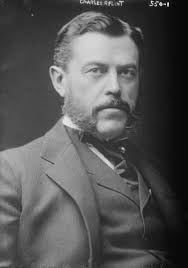
Charles Ranlett Flint was born in 1850 in Maine. The family soon moved to New York, where his father worked as the manager of a firm called Chapman & Flint. The family was business was set up in 1837, and served as a mercantile firm dealing in loans and fiscal help. Flint finished his graduation from the Brooklyn Polytechnic Institute in 1868, and two years later entered the shipping business. His first venture was as a partner in the firm Gilchrest, Flint & Co., which later became W.R. Grace & Co.
Between the years 1876 and 1879, he also served as the head Chilean consul at New York, and as a consul general for Nicaragua.

Image Source: Google

He brought several companies together via a merger and formed U.S. Rubber in 1892. A year later, he helped manufacture naval ships for the Brazilian Republic. He also helped Japan in the First Sino-Japanese War by getting them ships. His business acumen kept growing as he learned the ways of the trade. In 1899, he established American Chicle by merging Chiclets, Beemans, Dentyne and Adams Chewing Gum. He also played a part in the forming of American Woolen in the same year. But his greatest invention came a decade or so later.

Beginnings of IBM

Flint changed the way the world worked by forming the Computing-Tabulating-Recording Company in 1911. The company came to be via the merger of four different companies. This Goliath would later grow to become IBM, the company that revolutionized the field of personal computing! A decade later, CTR would rename itself International Business Machines, and the rest is history. Flint continued to work as a part of the board of directors at IBM until 1930.

Growth of IBM

Initially, the company made machinery like time recorders, slicers, and tabulators. After Thomas J. Watson, Sr became the President, the company went huge, bringing in $9 million, which is worth $130 million today every year.

The company also expanded to Europe, Asia, and Australia. Watson was also responsible for re-christening the Computing-Tabulating-Recording Company to International Business Machines. By 1937 IBM’s equipment was helping companies deal with massive amounts of data. They helped the US Government maintain employee records, and the names of Nazi sympathizers, during the 1940s.

Thomas Watson, Sr., stepped down in 1952, after 40 glorious years, and his son took over. By 1956 the company started working on artificial intelligence through IBM 704 and within a year, they developed FORTRAN. IBM was also responsible for the development of the highly successful Selectric typewriter. During the 1960’s IBM helped NASA with their logistics and was a part of the Gemini and Saturn flights.

Computer Revolution

They came out with the first PC in 1964, called the IBM System/360, following it up with the IBM System/370 in 1970. Both these models were responsible for making the concept of mainframe computing popular around the world. In 1993 IBM posted a US$8 billion loss which was the highest loss by an American company at the time. But the company turned its fortunes around through smart decision making.

In 2005 Lenovo acquired rights to IBM’s PC business and switched over to software development by acquiring SPSS Inc. The company celebrated its 100th anniversary in 2011, and bought SoftLayer Technologies, for $2 billion. They are now working in partnerships with several companies such as Apple Inc., Twitter, Cisco, and Facebook.

Flint’s fluency with handling financial dealings, earned him the nickname Father of Trusts. Honestly, if not for Flint, the world would still be decades behind with respect to computing technology. The company he formed changed the way people looked at personal computing. In many ways, Flint was responsible for starting the Digital Age, which we all cherish and celebrate!

In 2005 Lenovo acquired rights to IBM’s PC business and switched over to software development by acquiring SPSS Inc. The company celebrated its 100th anniversary in 2011, and bought SoftLayer Technologies, for $2 billion. They are now working in partnerships with several companies such as Apple Inc., Twitter, Cisco, and Facebook.

Flint’s fluency with handling financial dealings, earned him the nickname Father of Trusts. Honestly, if not for Flint, the world would still be decades behind with respect to computing technology. The company he formed changed the way people looked at personal computing. In many ways, Flint was responsible for starting the Digital Age, which we all cherish and celebrate!

Akamai Technologies

Akamai Technologies, Unlocking The Power Of Content Delivery Network

Among the major companies availing us the advantage of cloud service and networking, content delivery network (CDN) is rare. Many of us don’t know what does CDN actually means. In simple words, it is a content distribution system which distributes proxy serves geographically. The main aim of CDN is to provide an efficient and better quality network to the end-user. So, one of the most embarking breakthroughs in this domain was successfully achieved by Akamai Technologies.

Akamai Technologies is an American based technology conglomerate founded in 1998. The main product of the company is CDN. Currently, Akamai is in the top position for its content delivery network. The other services of Akamai are cloud service and cybersecurity.

The four co-founders of Akamai Technologies are Frank Thomson Leighton, Daniel Lewin, Randall Kaplan, and Jonathan Seelig.

About the Founders

Frank Thomson Leighton

Frank Thomson Leighton is an Electrical Engineer who acquired a B.S.E degree in 1978 from Princeton University. After his undergraduate program, Leighton went to MIT and completed his Ph.D. in Mathematics. Leighton was very much interested in Applied Mathematics and Computer Science. This passion drove him to co-establish a software company.

Apart from co-founding Akamai Technologies, Leighton served as a professor at MIT and a member of the Computer Science and Artificial Intelligence Laboratory (MIT). He has bagged many awards and served as an advisor for industrial and academic organizations as well.

Daniel Lewin

Born in Denver, Lewin moved to Israel at the age of fourteen. In his early career, Lewin was highly dedicated to serving his country. Lewin served in the Israel Defense Forces for four years and served as a captain in one of the Special Forces.

Lewin started rising as a tech pro after beginning his work at IBM’s research laboratory. He developed a system that is still used as a verification tool in many companies. Lewin completed Bachelor’s and went to Cambridge for PhD at MIT. He faced a tragic death in 2001 in an airplane highjack.

Randall Kaplan

Kaplan went to the University of Michigan and later moved to Chicago to study law. He was inclined towards being an entrepreneur from an early age. Prior to co-founding Akamai, he served as the Assistant Chairman of SunAmerica.

After leaving Akamai, he started his own venture capital firm, JUMP Investors. Kaplan is also a well-known philanthropist.

Jonathan Seelig

After completing his B.Sc. from Stanford University in Physics, Seelig went to MIT Sloan School of Management. Seelig dropped out after a year and co-founded Akamai. He served as a Board Member of innumerable companies including Dotomi, Provident, oDesk, SundaySky, etc.

Seelig co-founded Ridge, an Israel based start-up in October 2018.

Challenge Accepted!

The beginning of Akamai Technologies has a very interesting story to narrate. Leighton didn’t plan to start a company until he accepted a challenge by one of his MIT colleagues.

Right after the era of the Internet started revolutionizing the world, web congestion stood in its way. This hindered the swift delivery of web content to the users. Tim Lee, the inventor of the World Wide Web, thus challenged everyone to find a solution to it.

After brainstorming, kudos to Leighton that he came up with a solution. Lewin started working under Leighton and they made significant progress. Leighton’s knowledge in Applied Mathematics led to developing some algorithm that solved the problem of congestion and came up with something excellent. This led to the founding of Akamai.

Setting up the business

To set up the business they needed capital and thus enrolled in the $50,000 Entrepreneurship Competition. The judges saw the immense potential in CDN and thus they received both capital and access to some of MIT’s intellectual properties. Akamai’s business started running in 1998. The commercial services of Akamai started in 1999 and it was listed on the NASDAQ Stock Market.

Success

In the same year, Akamai and Apple came into a partnership for building Apple’s new Media Network. This was followed by a strategic partnership between Akamai and Microsoft in the same year.

The success of Akamai surely surprised all its competitors. The idea and the efficiency of CDN were very unique to the company. By 2005, the company’s annual revenue summed up to $1.37 billion. Some of the biggest customers of Akamai are Al-Jazeera, Adobe, Sony, ESPN, Airbnb, etc.

The headquarters of Akamai is based on Cambridge, US. The company currently has over 7,000 employees and made more than thirty big acquisitions.

apigee

How a Simple Man from Meerut Changed the Global API Landscape?

One of the leading technologies to have burst into the scene in recent years is none other than API. Over the past decade, it has proven itself to be a defining and driving force in the IT industry. The API framework allows the software to access other software to perform a particular function or collect data.

Since their inception, API has been helping scientists transform the way applications work and communicate with each other. The growth API’s fueled was so high that a single core API structure helped Twilio and Stripe reach billion-dollar valuations. These frameworks now act as the backbone for several applications we use on a daily basis. Here’s a look at a software company that used API to grow, evolve and attract the attention of some of the biggest names in the tech industry.

What Apigee Does

Apigee is a software company that focuses on providing services related to predictive and analytical functions. The company, founded by Indian origin entrepreneurs Raj Singh and Ravi Chandra relied on API to run processes and work on data. The API development done by Apigee has helped to make communication between devices easier and more efficient. The company provides services including the creation, management, and handling of API proxies. Most of Apigee’s revenues come from subscriptions who run their analytics on the API management platform and a part of it is generated via professional services rendered to customers. Some of the added premium features the company provides is the ability to monetize APIs, traffic isolation, PCI-DSS compliance, and multi-region deployment.

About the Founders

Co-founder Raj Singh is a serial entrepreneur who has a string of successful start-ups behind him. He is the brain behind the jackpot start-up Fiberlane and also the venture capitalist firm Redwood Venture Partners. Ravi Chanda meanwhile, joined Sonoa as the COO. Prior to working for Apigee, he served as the VP of Engineering at Redback, and the company’s VP of Product Management and Engineering, Kishore Seshadri and Ravi Krishna respectively, are ex-Redback employees. The team is rounded up by CTO Vikas Deolaliker, whose impressive resume includes a stint at Sun Microsystems Inc.

Image Source – Google

Raj Singh hails from Meerut, and did his Electrical Engineering from Roorkee, before joining the Navy. He worked on INS Vikrant but found the work to be boring and so left, taking up a Masters in computer science from IIT Delhi. He followed this up by joining the University of Minnesota for an MS in computer science. Between 1981 and 1995 Raj worked for CDC, National Semiconductors, Trilogy Systems, Cirrus Logic, and Inter HDL. Then he ventured into his first startup Advancel Logic, which later became Fiberlane and Stratum One.

Raj’s Multiple Efforts

Singh led InterHDL, which worked on EDA tools for chip design, and sold it to Avant. Next, he found, Advancel Logic which went with Noise Cancellation Technologies. Raj Singh founded Fiberlane in 1996, which he then split into three parts; Cerent, Siara, and Cyras. Out of these, he sold Cerent to Cisco for $7 billion, Siara, meanwhile went to Redback for $4 billion, Cyras was taken up by the Ciena Corp. for $2 billion. He then left the company to form StratumOne, a company that built semi-conductor chips. This company as well went away to Cisco, and we are only half-way done at this point!

Following this, he created Roshnee, which split in two pieces: Inara Networks and Optovation. He then switched over to Corona Networks and worked as a CEO there before leaving to reenter the chip market. Singh and Raj Parekh took over RealChip, and steered it towards success, before unloading and moving on with other interests.

Founding Apigee

The company started out as an XML processing software-based company, working on semiconductors. The markup language was an industry favorite when it comes to operations such as transaction processing. Furthermore, most router companies used XML to switch and route traffic on their systems, in place of Ethernet and Internet Protocol.

Accelerator microchips were adept at language processing help in processing XML and HTML. Some of the early players in this field were Xambala and XaQti. It is interesting to note that Singh was an investor in Xambala, way back in 2001, indicating how interested he is in the industry. Though Sonoa started out with building such chips and engaging in research in this field, it soon changed verticals.

Sonoa Systems began as a project in Santa Clara, California, in 2004. Two years later, the company brought in Chet Kapoor to run its operations as CEO. Though initially, the company worked on creating routers for SOA governance, their priorities quickly changed. Soon enough, the company branched into cloud computing and building application platforms.

They launched a Beta version of Apigee in 2009 giving users a platform to runs their analytics. A year later, the company switched names Apigee and began functioning as an API Management platform. Soon enough the initial application came out with several premium featured added to it.

Success and Subsequent IPO

The platform was an instant success, and soon enough attracted big-shots such as Netflix and Walgreens. In 2012 Apigee acquired Usergrid which works on Mobile API applications, and in 2014, they acquired InsightsOne, which primarily works on Predictive Analysis. The company went public in 2015, raising $87 million via its IPO on NASDAQ. Apigee along with SmartBear and IBM, after receiving backing by Linux, founded the OpenAPI initiative. In September 2016 Google acquired Apigee for $625 million in 2016, owing to the phenomenal work they were doing in the API market.

Apigee grew in a stellar fashion with several high-profile clients including 20 of the Fortune 100 companies. They have a presence in over 30 countries, making over $52.7 million in 2014. The company initially raised $173 million with the help of investors like Vilicus Ventures and Juniper Networks. The IPO gifted them another $87 million, by selling 5.1 million shares at $17 per share at a valuation of $409 million.

This stellar growth and acquisition prove how the entrepreneurial spirit thrives in spite of everything. A simple man from Meerut changed the face of the chip industry, and the world is better due to it. It will be interesting to see what Raj has up his sleeves next!