Your Tech Story

Story

Recruit Holdings

Recruit Holdings: A Japanese company thriving in the publishing Media Industry.

Back in the 1960s, people didn’t have the internet to look for jobs and other opportunities. Most of them either preferred reading newspapers or magazines to find a suitable job for themselves. During this time, a Japanese company called Daigaku Shimbun Koukokusha (current-day Recruit Holdings) was founded in Japan to help out job seekers find suitable jobs. Later, the company expanded and started publishing magazines not only in the job sector but overseas travel, automobiles, etc. The company, Recruit Holdings was founded by Hiromasa Ezoe in 1960.

About Recruit Holdings

Hiromasa Ezoe was an advertising agent who founded the company Recruit Holdings and as its first product launched a job-hunting magazine for university students. The magazine was called Invitation to Companies and its main target was to create an open job market for fresh graduates. Last year, the company celebrated its 60th anniversary of bringing new services and solutions to people around the world.

Recruit Holdings main mission is to create opportunities for life by prioritizing several factors like social values, delivering information at a very fast speed, convenience, and broadening the scope of opportunities.  The company is trying to evolve and make its solutions easier and more accessible while syncing with digital transformation and globalization.

History of Recruit Holdings

In 1960, the company Daigaku Shimbun Koukokusha was founded and two years later the magazine, Invitation to Companies was rolled out mainly for university students and fresh graduates. Recruit Holdings has always been very enthusiastic about digital transformation and valued the need for evolving with time. In 1968, Recruit Holdings was the first company in Japan to introduce IBM 1130 computing system in its company. In 1971, the company established Recruit Computer Print, a company for digitized pre-production processes.

Recruit Holdings
Image Source: commons.wikimedia.org

After the great recession, Recruit expanded its business and in 1976 started launching information in the housing industry which became a huge success. In 1980, the company launched another new magazine Travail which was Japan’s first career choice magazine for women. In the consecutive years, Recruit introduced another new magazine called Car Sensor and launched Information Network Service. In 1985, Recruit Holdings established Recruit USA in order to support Japanese companies by local hiring in the US.

Growth and Expansion

Focusing on the digital transformation and the high data-driven society that was slowly approaching the late twentieth century, Recruit Holdings established Supercomputers Research Institute to gain more insights on the same. This is one of the best qualities of Recruit Holdings that it not only evolved with time but knew how to think ahead of it. In 1990, the company took a step forward on expanding its business and launched Jalan, an innovative travel magazine. After a couple of years, the company again launched a new magazine, Zexy which was for bridal information. In 1995, the company established a strong online presence by starting its online media business called Mix Juice (now ISIZE).

In 1996, the company digitized its job hunting magazines which were followed by launching a brand new lifestyle magazine called Hot Pepper. Expanding the online media, Recruit opened a new platform for booking accommodations and doing reservations online. Recruit launched its bridal magazine in China in 2004 but it failed after a few years.

Globalization

Recruit Holdings is a very forward-looking company that acquired The CSI Companies, a US-based staffing company. In 2011, the company acquired Staffmark Group and Advantage Resourcing Europe to expand its business in the US and Europe. One of the most remarkable acquisitions in the history of Recruit was acquiring Indeed, a job search engine based in the US. In 2015, the company established Megagon Labs to connect with other organizations for AI developments, sensors, and other new technologies. Recently, the company had acquired Glassdoor, a famous company information site.

Masumi Minegishi – Chairperson of Recruit Holdings

Masumi Minegishi joined the company in 1987 and since then significantly contributed to the success of Recruit Holdings and making it a global tech. He served as the CEO, Chairperson, and representative director of the board in Recruit Holdings. He contributed significantly during the launch of Zexy and his business strategies and corporate plannings are brilliant.

Dish Network

Dish Network Corporation: A company that aimed to bring TV to rural America

Dish Network is a company that most of us have heard of especially a couple of decades ago when television was the only source of entertainment. Dish Network Corporation is a famous American television provider which is the owner of the direct broadcast satellite, Dish. Every company evolves with time to stay intact in the market and increase its growth. So, apart from a television provider, Dish also provides mobile wireless service. The mobile service is currently prepaid with 9.055 million customers and the company plans to roll out postpaid plans as well.

The founders of the Dish Network Corporation are Jim DeFranco, Charlie Ergen, and Cantey Ergen. Dish Network is currently based in Englewood, Colorado, US. Areas served by the company are the US, North America, and South America. Dish Network has multiple subsidiaries which include Dish Wireless, Boost Mobile, Sling TV, Sling Media, etc. Currently, the company has around 16,000 employees. Let’s have a more detailed look into the history of the company.

Establishment of Dish Network

Dish’s story began with a simple yet powerful idea of making television accessible to every rural American. When the company was founded, it received a ton of criticism and that it was impossible to launch satellites into space. But, the company did it all from launching satellites to connecting millions of Americans to the TV. Dish Network believes that watching television shouldn’t be a mere dream of any American. Their main target was to develop something easily accessible and affordable at the same time. So, Dish Network became the first company in the world to invent a DVR, introducing a 2-Year TV Price Guarantee, developing a voice remote, and launching a remote finder.

Dish Network
Image Source: reuters.com

Innovations at Dish Network

Dish Network has embarked on an adventure with this company and they always think long-term and innovation when it comes to the consumer. So, when the internet first came into the market Dish started preparing ahead and analyzing its impact on pay-TV. Hence, the company launched Sling TV in 2015 which became the world’s first live TV streaming platform. Since the beginning of the company, Dish has always strived to innovate its core business and thus currently focusing on building a multi-brand wireless telco.

The Company is currently building the nation’s first cloud-native, Open RAN-complaint 5G network to provide the fastest network to the cities. The next target of the company is to provide 5G connectivity, enhance smart homes, and also harness the power of AI to make the lives of common people better.

History of the Company

The history of Dish Network dates back to 1980 when Echostar was founded by Charles Ergen. He founded the company as a distributor of C band TV systems. The company also applied for a direct broadcast satellite (DBS) license and in 1995 successfully launched its first satellite EchoStar I. In 1996, it established the brand name DISH Network for its home satellite TV system. The name of the company was finally made Dish Network Corporation in 2008 when it decided to spin off its technology sector as a whole new company called EchoStar Corporation. Charles Ergen remained a part of the company from the beginning until 2017 when he stepped down and was replaced by Erik Carlson. Charles Ergen was both the Chairman and CEO of the company.

Growth and expansion

Dish Network laid down a very effective strategy when it came to acquisition as it mostly acquired bankrupt companies. In April 2011, the company acquired Blockbuster Inc by paying $322 million in cash and the rest in liabilities. The company also approached Hulu’s owner to buy the company which was not very successful. In 2012, the company again rebranded itself by the name DISH replacing Dish Network. On May 20, 2019, EchoStar, the technology sector which was spun off, announced a deal with DISH to transfer a portion of that company’s business which dealt with managing broadcast satellite services, referred to as the BSS (Broadcast Satellite Services) business to DISH. The deal was successfully completed on September 10, 2019.

The Founders

Charles Ergen is the co-founder of both EchoStar and Dish Network Corporation.  Currently, he owns a 48 percent share in Dish and 46 percent in EchoStar. He went to the University of Tennessee followed by Wake Forest University where he completed his MBA. He was awarded the Business Person of the year in 1996 by Rocky Mountain News.

Singtel

Singtel: The Telecom Conglomerate and The Largest Mobile Network Operator in Singapore.

Telecommunication is the most successful industry in the world, and there are few names that are the biggest contributor to what the telecommunication industry is today. Singtel is one such company, with almost a century-old history in the field. The company is based in Singapore and has a customer base of over 640 million. Singtel is one of the four leading telecom companies of Singapore, and apart from Singapore, it is serving in countries like Australia and India.

A Brief Introduction

Temasek Holdings is the owner company of Singtel, and it trades with the name Singapore Telecommunications Limited. Previously it was branded as SingTel. It is one of the four largest telecom companies in Singapore and is headquartered at 31 Exeter Rd, Singapore 239732. Singtel specializes in fixed-line and mobile telephony, broadband and fixed-line internet services, digital television as well as in IT and network services. As of  2020, the total recorded annual revenue of the company was SGD16.54 billion. Amobee, Dataspark Pte. Ltd., Hooq Digital, Singtel Innov8, NCS Pte Ltd, and Trustwave Holdings are some of its subsidiary companies.

Singtel
Image Source: tranglo.com

The Establishment of Singtel

The history of Singtel dates back to the era of the private telephone exchange in 1883. Singapore got its first telephone network handled by Oriental Telephone and Electric Company (OTEC). OTEC operated the local telephone line for about 25 years, and in 1907 it came under the control of the Central Telephone Exchange in Hill Street. The telephone companies then were under the control of British interests, which changed in the mid of 1950s.

In 1955, the Singapore government incorporated a separate entity to control the telephone networks in the country. The entity was a statutory body and was called the Singapore Telephone Board (STB). After working independently for about 20 years, STB was merged with the Telecommunications Authority of Singapore (TAS), which made the local telecom operations of STB go international. In 1982, the postal services of Singapore were also merged with the telecom services of Singapore.

In 1992, the Singapore telecom merger was again split back into three entities; the Telecommunication Authority of Singapore (TAS), Singapore Telecommunications Private Limited, and Singapore Post Private Limited. This spin-off also formed a subsidiary company named Telecommunications Equipment, which later became Singtel. This subsidiary was formed to make the telecom operations of the company expand to other countries as well. In 1992, the company was renamed Singtel, and a new logo was also introduced for it.

The Growth Years

In 1993, Singtel had the largest IPO of Singapore and was listed on the Singapore Stock Exchange on 1 November 1993. The same year, the company also entered the Philippines. In 1997, Singtel acquired National Computer Systems (NCS), and in 1999, it acquired a stake in Thailand’s Advanced Info Service (AIS). By the beginning of the 2000s, the company had entered countries like India, Australia, Sri Lanka, Indonesia, and Africa, by acquiring shares in companies like Airtel, Optus, and Telkomsel.

Singtel also started its business in the field of enterprise solutions and investment business. In 2010, the company founded Innov8, an investment company to invest in innovative technologies. In 2012, Singtel acquired a digital marketing company named Amobee, and in 2015, the company took over the operations of a leading US cybersecurity firm, Trustwave. The same year,  Singtel came with an instant message app Wavee to compete with the already existing apps like Skype and WhatsApp. The users could make video and audio calls through the app.

Singtel
Image Source: hrmasia.com

The Company joined its hands with companies like Etisalat, SoftBank, and Telefónica for a  Global Telco Security Alliance to offer cybersecurity services to companies in 2018. The same year, Singtel established the FutureNow Innovation Centre to enter into the consulting business. Singtel, along with Ericsson and Singapore Polytechnic, started the first live 5G facility to support the 5G ecosystem in Singapore in 2019.

In 2020, Singtel won a 5G license for the nationwide 5G connectivity by the Infocomm Media Development Authority (IMDA) Singapore.

The CEO

Singtel announced Yuen Kuan Moon to become Group CEO of Singtel on 1 October 2020. He succeeded Chua Sock Koong as the CEO, who retired in January 2021 from her post. Kuan Moon has been with the company since 1993, and over these years, he has handled some major jobs at the marketing, business development, and sales department of the company. Other than being the CEO of Singtel, he also holds the position of chief digital officer in the company.

Etisalat Corporation

Etisalat Corporation: The most powerful Telecommunications Company in the Middle East.

The Telecommunication Industry is always in demand and thus the companies are always booming. Different companies in the telecommunication sector are responsible for producing various equipment that is crucial to many other sectors as well. In the past few decades, many successful telecommunication companies have been established and expanded across the world, and one of them is Etisalat Group. Etisalat Corporation is one of the biggest telecommunication companies in the Middle East which is headquartered in Abu Dhabi, UAE.

About Etisalat Corporation

Etisalat Corporation was founded in 1976 and currently, the CEO of the company is Hatem Dowidar. Apart from the Middle East countries, the company has also expanded its telecom services to Asia and Africa. In 2014, Etisalat was the 14th largest mobile network provider globally. As of 2019, the company’s consolidated net profit was AED8.7 billion and consolidated net revenue of AED52.2 billion. The company has maintained consistency in its performance for a long time and that’s one of the reasons behind its high credit ratings.

Etisalat Corporation
Image Source: teoco.com

When Etisalat was established more than four decades ago, it was the first telecom service provider in the country. This is the main reason behind the company’s success and that it has become more powerful with time. Currently, the company provides services to more than 149 million subscribers across 16 countries. By Ookla Speedtest in 2020, Etisalat is the fastest mobile network globally and it is also named as the “The Most Valuable Portfolio Brand” in the Middle East and in North Africa (MENA) by Brand Finance. Etisalat is also the first company from the Middle East to cross USD 10 billion in terms of wider portfolio value. 

There are mainly two reasons behind the huge success and recognition of Etisalat Group. The first reason is the company was established in such a time frame that initially it didn’t have any other competitors in the origin country. Having huge control over the market right from the beginning is very advantageous for a company’s growth and expansion. And, the second reason is even though the company grew rapidly it didn’t compromise the quality of the service they provide. Etisalat Corporation’s service has been very consistent from the beginning and till now they are equally looking after their customers.

History of the Etisalat Corporation

Founded in 1976, Etisalat Corporation launched its first mobile network in the Middle East six years from then. In 1983, the company went through some ownership changes according to which 60 percent of the share of the company will be received by the UAE government and the rest will be traded publicly. Etisalat even as a new company didn’t focus exclusively on its product line but also thought of the company and the country’s future. So, in 1989, the company established Etisalat University College to create and nurture engineers who will secure the future growth of the company. And, if the company makes a breakthrough it will also become a major success for that nation.

In 1991, the company received permission from the UAE central government to provide both wired and wireless telecommunication services across the country and also between other countries and UAE. With the much-evolving telecommunication sector, in 1994, the first GSM service in the Middle East was introduced in UAE. Seeing this as a very lucrative opportunity, Etisalat launched Emirates Data Clearing House which was to provide a complete suite of solutions to the GSM operators. During this period, the internet was rolling out in many countries and Etisalat was the first to avail internet services in the region. The company also opened its SIM card factory called Ebitkar in 1995.

In 2000, Etisalat’s mobile subscribers crossed the 1million benchmark as the mobile data services are introduced using eWap. Within the next couple of years, the subscribers increased by two folds and in 2003 the company launched the first 3G network in the Middle East and started offering MMS services. In 2004, the company started operating in Saudi Arabia and also bought a stake in Canar (a fixed-line operator in Sudan). In the following years, Etisalat started operating in Africa and Asia and became a significant network provider in the Middle East.

The CEO: Hatem Dowidar

Etisalat Corporation
Image Source: etisalat.com

Hatem Dowidar is the CEO of the Etisalat Corporation and he joined the company in 2015. He is also on the subsidiaries board in Pakistan, Morocco, and Egypt. Before joining Etisalat, Hatem has a working experience in Vodafone with 24years of experience in the telecommunication industry.  He completed his studies at Cairo University followed by American University in Cairo. Hatem came into Etisalat with a very rich experience and a very impressive track record.

Lam Research

Lam Research: The Innovative Journey of a Future-oriented Company.

Innovation is what keeps a company to stay relevant to the changing market trends. This innovation keeps the company going and deal with high-pressure competition. Lam Research is a company that also believes in adapting the change and making use of the technology of the future. This very attitude has kept Lam Research stay on the top in the semiconductor market even after 30 years of its inception, and it has never failed to impress its clients with the innovation it brings for them.

Establishment of Lam Research

Lam Research is a leading semiconductor processing equipment design and manufacturing company. It serves the major semiconductor manufacturing businesses from all around the world. The major areas where the company serves, include the United States, Europe, and Asia. The company products involve the manufacturing of equipment for front-end wafer processing and back-end wafer-level packaging (WLP).

Lam Research company headquarter is located in Fremont in Silicon Valley, California. As of 2019, Lam Research made an annual revenue of US$ 9.65 billion, and around 10,700 employees are working for the company in its various branches in the world. Currently, Timothy M. Archer is serving Lam Research as the president and chief executive officer. Before that, he was working as the executive vice president and chief operating officer of the company.

Products from Lam Research

The company specializes in manufacturing thin film deposition, plasma etch, photoresist strip, etc., for the manufacturing of semiconductors. The company offers smart wafer processing solutions for the tine chips to be used in the transistor, interconnect, patterning, advanced memory, and packaging to sensors and transducers. The products made by the company are essentially used in mobile phones, computing devices, entertainment systems, and also in the new smart cars.

Lam Research
Image Source: twitter.com

The Back Story

David K. Lam founded Lam Research in 1980. Lam was working as an engineer at Hewlett-Packard when he thought of bringing better plasma etching equipment into the market at the time when the semiconductors were reducing in size. He was sceptical about his business plan, but Intel’s founder Bob Noyce helped him in raising the funds for the company.

The Company introduced its first automated polysilicon plasma etcher, AutoEtch 480, in 1981 and sold the first system in the January of the next year. Just four years of its inception, the company had its first IPO on NASDAQ, and it traded as LRCX. Though Lam was the founder of Lam Research, he left the company in 1985 and joined Link Technologies. During the late 80s and the beginning of the 90s, the company had started to expand overseas. The company established its factory units and customer support centers in countries like Taiwan, the U.S., China, Korea, Singapore, and Japan.

Lam Research also did some major acquisitions during the same time. It acquired the chip equipment manufacturing company, OnTrak Systems Inc., in 1997 by paying a sum of $225 Million. This acquisition helped the company grow even faster. In fact, the CEO of OnTrak Jim Bagley was also appointed the CEO of Lam Research in the same year. In the late 2000s, Lam Research made some powerful acquisitions, including Bullen Semiconducto (2005), SEZ (2008), and Novellus Systems (2011). Lam Research also made it to the Fortune 500 list in 2016.

Lam Research in 2017 established an investment firm named Lam Research Capital to enhance its investments in new companies.

The Founder: David K. Lam

Before becoming a famous entrepreneur in the U.S., David K. Lam had to wander around in various countries. He was born in Guangdong, China on 10 February 1943, but he spent most of his childhood in Cholon, South Vietnam. In the mid-50s, he, along with his family, moved to Hong Kong, where he joined Pui Ching Middle School.

To complete his further studies, Lam flew to Canada and attended the University of Toronto, and received a bachelor’s degree in Applied Science in Engineering Physics in 1967. He then completed an M.S. degree and an Sc.D. doctoral degree from the Massachusetts Institute of Technology, in the 1970 and 1973, respectively. As soon he completed his education, he joined Texas Instruments and Hewlett-Packard. This was the same time when he thought of founding Lam Research. Currently, Lam is serving as the chairman of Multibeam Corporation.

Sopra Steria

Sopra Steria: The Major French Software Consulting Service Company.

Sopra Steria Group is a France-based software consulting service company, with its service offices established in different parts of the world. With 50 plus years of experience, Sopra Steria has been offering its in-depth knowledge to companies that require software solutions for their growth. The company follows the motto of “Delivering Transformation Together” and has been making means of IT to offer its customers the best possible services. It is known for its IT consulting and management service along with its banking and HR software solutions.

A Brief Introduction

Sopra Steria is a management consulting and software solution firm that deals in three major categories; Sopra Steria Consulting, Sopra Banking Software, and Sopra HR software. The company has clients all over the world and has established dedicated offices in different parts of the globe to assist its international clients better. As of 2020, the recorded company revenue was €4.262 billion. The total number of employees working globally for the company is 46,000. The company’s headquarter is located in Paris, France.

The Foundational Story of Sopra Steria

Sopra Steria is a resultant of the merger of two big IT companies, Sopra and Steria. The merger took place in 2014, before that, Sopra was an independent IT service company founded in 1968. On the other hand, Steria also came into being in 1969, a year after Sopra.

After its inception in 1972, Sopra came with its first banking platform. Eventually, the platform became very popular and helped Sopra make its name in the IT service industry. In 1986, the company won a contract from the French Ministry of the Interior for another major IT project. In 1990, the company was listed on the Paris stock exchange. In the next ten years, Sopra started to expand to other countries, including the U.K., Germany, Italy, and Spain. During the same time, Sopra introduced its new and powerful management software known as EVOLAN suite.

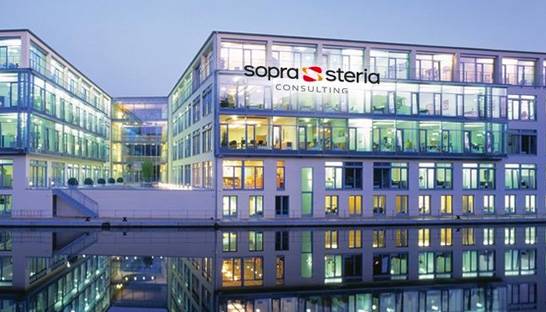
Sopra Steria
Image Source: consultancy.uk

Starting from 2000, the company went on to acquire some of the consulting firms based in different countries to expand its operations. These firms include names like Orga Consultants, Inforsud Ingénierie, Viewlocity, Cyclone Commerce, and Tumbleweed Communications, etc. In 2005, Sopra established its various centers in Europe and India. In the year 2014, Sopra partnered with La Banque Postale to build a new revamped banking software.

The Back History of Steria

Steria as mentioned before was founded a year after Sopra. The company introduced its first software a text processing system in 1973, to enable Agence France-Presse to computerize its all operations. By the year 1981, the company had launched some other software as well including Minitel. With Steria’s automation project, the company entered into the transport and mobility industry in 1987.

In 1994, Steria created a banking system for the French banks to carry out interbank payments. The company entered the Indian market after it acquired the IIS Infotech based in Delhi in 1997. In 1999, Steria went public on the Paris stock exchange. The year 2000 onwards were great for the company as it acquired a few major consulting businesses in France, including Experian, Tecsi, Equip. Its international acquisitions of that time include Mummert Consulting, Newell & Budge, Xansa, and PROFit. Steria, in 2007, won the biggest national project from the French Ministry of Finance.

The Merger

On 8 April 2014, Sopra and Steria announced that they have come together to form the Sopra Steria Group. The two announced that both have joined their hands as they intend to become the European leader in digital services. The merger was completed on 31 December 2014. The deal was the exchange of one Sopra share for four Steria shares, and the group ultimately was called the Sopra Steria Group.

The CEO: Vincent Paris

Vincent Paris is serving as the CEO of Sopra Steria Group. He has a long history with the Sopra Group, as he joined the Sopra Group in 1987, soon after he graduated from the prestigious École Polytechnique. Since then, Paris has served the company in several different leadership positions. Before becoming the CEO of Sopra Steria Group, he handled the important posts of Director of French operations and Deputy CEO of Sopra. He is also a member of the Executive Committee of the company for the past ten years.