Yashica is a Software Engineer turned Content Writer, who loves to write on social causes and expertise in writing technical stuff. She loves to watch movies and explore new places. She believes that you need to live once before you die. So experimenting with her life and career choices, she is trying to live her life to the fullest.
Reportedly,
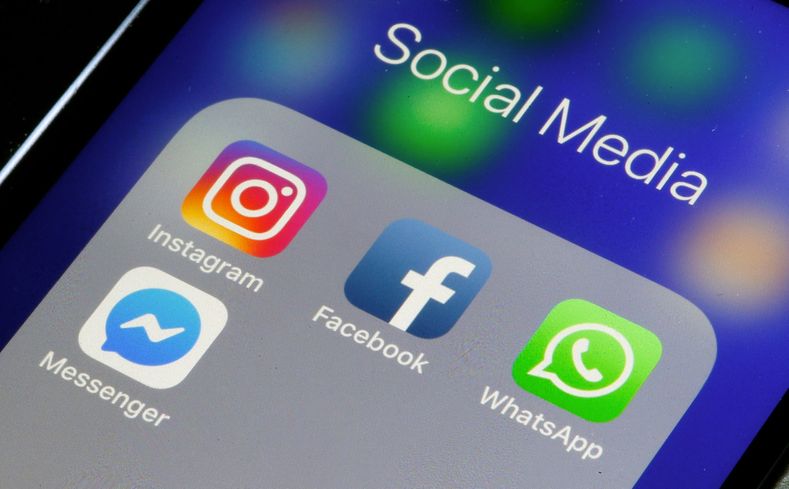
the major social media apps, including Facebook, Instagram, Whatsapp,
and Twitter, went down for over an hour on Wednesday at 8:45 a.m. ET.
The users of these apps around the world reported issues while
downloading and sending images, audios, and videos for some time.
It has become quite common for Instagram to go down, in the past few months. But this time, the other three prime apps, FB, Twitter, and Whatsapp, were also facing the same issues at the same time.
Image Source: telegraph.co
Every
time the users were trying to see an Instagram post, it was showing
the error, “Couldn’t refresh feed” or “Couldn’t load the
image. Tap to retry”. Though, the app was able to load the caption
under it. Same issues went with Whatsapp multimedia sending and
downloading, whereas Facebook was unable to publish the posts.
Twitter users, on the other hand, were unable to direct message. It was showing notification of unread messages, even after the users read the message.
Facebook,
while facing these issues, said on the behalf of all its apps in a
report, “During one of our routine maintenance operations, we
triggered an issue that is making it difficult for some people to
upload or send photos and videos. We’re working to get things back
to normal as quickly as possible, and we apologize for any
inconvenience.”
Where
Facebook gave a proper explanation for its app going down, Twitter
did not say anything on what caused the issue. But after resolving
the issue, Twitter took it to its support handle and wrote, “almost
at 100% resolved. There may be some residual effects for a small
group of people, but overall your DMs should be working properly now.
We appreciate your patience!”
Around
8 p.m. ET, Facebook also said, “The issue has since been resolved
and we should be back at 100% for everyone.”
Instagram has been facing such troubles quite often. Last time, it was three weeks ago when the platform faced the interruptions, that too for two hours. Before the four apps went down yesterday, apps like OKCupid, Peloton, Feedly, Discord and DownDetector have also gone down the day before yesterday, after an outage at Cloudflare.
Yashica is a Software Engineer turned Content Writer, who loves to write on social causes and expertise in writing technical stuff. She loves to watch movies and explore new places. She believes that you need to live once before you die. So experimenting with her life and career choices, she is trying to live her life to the fullest.
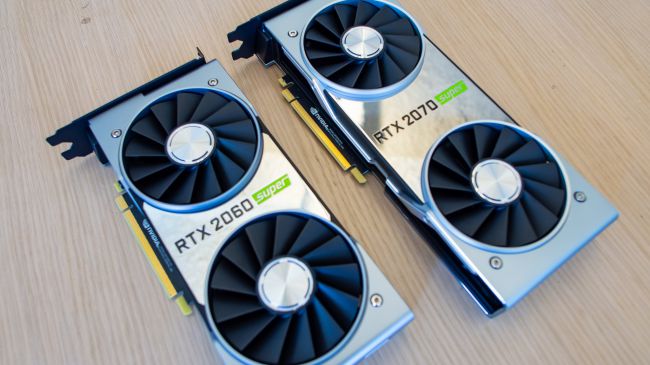
Nvidia, the American technology company, is all set to launch the ‘super’ version of its gaming-focused graphics cards, GeForce RTX 2060, 2070, and 2080. The company will be bringing the RTX 2060 Super, 2070 Super, and 2080 Super, today, as an addition to its RTX graphic lineup, which according to Nvidia, are faster and better at the performance.
The much-awaited set of graphics cards from Nvidia have already been the topic of discussion, and the rumours have already been making the rounds about the features of these new desktop cards.
Image Source: techradar.com
The
reports suggest that the GeForce RTX 2060 Super and the GeForce RTX
2070 Super will render 15 per cent faster performance than their
counterpart, whereas the GeForce RTX 2080 Super is a high-end
graphics card version, which will exhibit 20 to 25 per cent faster
performance than RTX 2080 (non-super version). The GeForce RTX 2070
is now supporting additional CUDA cores, i.e., a total of 2560, at
the higher base and boost clocks (1605MHz and 1770MHz, respectively).
On the other hand, RTX 2060 Super at the higher base and boost clock,
i.e. 1470MHz and 1650MHz, respectively, is supporting a total of 2176
CUDA cores. The high-end RTX 2080 Super will be coming with an
additional 128 CUDA cores.
The
three graphics cards have also been revamped, in the terms of memory,
with a wider 256-bit GDDR6 memory interface and an additional 2GB of
GDDR6 memory making it a total of 8GB memory.
“Dubbed the ‘graphics holy grail,’ real-time ray tracing brings cinematic quality lighting effects to interactive experiences for the first-time. The world’s most advanced GPU architecture, Turing fuses next-generation shaders with real-time ray tracing and all-new AI capabilities. Turing’s hybrid graphics capability represents the biggest generational leap ever in gaming GPUs, delivering up to 6x more performance than previous 10 Series Pascal GPUs”, the global head of marketing for the GeForce business at Nvidia, Matt Wuebbling, stated in a blog post.
The
company has revealed that it will be shipping the GeForce RTX 2060
Super and the GeForce RTX 2070 Super starting from July 9, whereas
the RTX 2080 will be dropped by the end of this month. The prices of
all the three cards have been kept similar to their current versions.
That means, the RTX 2060 Super will be available for $399, the price
of the RTX 2060 is $499, and the RTX 2080 will be sold for $699.
Yashica is a Software Engineer turned Content Writer, who loves to write on social causes and expertise in writing technical stuff. She loves to watch movies and explore new places. She believes that you need to live once before you die. So experimenting with her life and career choices, she is trying to live her life to the fullest.
Technology
is the field that is introducing people to new things almost every
day. Whether it is the smartphone, self-driving cars or a mission to
Mars, technology is taking us to new horizons. In fact, in the past
few years, it has completely transformed the way people live their
lives. Great minds are coming with greater ideas, and one such great
mind is the Chinese technology enthusiast and the AI expert, Kai-Fu
Lee.
Kai-Fu Lee is the founder of the venture capital fund, Sinovation Ventures, and the inventor of the world’s first speaker-independent, continuous speech recognition system, which he developed as his PhD thesis subject.
Early Life
Lee was born on 3 December 1965, in Taipei, Taiwan to a legislator and historian, Li Tianmin. In 1973, when he was thirteen, he moved to the U.S. In the U.S., he attended the Oak Ridge High School. In 1983, he completed a B.S. degree in Computer Science from Columbia University followed by obtaining a PhD degree from the Carnegie Mellon University in 1988.
Image Source: edge.org
During
his PhD at the Carnegie Mellon, he got interested in machine learning
and pattern recognition. He even participated in a few competitions,
one of which was the US national tournament of computer players,
where he represented a Bayesian learning-based system used to play
the board game, Othello. He developed the system with his classmate
Sanjoy Mahajan and even won the competition.
The
topic of the thesis of his PhD was speech recognition, and he
developed the world’s first large-vocabulary, speaker-independent,
speech recognition, in 1988, as a Kluwer monograph, titled Automatic
Speech Recognition: The Development of the Sphinx Recognition System.
Career
After completing his PhD, he
joined the Carnegie Mellon University as the member of the faculty.
In 1990, after working at the university for two years, Lee left the
job and started working for Apple Computer as one of the leading
research scientists. At Apple, he was appointed as the head of the
research and development groups that worked on the major Apple
projects, including Bandai Pippin, PlainTalk, Casper, Galatea, etc.
Lee stayed with Apple for six years, and in 1996, left the company to
join Silicon Graphics.
At Silicon Graphics, Lee
worked as the vice president of the company’s Web Products
division, and then was promoted to as the president of Cosmo
Software.
After two years of his job at Silicon Graphics, Lee then joined Microsoft and was sent to Beijing, to set up the Microsoft Research (MSR) division there. In 2000, he shifted back to America, where he held the post of corporate vice president of interactive services division at Microsoft.
In 2005, Lee after leaving his job at Microsoft moved to join Google. This move of Lee led Microsoft to initiate a lawsuit against Google and Lee, as Lee had joined Google within one year of leaving Microsoft, which was against the company’s non-compete agreement. Google soon resolved the lawsuits, but Lee was restricted to work on Google’s projects similar to Microsoft’s. So Google sent Lee to China to handle its Asian subsidiary, as its President. Lee held the position till 2009. He became one of the key people for the establishment of Google.cn, and the achievements that the company had during this time in China.
Founding Sinovation Ventures
Despite a great career with
Google, Lee left the company in 2009, to found a venture capital to
provide support for Chinese talent and technology. On 7 September
2009, Lee formed Innovation Works, later renamed as Sinovation
Ventures. The company funds the five most innovative technology ideas
from the Chinese entrepreneur and startups every year. Sinovation
Ventures involves some big names from the tech industry as the prime
investors, including YouTube, Legend Holdings, WI Harper Group, etc.
Lee collaborated with Google
to bring an OS for Android specifically built for the Chinese people.
The collaboration also brought a desktop phone manager for Android
for China.
By 2017, the company had
raised over $1 billion funds, and in 2018, it raised over $500
million from its investors. Since its inception, Sinovation Ventures
has helped over 300 Chinese startups with their business
establishment.
Lee is an iconic personality
that has been inspiring not only Chinese people, but people from
around the world. In his career, he worked with big tech companies
and even chaired some big-name organisations. He held the position of
the chairman of the World Economic Forum’s Global AI Council. He
was named under the Time 100 list in 2013 and was also featured as
the Asia House Asian Business Leader in 2018.
Lee has also published a few
books including Be Your Personal Best (2005), A Walk into The Future
(2006), Making A World of Difference (2009), Seeing Life Through
Death (2015), Artificial Intelligence (2017) and AI Superpowers:
China, Silicon Valley, and the New World Order (2018).
Yashica is a Software Engineer turned Content Writer, who loves to write on social causes and expertise in writing technical stuff. She loves to watch movies and explore new places. She believes that you need to live once before you die. So experimenting with her life and career choices, she is trying to live her life to the fullest.
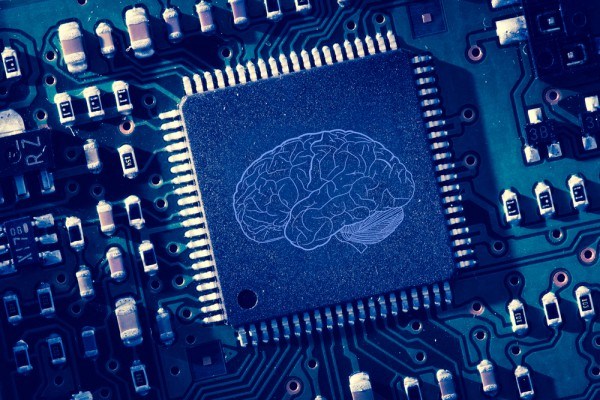
Baidu is hosting its Create conference for AI developers at Beijing, and it has announced a new partnership with Intel at the same. The two companies have plans to work together to build a new Nervana Neural Network Processor for training, aka NNP-T 100.
Image Source: themarketreportsworld.com
The Nervana Neural Network Processor for training is a 16nm NNP-T, and as the name suggests, it is specifically designed for the purpose of deep learning and research of the neural network. The two companies have collaborated for both the software and hardware manufacturing of the chip, such that it will provide full support for the Baidu’s PaddlePaddle deep learning framework. The PaddlePaddle framework focuses on deep learning and research of the neural networks, to utilize it for the AI applications. Intel already provides its support for the framework through its Intel Xeon Scalable processors.
The chip is being
built under the code name Spring Crest and is based on a new class AI
model. According to Intel, the chip has got a different architecture
than the other chips made by Intel. The new NNP-T 100 is enabled with
image recognition and has got the software support for the on-chip
memory. The company claims that the chip is much faster at
performance and has been equipped with the high-speed on- and
off-chip interconnects.
The corporate vice president of Intel Naveen Rao made the announcement during the event, where he said, “The next few years will see an explosion in the complexity of AI models and the need for massive deep learning compute at scale. Intel and Baidu are focusing their decade-long collaboration on building radical new hardware, codesigned with enabling software, that will evolve with this new reality – something we call ‘AI 2.0.’”
The company had
released the first version of NNP in 2017 and plans to ship this
version of NNP by the end of this year. The two companies have been
working together since 2016, and their future collaborative plans
also include MesaTEE, a memory-safe function-as-a-service (FaaS)
computing framework based on the Intel Software Guard Extensions
(SGX) technology.
Yashica is a Software Engineer turned Content Writer, who loves to write on social causes and expertise in writing technical stuff. She loves to watch movies and explore new places. She believes that you need to live once before you die. So experimenting with her life and career choices, she is trying to live her life to the fullest.
After Apple’s Siri became popular as the smart assistant for iPhones, other rival companies, including Google, also started working to bring their own smart assistants for their mobile users. Though Google brought Google Assistant for Android, other companies focused on bringing smart assistants for homes. This way, Amazon introduced ‘Alexa’, Microsoft brought ‘Cortana’, and Google chose to expand its Android assistant, Google Assistant, as the home assistant. Samsung too, following the league, finally, launched Bixby.
Image Source: xda-developers.com
Being a bit late, the smart assistant from Samsung could not make the mark. But Samsung had to do something, so it introduced third-party integration to Bixby and opened the platform for third-party developers. Opening Bixby for third-party developers was a great idea as it started getting the updates that Samsung had promised while launching the app. But still, the company need to do a lot more to get the product to success.
For
the same, the company has launched a new marketplace, called ‘Bixby
Marketplace’, where the users will get the ‘Bixby capsules.’
The capsules are nothing but the services that Bixby will be
providing to its users with third-party app integration on their
voice instructions. The popular third-party apps, including Spotify,
Yelp, YouTube, NPR, iHeartRadio, and Google Maps, have already been
made available as capsule through the store. And, Samsung has claimed
that it will also bring the other famous and useful capsule to the
platform in the coming future.
“To
add even more customization, users can set a capsule as the
‘preferred capsule’ for certain types of requests. For example, if a
user says ‘Get me a ride to San Francisco airport’, Bixby will prompt
the user to pick one of the supported Rideshare capsules. Users will
have the option to set their favourite provider as their preferred
Rideshare capsule. Once that is set, any Rideshare request would
automatically go to the user’s preferred provider, even if the user
does not mention the capsule name. The ability for users to customize
their own personal Bixby experience allows them to easily incorporate
a wide range of capsules into their everyday lives.” Samsung
said during the launch announcement.
The
Bixby Marketplace is already opened for the U.S., South Korea and
Spain users. The company is looking forward to luring more users to
Bixby and has also integrated the smart assistant to many of its home
appliances, including its smart TVs.
Yashica is a Software Engineer turned Content Writer, who loves to write on social causes and expertise in writing technical stuff. She loves to watch movies and explore new places. She believes that you need to live once before you die. So experimenting with her life and career choices, she is trying to live her life to the fullest.
Our solar system and space beyond have always been the topic of interest for the humans. For a few years now, most of the big space agencies are exploring the Martian surface, and now, the American space organisation, NASA has decided to explore ‘Titan’, one of the 62 moons of Saturn.
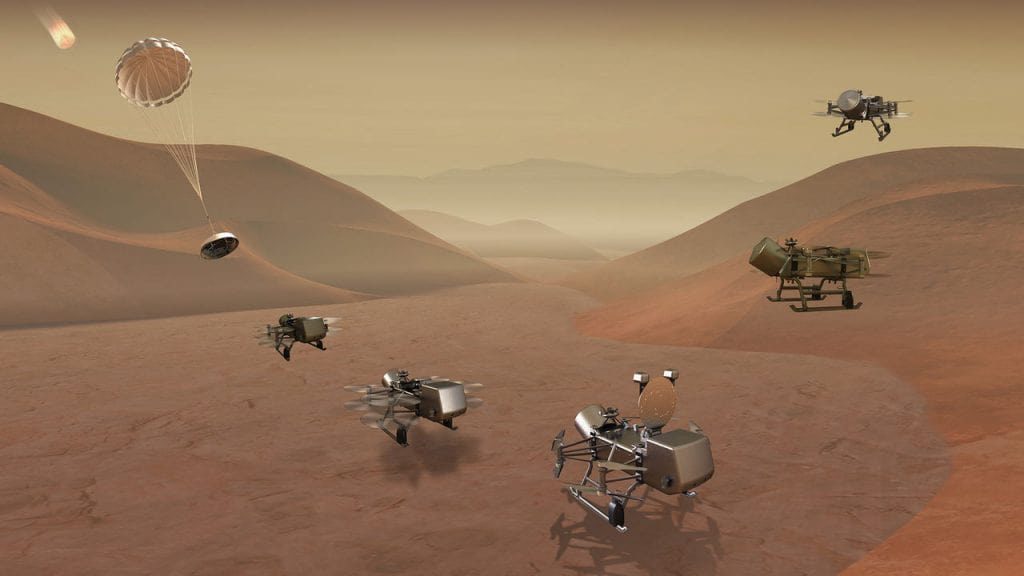
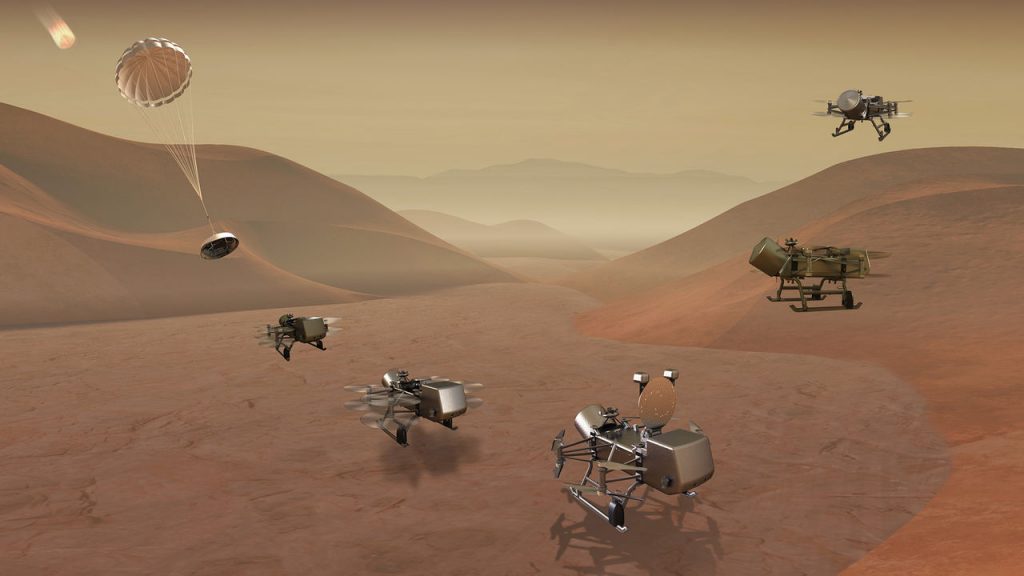
Nasa has revealed that it will send a drone-like lander, named Dragonfly, on the surface of Titan, capable of flying 8 or 9 miles in an hour. The Dragonfly will be a 10-foot-long, and 10-foot-wide dual-quadcopter, similar to the size of the Mars rover and will be a look-alike of a giant drone.
Image Source: sciencemag.org
Since
the Titan has the best environment for flying rather than walking or
rolling over the surface, the drone is specifically designed to hop
and fly over it. The gravity of Titan is equal to one-seventh of the
Earth’s gravity and has a far thicker environment than that of the
Earth, providing the suitable conditions for Dragonfly to fly in it.
According
to Nasa, the drone will be exploring the surface of Titan and will
discover places for landing over it. It will be collecting samples
for research, observe the weather conditions and will notify the
agency if it finds something unusual. The drone is equipped with
drills and probes, to investigate the surface and has got cameras
embedded to it, through which will it will be sending HD pictures of
the objects found on Titan back to Nasa. Dragonfly will spend about
16 days at a single place and examine the environment. After 16 days,
it will move further with the help of the eight rotors it possesses.
Elizabeth
Zibi Turtle, the lead investigator of the mission, said during the
announcement that Nasa will launch Dragonfly in 2026, which will land
on the dune-filled equatorial region of Titan through a parachute.
The drone will be back to Earth in 2034.
Nasa
has already touched down the surface of Titan with the Huygens probe
via the Cassini mission earlier, but according to Turtle, with
Dragonfly, it will be a more in-depth mission and will discover major
alien things on it.
“We
know that Titan has rich organic material, very complex organic
material on the surface. There’s energy in the form of sunlight,
and we know there’s been water on the surface in the past. These
ingredients, that we know, are necessary for the development of life,
as we know it is sitting on the surface on Titan. They’ve been
doing chemistry experiments, basically, for hundreds of millions of
years, and Dragonfly is designed to go pick up the results of those
experiments.” said Turtle.
With
the rivers and other organic material found on Titan, it has always
been considered as a prototype of Earth, before life on Earth. So the
interest of the researchers has always been to find the traces of
life over it.
Yashica is a Software Engineer turned Content Writer, who loves to write on social causes and expertise in writing technical stuff. She loves to watch movies and explore new places. She believes that you need to live once before you die. So experimenting with her life and career choices, she is trying to live her life to the fullest.